BEIJING: Coming from nowhere, with its top two gymnasts injured and gone within 10 days and with an inconsistent replacement who hadn’t been trusted enough to make the original team coming through at the best possible moment, the United States won an unlikely bronze medal in the Olympic men’s gymnastics team competition yesterday at National Indoor Stadium. China destroyed the field as expected, winning the gold medal with 286.125 points. Japan overtook the US on the last rotation to win the silver with 278.875.
But even after Kevin Tan had a sit-down moment on the pommel horse and Raj Bhavsar so slowly rotated that it seemed as if time stood still, Alexander Artemev came out for the second time in a row to fiercely swing around the horse, flying high and landing with satisfaction. The Americans had to wait while Germany also finished on the pommel horse. The Germans had needed to score at least 45.900 points to tie the US but Phillip Boy, Robert Juckel and Thomas Andergassen only managed 44.650. The US had its bronze with 275.850. The Germans hugged the Americans in a teary moment for both the medalists and the fourth-place finishers.
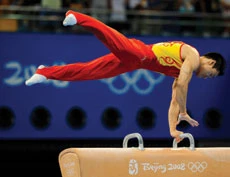
The Chinese placed first on five of the six apparatus and finished the night on the high bar able to whirl around, catch and grab the bar and not worry about falling. It was sweet redemption for the team that had been heavily favored to win team gold four years ago and then finished fifth. This bronze medal, in its way, was equally redemptive for the Americans. After stars Paul and Morgan Hamm withdrew within 10 days of each other and the team had to add alternates Raj Bhavsar and Artemev there were questions about whether the team would even advance out of qualifying and into the eight team final. But Artemev, who had fallen three times during the four rounds of Olympic qualifying on the pommel horse, came through with his nerves bundled up and put away.
When he completed his horse routine, a sweet-swinging set, Artemev let out a long howl and jumped off the podium and into the arms of his teammates. Even though the US finished with its two worst scores (on floor exercise and pommel horse) it had built up a cushion. On the very first routine of the morning, Chen Yibing, 23, an Olympic rookie, finished his final floor pass by staggering out of bounds and slapping his hands to his head. His score of 14.575 brought a collective groan at the National Indoor Stadium.
The Chinese men were heavy favorites to defend the team gold medal they had won in Sydney, Australia, in 2000 but instead had a series of major falls in the team finals and were a dispirited fifth place. Japan won the team gold and the United States, led by the Hamms, won the silver medal. The word “choke” was used about China.
After Chen’s inauspicious start, though, Yang Wei and another youngster, 20-year-old Zou Kai, powered through their floor tumbling with tightly-wound somersaults and flips to knock away bad memories. Yang had a solid 15.425 and Zou an excellent 15.925 and as Japan’s Takuya stumbled badly to lead off on floor for Japan, it seemed a Chinese rout might be on.
This Chinese team is filled with veterans. Leader Yang, 28, is a three-time Olympian who won team gold and individual all-around silver in 2000; Xiao Qin, and Li Xiaopeng (who won team gold and individual gold on parallel bars in 2000 and a parallel bronze in 2004); all have Olympic experience.
The Americans started on still rings where Raj Bhavsar did a steady turn and scored 15.325. It was on the third rotation for China, the still rings that the team began to pull well ahead.
Huang, Yang and Chen Yibing all scored over 16.000 and the arena erupted. Chinese flags waved and even for those who don’t speak Mandarin the chant was clear. “Let’s go...China...Let’s go...China.” Chen’s was the final score of 16.575 was posted and the team high-fived and acknowledged the crowd.
The rest of the competition would be used for sorting out the other medals.
The American fans began tentatively making themselves heard with a “USA, USA chant” after both Bhavsar (15.575) and Jonathan Horton (15.625) knocked out solid parallel bar routines. When Justin Spring finished off the set for the US with a 15.850 the US actually led the competition though it wouldn’t last. China took the lead after vault. Those “USA” cheers got even louder when Joey Hagerty, Horton and Justin Spring flew through the high bar without a fall. Both Horton and Spring, who do high-risk moves, had taken big falls during Olympic qualifying competitions.
, but when Spring held his landing the men jumped into each others’ arms. Assistant coach Miles Avery swung Spring around.
After four rotations the US was second, 1.575 points behind China and over three points ahead of third-place Japan. But the US finished with its two weakest events, floor exercise and pommel horse.