

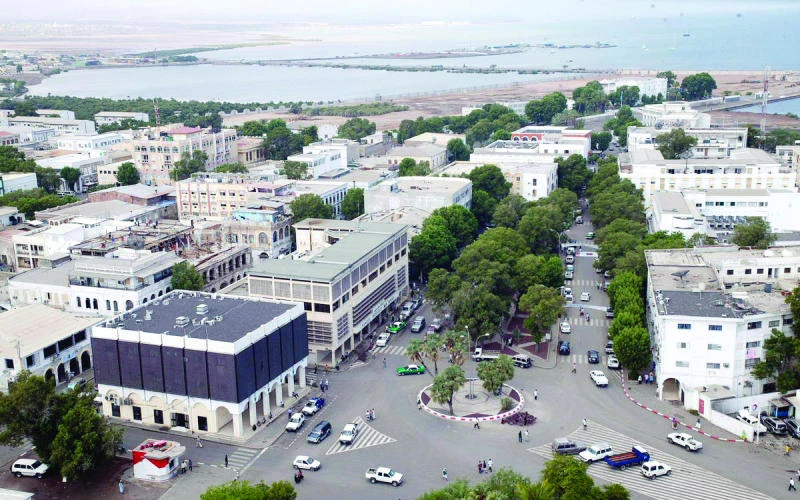


France was the ruling European state for many years and now remains its main ally and bulwark. The US and Britain are using its territory to operate military missions in Yemen and adjoining African countries. Drone flights without pilots are regularly bombing Al-Qaeda bases and operatives in Yemen and elsewhere because Djibouti is conveniently located in the Red Sea close to many targets in Arabia and Africa. Britain also has modest forces there and the three countries are said to be helping Djibouti in various small ways.
Djibouti was colonized by France which seized it from two tribes, the Affars and the Issas from the middle of the l9th century to l977 when it attained independence and joined the United Nations. Earlier on it was formed into a French protectorate named the French Territory of the Affar and Issas, which have been coexisting peacefully under the French umbrella that has made it into a strong naval base to protect its interests in the Red Sea region.
It is a small piece of land facing the erstwhile British colony of Aden with about 800,000 people of African stock occupying 23,000 square kms of mainly desert land. It has a free port. But its strategic value lies in its location on the Red Sea which gave the French a place for a military base facing the British colony, at the southern tip of the Red sea en route to south-east Asia where France had a vast empire until the end of the World War II.
At the same time Britain controlled India and some parts of Asia up to Hong Kong. The two powers were content with what they had until France lost everything to the Japanese during 1940 until the end of the war. Then the US prevailed on it to quit as it did on Britain to leave India alone and terminate the anomaly of a small western country controlling one of the largest countries in the world.
While staying in the city I found very little to do except writing a book in English at the suggestion of Prime Minister Ali Aref, who is now living in France like many Djiboutians who have the right to claim French nationality as for a long time France considered the territory part of it. The book was sustained by commercial advertisements since the government was unwilling to finance it. It was printed in India and shipped to Aden on its way to Djibouti.
As qat was legal the Arabs and Somalis engaged in chewing it all afternoons. It is a mild narcotic planted in Ethiopia and exported daily in fresh leaves to Somalia, South Yemen and Djibouti legally. Although it cost a substantial portion of the personal income the people consumed it daily without a letup.
In the past both Ethiopia, Eritrea and Somalia utilized the position and free port status of Djibouti by trading with it and through it because it was a free port as they had done with the free port of Aden, which was one of the largest of its kind in the world until the Marxist regime which took over from Britain, put an end to all that and the country suffered immensely. Its catastrophe was compounded by the closure of the Suez Canal in 1967. It was saved somewhat by the union of South and North Yemen in 1990. But the days of glory are yet to return to Aden when nearly 600 ships including passenger ocean liners visited it to buy bunker oil and disembark thousands of passengers to shop in it’s duty free zones.
Djibouti at present depends heavily on the French base and Americans, in addition to Arab funds since it is a member of the Arab League. Tourism is limited as there is little to see and do and I do not see why tourists would come from far away to spend a few days in it. Only a few westerners would bother to go there except to spend a tour of duty before returning home possibly via Ethiopia, which has much to offer to the tourists.
With the near collapse of the state in Somalia and the denial of Eritrean ports to Ethiopia, Djibouti has gained some importance for Ethiopia although the income from this relationship is not enough to help it build a viable state.
Historical records show that Djibouti, parts of Somalia and Eritrea, were most probably part of the legendary Land of Punt, which had been ruled or controlled by Egypt under the Pharaohs, although there is not much evidence to prove that. The region being close to Arabia maintained close relations with the Arabs who migrated to and traded with it and was once one of the earliest to embrace Islam.
The region then broke up into sultanates, like those of southern Yemen, which made it easier for the French in Djibouti and the British in Yemen to defeat the inhabitants and colonize the lands.
In 1958, Somalia became independent with Mogadishu as its capital and both Italian-ruled north and British controlled south decided to unite into Somalia in one of the fastest acts of union in the world.
-Farouk Luqman is an eminent journalist based in Jeddah.
Email: [email protected]


