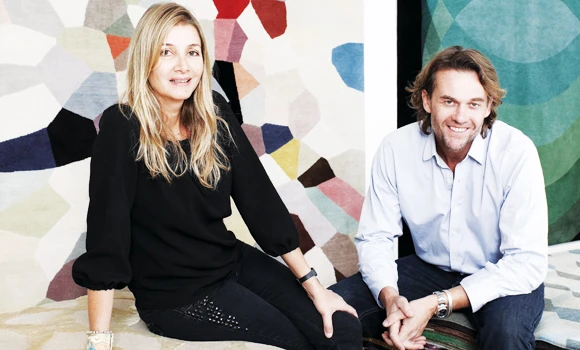
British rug designer and collector Christopher Sharp is the CEO and co-founder of The Rug Company. His vision has brought together the age-old craft of rug making with contemporary design.
The company is represented in 13 countries and offers a major source of essential employment in Nepal. Sharp has helped to invigorate an ancient craft and triggered a revolution in rugs.
The success of The Rug Company’s collections are grounded not only in Sharp’s passion for rug collecting, which was initially ignited while he was working in film production in the Middle East, but also in a determination to ensure that every aspect of the company meets the highest standards while retaining a strong humanist stance.
Sharp worked with some of the world’s most influential and inspirational fashion designers including Paul Smith, Vivienne Westwood, Alexander McQueen, Tom Dixon, Diane von Furstenberg, Mattew Williamson, Jaime Hayon and Marni, and works closely with the team to create collectable pieces.
We spoke to Sharp in an exclusive interview, where he talked about the art of rugs and his rug philosophy.
Q. What is it about rugs that made you fall in love with them? You lived in Riyadh, Saudi Arabia, and this is where your rug passion started. Tell us more about it.
My wife Suzanne and I lived in the Middle East for a while and learnt to appreciate and love rugs there. I was making documentaries for a TV station and we would spend our evenings trawling the souks and markets. We began appreciating rugs, understanding their quality, and started falling in love with them. We started collecting them, and our knowledge and appreciation for them grew. We founded The Rug Company because of a genuine passion for rugs.
Q. You started your career in TV and then moved to retail. Why did you make this huge career shift?
When we returned to London in 1997 we had a collection of rugs and a passion. We thought the other rug shops in London weren’t good and that we could do better. We opened a small shop in Chelsea and the business grew from there. A love of rugs has been at the heart of the business ever since.
Q. Looking back, what were your thoughts when you decided to open a gallery selling antique oriental rugs? What made you decide to go into this particular niche?
When we came back to London in 1997, with a stack of wonderful rugs, we thought we could use our knowledge and start an interesting business. We quickly realized that our clients were looking for something fresh and exciting. We had the idea to bring together the ancient craft of making rugs by hand with quality contemporary design.
Q. You then moved to London with a small boutique selling Persian and Indian rugs. Did you have to go to Iran and India to choose and resell those rugs? Tell us about your travel adventures.
We have been collecting rugs for 25 years now, and we find them from a number of different countries. Our travels are led by the hunt for new and interesting rugs, and our collections were and still are formed by handpicked finds from across the globe. For us, disappearing into the souk or up a rickety staircase and looking through hundreds of rugs is still a very exciting part of the job. We are always trying to find the extraordinary, and we still sell these unique pieces in some showrooms (and love a commission too!). We travel often, and Suzanne is also continually finding inspiration for her designs when visiting other countries.
The majority of the weaving of our contemporary rugs is done in Nepal. Any product is only as good as its ingredients and we have remained fastidious in ensuring we follow traditional rug weaving practices. We’ve built a wonderful relationship with the craftspeople who contribute to the production. Every rug will have twenty different people, with different skills, involved in its production, from the spinners of the wool to the ‘dye master’, (the man who gets the colors right) to the people who knot the thousands of individual knots that collectively make up the finished piece. Because we have been working with the same people for so long we understand each other and mistakes and misunderstandings are rare, it’s a relationship built on a common respect. We would not have a product without them and they need our understanding of design to have a market for the rugs they weave. Different regions employ different knotting techniques. In Nepal, they use the Tibetan Knot, which is a relatively quick way of weaving a rug. Typically it takes four months for us to make a rug, it sounds like a long time but in the world of hand knotted rugs it’s fast. If we were weaving the rugs in Iran it would take considerably longer. Contemporary designs translate particularly well using the Tibetan knot, there’s a brilliance and modernity about the finished product.
Q. You have collaborated with a number of fashion designers to design rugs. Tell us about the experience.
Suzanne and I started The Rug Company with the idea that we could look at rugs from a contemporary viewpoint without sacrificing quality and the traditional rug making skills. It was a daunting task but it was a challenge that we thrived on. We started to collaborate with artists and designers to produce contemporary designs that captured the spirit of our time in the best possible quality. In 2000, we launched The Rug Company Designer Collection; this was a collaboration with 10 leading designers which included Nina Campbell, Nicky Haslam and Cath Kidston. We soon started working with Marni and Paul Smith (who we met by chance at his Notting Hill shop), and now we have over 40 guest designers providing some of our most desirable and collectable pieces. We are very fortunate in that our designers all bring something unique and inspirational to the collection.
Designing for The Rug Company enables designers at the top of their field to work in a new medium and use production techniques that are very much valued by The Rug Company but not common in fashion and textiles. Encouraging a designer to step out of their familiar realm can create really exciting results and we never ask a designer to collaborate with us unless we believe they will bring something new and innovative to the collection. Our designers are excited to work with us because we pride ourselves on the quality of our rugs, and the ethical production.
Q. Who are the designers you worked with?
We’ve worked with many designers including Alexander McQueen before he tragically died, Paul Smith, Vivienne Westwood, Tom Dixon, Diane von Furstenberg, Barber & Osgerby, Jonathan Saunders and Jaime Hayon.
Q. What are your favorite fabrics and materials that you like to work with?
We use the finest natural materials, Tibetan wool, silk, mohair, cashmere and merino wool for example. The quality of the wool we use is incredible, it comes from the Tibetan plateau and, because the sheep live at such giddy heights, the wool is full of natural lanolin (oil). If you treat the wool with respect during the weaving process this oil will actually help protect the finished rug for the duration of its life, which could be, literally, hundreds of years.
Q. You have mentioned that when a certain design is a best seller in one region, it is a best seller all over. Why is that?
We have a few designs which are always very popular in every market. Paul Smith’s Swirl is one of them, it has become iconic. I think our customers the world over are appreciative of good design and good quality.
Q. Tell us more about your clients. Who shops at The Rug Company?
Customers who purchase from The Rug Company are interested in the craftsmanship and traditional handmade production of our rugs, the high quality and contemporary aesthetic. These people are aware that they are purchasing a long-lasting investment, a work of art.
Q. When traveling, what are you most inspired by?
Suzanne Sharp: We travel a lot, and inspiration comes from the different cultural aesthetics, the chaos of Palermo, the Baroque city of Valetta, the vitality of India, the warmth of Tuscany, the souks of the Middle East and the earthiness of Africa. All these experiences lend themselves to my visual vocabulary.
Q. What are the most common mistake people make with carpets?
Getting a rug that is too small. This is a common mistake; a small rug will make a room look bitty and mean. Having the right size rug will make all the difference.
Q. What are your tips for people when choosing the best carpets for their homes?
Raw materials: A rug is only as good as the materials it is made from. We use only the finest hand spun yarns, such as Tibetan wool, silk, cashmere or mohair. Craftsmanship: All of our rugs are made with an incredible degree of care. Not only does this make the rug much more beautiful, but it will ensure it lasts for many, many years.
Quality design: It’s not easy to design a great rug. As the rugs are made to last for hundreds of years, the designs must be good enough to stand the test of time.
Always ask for advice. A good rug seller will be able to guide you and ideally let you try the rug at home before making a decision; rugs can look so different at home. They can even help you design your own.
Q. Who was your favorite collaboration?
That’s like trying to choose a favorite child! We have just celebrated 15 years of creative collaboration with Paul Smith, which shows how much we enjoy working together.
Q. Who is your dream collaboration?
The American fashion designer and film director, Tom Ford.
Q. How can you tell whether the rug is authentic or fake?
In terms of quality, you should always have a look at the back of a rug. You should be able to see the many thousands of knots for a truly handmade rug.
In terms of design, you should always be able to get certification from a reputable seller. The Rug Company works exclusively with collaborating designers so you won’t be able to find an Alexander McQueen or Paul Smith rug anywhere else.
—
Email: [email protected]
Christopher Sharp: The rug master