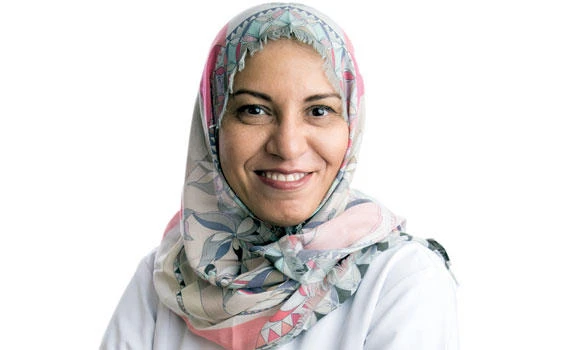
She is the first Saudi woman in the field of colorectal surgery. Dr. Samar Al-Homoud faced many challenges in life to achieve her childhood dream of becoming a top surgeon.
She is a consultant colorectal surgeon at the King Faisal Specialist Hospital and Research Center, Riyadh, and became the first visiting consultant from Saudi Arabia at the UK’s St. Mark’s Hospital.
Dr. Al-Homoud spoke exclusively to Sayidaty and proved why she is just the right role model for all Saudi women:
You are a honorary visiting consultant surgeon at St. Mark’s. What does this role mean to you on a personal and professional level?
I am very pleased to have been offered the position. It has without a doubt doubled my responsibility to do more, to represent an honorable image of Saudi women and doctors internationally and to show what Saudi Arabia has achieved on a global medical level.
I have contributed, through my position at St. Mark‘s Hospital, to raise the level of cooperation and exchange of expertise and scientific research to support the development of specialized medical expertise in Saudi Arabia. For example, the training of anastomosis intestinal nurses and training in the field of clinical treatment. The result of this cooperation was the annual Saudi-International Colorectal Disease Forum, which was held this year with the participation of 15 experts from St. Mark‘s Hospital. It was the hospital’s first contribution to the Middle East.
Have you been honored locally after getting the job?
No, despite the fact that we witness Saudi achievements being honored abroad.
Why did you choose colorectal diseases and surgery as your specialization?
At the beginning of my career in the field of general surgery, some doctors advised me against this field as I am a woman, and the number of women in this area is few compared to other fields. The field of surgery is not easy, locally and globally, with a lot of challenges and difficulties. The specialty of colorectal surgery in particular is a rare one. There aren’t enough Saudi female surgeons in this area and the disease has not received enough attention in Saudi Arabia and the Arab world. I would like to mention here that during the training period I was the only doctor who completed the training; my colleagues withdrew and moved on to other specialties.
Why is there a lack of Saudi women in the field of surgery?
The lack of surgeons is not only a local issue but also a global one; it requires great effort, long working hours in the operating room, as well as accuracy and follow-up during and after the operation. Saudi surgeons, in particular women, have proven to be successful in the field of surgery, due to the accuracy and precision in their work.
After your return to Saudi Arabia, how did patients and co-workers accept a female Saudi surgeon?
I must admit that at first I felt a sense of anxiety and fear that I would not be accepted by patients and colleagues, but thankfully I have earned a lot of support and encouragement. The presence of a female doctor in this area has encouraged a lot of women who suffer from colon problems to undergo examination and seek treatment.
What are the most important achievements of Saudi women?
Saudi women have proven their excellence in several areas, locally and globally, thanks to the continuous support of King Abdullah and his adherence to offer them the opportunity to enter new areas. Therefore, their achievements are numerous, the most important of which was the selection of women to be members of the Shoura Council to participate in decision-making and to support female issues.
Lately, the prevalence of colon diseases and cancer has increased dramatically. What is the cause?
Colon diseases are spreading, especially colon cancer; it has become the most common disease amongst men, and the third most common in women, according to the latest statistics from the national cancer database. Our modern way of life, such as unhealthy nutrition, lack of exercise and smoking, are all factors that contribute to this high percentage, in addition to other diseases like colon immune infections and irritable bowel syndrome.
Tell us about the cancer conference you attended representing the Gulf Center for Cancer Control and Prevention?
The Executive Office of the Council of Health Ministers for Cancer in the GCC region and the Gulf Center for Cancer at King Faisal Specialist Hospital and Research Center ((KFSHRC) held a conference at KFSHRC in Riyadh to discuss cancer. Also, the priorities of screening and early detection strategies for fighting the disease were highlighted and the first regional document on this subject was released.
What does the awareness program for early screening to detect colon cancer at the King Faisal Specialist Hospital and Research Center hope to achieve?
Unfortunately, most tumors are diagnosed in advanced stages, which reduces the cure rate and increases the cost of treatment. However, colorectal tumors are one of the few that can be prevented through early screening and the rate of recovery in the case of early detection reaches over 90 percent.There is a lack of community awareness regarding the disease and its causes. Also, efforts to raise health awareness in the community to highlight the importance of early screening are inadequate. So the objectives of this program are to spread awareness about the disease and show ways to prevent it and emphasize the importance of early screening for colon cancer through newsletters, public awareness campaigns and various means of social communication. The media has played an active and important role in raising awareness of the disease and how to fight it.
What are the latest developments in the field of surgery and the treatment of colorectal diseases?
The laparoscopic three-dimensional surgery and surgery through a single wound by the robot are the latest advances in this area.
What health tips and guidelines do you offer for the prevention of colorectal disease?
It is important to follow a healthy and balanced daily life pattern. Eat healthy food, which includes fiber intake in abundance, fruits and vegetables and avoid high-fat foods. Exercise regularly, avoid smoking and have a colon screening at the age of 50.
What was the most challenging aspects of your career?
The scholarship period and being away from my family, that stage was a great challenge for me, especially because I was one of the first doctors in this area. Thanks to God and the support of many, I was able to overcome difficulties, specifically with regard to working abroad and earning the confidence of supervisors and colleagues.
Tell us about your childhood and your early studies.
During my childhood I excelled at school and dreamt of becoming a doctor, to the extent that my father used to call me “doctor” from an early age, which increased my determination to do my best to achieve that dream.
Do you find time for hobbies?
Yes, especially reading, sports and traveling to learn about other cultures and civilizations.
What issues concern you?
Increasing education and awareness in our society for the prevention of colon cancer and providing early treatment for diseases of the colon.
What are your wishes for the coming year?
I wish for all women to have more opportunities and to participate and contribute more effectively to our society.
Would you like to thank someone?
I am thankful for the unlimited encouragement that King Abdullah provided to the children of this country. I would also like to thank my parents and family for their support and encouragement.
—
Email: [email protected]
Making a difference in the medical world