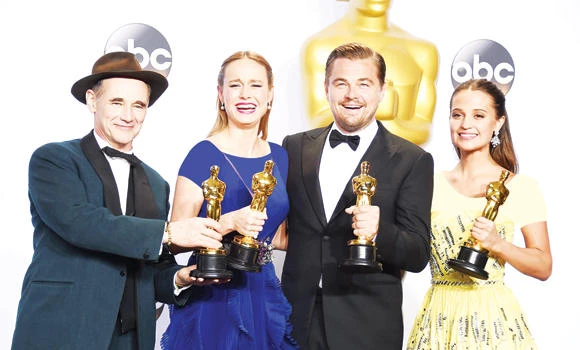
LOS ANGELES: In an underdog win for a movie about an underdog profession, the newspaper drama “Spotlight” took best picture Sunday at an Academy Awards riven by protest and outrage, and electrified by an unflinching Chris Rock.
Tom McCarthy’s film about the Boston Globe’s investigative reporting on sexual abuse by Roman Catholic priests won over the favored frontier epic “The Revenant.” McCarthy’s well-crafted procedural, led by a strong ensemble cast, had lagged in the lead-up to the Oscars, losing ground to the flashier filmmaking of Alejandro Inarritu’s film.
But “Spotlight” — an ode to the hard-nose, methodical work of a journalism increasingly seldom practiced — took the night’s top honor despite winning only one other Oscar for McCarthy and Josh Singer’s screenplay. Such a sparsely-awarded best picture winner hasn’t happened since 1952’s “The Greatest Show On Earth.”
Finally, it is
Leo’s year
After going home empty-handed four times previously, Leonardo DiCaprio won his first Oscar, for a best actor in “The Revenant” — a gruff, grunting performance that traded little on the actor’s youthful charisma. DiCaprio, greeted with a standing ovation, took the moment to talk about climate change.
“Let us not take our planet for granted,” said DiCaprio. “I do not take tonight for granted.”
His director, Inarritu won back-to-back directing awards after the triumph last year of “Birdman.”
Inarritu, whose win meant three straight years of Mexican filmmakers winning best director, was one of the few winners to remark passionately on diversity in his acceptance speech.
“What a great opportunity for our generation to really liberate ourselves from all prejudice and this tribal thinking and to make sure for once and forever that the color of our skin becomes as irrelevant as the length of our hair,” said Inarritu.
The night’s most-awarded film, however, went to neither “Spotlight” nor “The Revenant.” George Miller’s post-apocalyptic chase film, “Mad Max: Fury Road” sped away with six awards in technical categories for editing, makeup, production design, sound editing, sound mixing and costume design.
Best actress went to Brie Larson, the 26-year-old breakout of the mother-son captive drama “Room.” The Sweden-born Alicia Vikander took best supporting actress for “The Danish Girl.”
Gasps went around the Dolby when Mark Rylance won best supporting actor over Sylvester Stallone. Nominated a second time for role of Rocky Balboa 39 years later, Stallone had been expected to win his first acting Oscar for the “Rocky” sequel “Creed.” But the famed stage actor who co-starred in Steven Spielberg’s “Bridge of Spies” won instead.
Beyond
#OscarsSoWhite
The night, however, belonged to host Rock, who launched immediately into the uproar over the lack of diversity in this year’s nominees, and didn’t let up. “The White People’s Choice Awards,” he called the Oscars, which were protested beforehand outside the Dolby Theatre by the Rev. Al Sharpton, and saw some viewers boycotting the broadcast.
Rock insured that the topic remained at the forefront throughout the evening, usually finding hearty laughs in the process. In an award show traditionally known for song-and-dance routines and high doses of glamor, Rock gave the 88th Academy Awards a charged atmosphere, keeping with the outcry that followed a second straight year of all-white acting nominees. “Is Hollywood racist? You’re damn right it’s racist,” said Rock. “Hollywood is sorority racist. It’s like: We like you Rhonda, but you’re not a Kappa.”
’Theeb’ Oscar
hopes dashed
Desert drama Theeb narrowly missed out on Oscars glory as Hungary scored its second best foreign language Oscar for Laszlo Nemes’ “Son of Saul,” a harrowing drama set within a concentration camp. “Even in the darkest hours of mankind, there might be a voice within us that allows us to remain human,” said Nemes. “That’s the hope of this film.”
Theeb’s British-Jordanian director and co-writer Naji Abu Nowar, who described the film as “a Bedouin Western”, was hoping to add Oscars success to the clutch of awards the film has picked up at festivals around the globe, including Abu Dhabi, Dubai, Venice and Beijing. Most recently, Nowar and producer Rupert Lloyd received the prize for Outstanding Debut at the Baftas.
Although Nowar and Lloyd were unsuccessful in their quest for Oscars success, the nomination alone was an incredible achievement and thrust the film into the international spotlight, which should help Nowar to to achieve his ambition of making more films spotlighting the culture and lifestyle of tribes in his native Jordan.
A sparkling
red carpet
Hollywood’s top stars oozed glamor on Sunday as they hit the Oscars red carpet under sunny skies in plenty of bling — and with oodles of attitude.
Sweden’s Alicia Vikander has taken both the acting and fashion worlds by storm in the past year. On Sunday, she looked like the princess of Hollywood ready for her Oscars close-up. And she took home a golden statuette.
Vikander floated onto the red carpet in a strapless pale yellow Louis Vuitton gown with silver accents and an asymmetrical hemline. Her brown tresses were in a half up-do, most of it hanging loose and curly down her back. On Twitter, some compared her look to that of Belle in the Disney classic “Beauty and the Beast.” Not a bad call.
Blue skies and warm temperatures greeted Tinseltown’s elite. And they responded by embracing blue as the color of the moment. Best actress winner Brie Larson wowed in a bright blue Gucci gown with a floating skirt full of pleats and a silvery belt.
Sofia Vergara, the star of television’s “Modern Family” and a presenter on Sunday, stunned in a sweetheart-neckline navy blue Marchesa gown.
Pakistan’s Sharmeen claims second win
A documentary about a Pakistani girl shot in the face by her own family won an Oscar on Sunday, after helping persuade the government to fight so-called “honor killings.”
“A Girl in the River: The Price of Forgiveness” won the Academy Award for best documentary short at the star-studded ceremony in Hollywood.
Pakistani Prime Minister Nawaz Sharif hailed the win.
Sharmeen Obaid-Chinoy’s film follows the story of a young woman who survived being beaten, shot and thrown into a river by her father and uncle after marrying a man without their approval.
“This week, the Pakistani prime minister said he would change the law on honor killing of women,” said Obaid-Chinoy., who was also the only female director to win an award at Sunday’s ceremony. “That is the power of film.”
Oscars shine on ‘Spotlight’ but diversity had the limelight