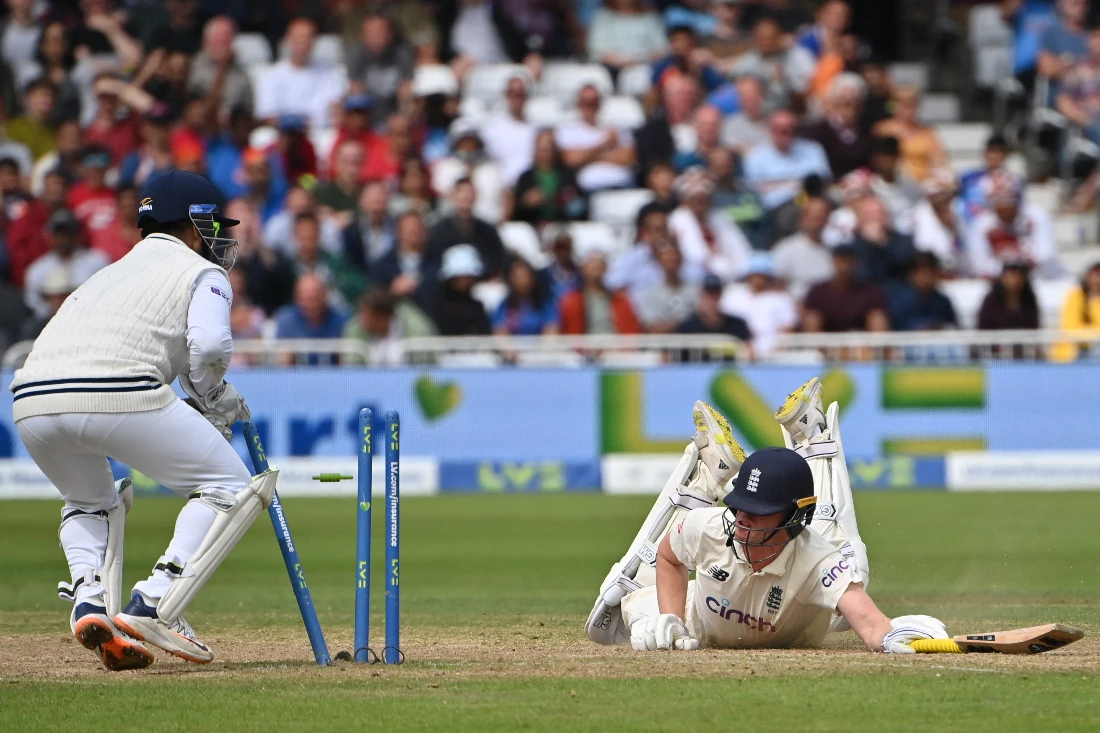
- Original reason for allowing technology in umpires’ decision-making was to review controversial decisions. DRS is now here to stay
LONDON: Last week, I traveled to Trent Bridge, Nottingham, to attend the first three days of the opening Test match of a series of five between England and India. The series is the first in the new round of the Test Match Championship to be contested by nine teams between mid-2021 and April 2023.
In a previous column, I covered the result of the play-off in June at Southampton between the top two teams in the 2019-2021 cycle, India and New Zealand, in which the latter triumphed, a setback to India’s quest to dominate world cricket.
There can be little doubt that the wounded Indian camp is seeking to re-set its goals by winning the series against an England team beset by injury, lack of preparation for Test cricket and, in the case of some players, a vulnerable technique. This showed through and England was fortunate that rain washed out the final day allowing a draw to be claimed.
My visit to Nottingham was partly sentimental. It is my former home territory, where I watched my first professional cricket match, and is the only international venue on which I ever played. However, following last week’s column on the authority of umpires, I went with an additional objective, that of focusing my eyes on the Decision Review System (DRS).
This can be invoked by the fielding team to challenge a “not out” decision and by the batting team to dispute an “out” decision. The fielding team captain or the batsman/batswoman being dismissed can activate a “Player Review” with a “T” sign.
In the 21st over, India reviewed an umpire’s decision, which ruled against an appeal for a catch by the wicketkeeper. The review is conducted by a third umpire, using a toolkit of technological aids. Based on these, he ruled that the ball had not touched the bat and that the umpire’s original decision was correct.
Two balls later, the bowler produced an almost identical delivery that drew an almost identical response from the batsman. The bowler and wicketkeeper appealed for a catch behind, which the umpire rejected. Again, the fielding team opted to review. This time, the third umpire detected the faintest of contact behind bat and ball and, almost reluctantly and apologetically, asked the on-field umpire to reverse his decision.
The DRS has added drama and tension to the game. The ultimate responsibility for deciding to review a not out decision rests with the captain of the fielding side, who has 15 seconds to form a view based on advice from those closest, usually the bowler and wicketkeeper. The crowd clapped down the 15 seconds and cheered his decision, made with one second left.
Whilst waiting for the third umpire’s decision, tension mounted, as the tracking process is shared on a big screen. When the decision was revealed, there was a heady mixture of jubilation and deflation amongst the spectators and the players. During the day, there were a further two reviews and, on the next day, four were activated. The spectacle is heightened in that each team has a limited number of reviews available per innings. In this series, it is three. Unsuccessful reviews are taken off the allowance, so each review carries both a degree of risk and judgement.
It should be remembered that the original reason for allowing technology to have a role in umpires’ decision-making was to review controversial decisions. The use of TV replays for three methods of dismissal had been introduced in November 1992 but it took a long while for any further technology to be accepted. Eventually, a player referral system was tested in a match between India and Sri Lanka in 2008 and was officially launched by the International Cricket Council (ICC) on Nov. 24, 2009 in the Test series between New Zealand and Pakistan. The system was extended to One-Day Internationals in January 2011 for a series between Australia and England.
At that time, the intention was to make the system mandatory in all international matches but not all countries could agree that all elements were to be used and its implementation became optional, the system being used only if both teams agreed. The system was first used for One-Day Internationals in January 2011 in a series between Australia and England.
One of the main resistors to DRS was The Board of Control of Cricket in India (BCCI). Although not against the use of technology in decision making, it did have concerns over the accuracy of the ball-tracking element. These concerns continued until 2016, when sufficient improvements had been made for the BCCI to agree to the experimental use of ball-tracking in a series against England. This paved the way for the use of DRS in T20 Internationals in October 2017 and a uniform system across all international match formats. More recently, it has been applied selectively in other first-class matches.
Every decision reviewed using DRS involves fixed steps followed by the third umpire. The first check is to establish if the delivery is legal, using tv replays, including slow-motion. Then, depending on whether the appeal is for a catch or leg-before-wicket, technology that uses directional microphones to detect small sounds made as ball hits bat or pad is available, as is infrared imaging system which shows if the ball has been in contact with bat or pad. Finally, for leg-before-wicket decisions, ball-tracking technology, which plots and projects the trajectory of a delivery that has been interrupted by the batsman/batswoman, often by the pad, is used to assess if the ball would have hit the stumps.
An on-field umpire has only moments to decide. Naturally, errors will be made. Research has revealed that, between 2009 and 2017, 26 percent of reviews resulted in on-field decisions being overturned, often by the slimmest of margins. It seems that DRS is here to stay and continue its uneasy relationship with the game.