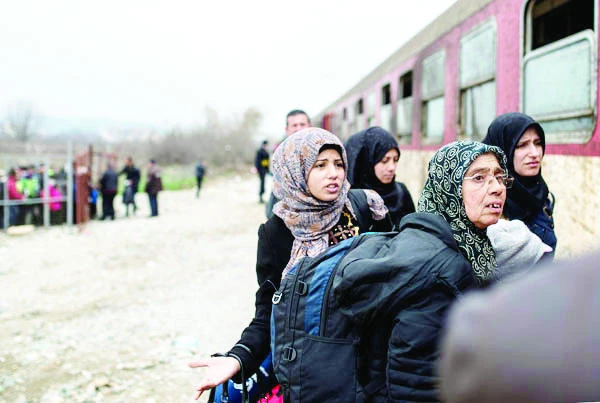
KABUL: A chartered airplane carrying 125 Afghan refugees back from Germany landed in Kabul on Wednesday, with officials on hand eager to assure the returnees that they have a future in Afghanistan.
The refugees returned voluntarily, in what is expected to be the first of many such flights coordinated between the governments in Kabul and Berlin as well as the International Organization for Migration, according the German Embassy in Kabul.
Seeking to escape the violence and economic malaise that continue to grip their home country, Afghans make up a major portion of the hundreds of thousands of refugees who have been pouring into Europe, which has struggled to find ways to accommodate the arrivals.
Officials in Kabul greeted the returning refugees with signs saying “Welcome back, Afghanistan needs you.”
“After a difficult way to Germany in the hands of people smugglers they realized their future is in Afghanistan and that they are needed in their home country,” the German embassy said in a statement. Many Afghans made their way to Germany, but in recent months the German government has launched media campaigns to dissuade would-be refugees from making the trip, warning of dangerous human traffickers and limited opportunities in Europe.
Afghans were 27 percent of the more than 100,000 refugees who made the dangerous journey across the Mediterranean Sea in January, second only to the number fleeing war-torn Syria, according to data collected by the UN.
Meanwhile, the Afghan Taliban said Wednesday they had not been officially contacted by Kabul about the resumption of direct talks aimed at ending their conflict.
The comment came a day after the latest round of dialogue in the Afghan capital between officials from Afghanistan, the US, China and Pakistan. The representatives of the four states called on the militants to return to the negotiating table and said they expect the process to begin by the first week of March.
“We are not aware of this, I cannot say anything regarding talks in Islamabad,” said the Islamist group’s spokesman Zabihullah Mujahid in a phone conversation.
“We have not received anything officially in this regard, we only heard it from media.”
A first round of direct talks with the Taliban took place in the Pakistani resort town of Murree last July, but came to a standstill after the Kabul government leaked news of the death of Taliban leader Mullah Omar two years before.
The announcement, and the appointment of his successor Mullah Akhtar Mansour, accentuated divisions among the militants, with many holding Mansour responsible for lying to them about Omar’s death.
A splinter group formed under Mullah Rasool and challenged Mansour’s leadership.
But the disunity has not dented the Taliban’s fighting ability.
The insurgents are waging an unprecedented winter campaign of violence across Afghanistan, underscoring a worsening security situation more than 14 years after their government in Kabul was toppled by a US-led invasion.
In January, during a seminar organized by the Pugwash peace movement in Qatar, Taliban representatives called for their cadres to be removed from US and UN blacklists which have frozen their assets and restricted their freedom of movement.
In addition, they have said talks cannot take place until the withdrawal of some 13,000 NATO troops still deployed in Afghanistan.
“We have expressed our position clearly in the Pugwash conference,” Mujahid told AFP.
Afghanistan’s Independent Election Commission publicly confirmed the official results of the disputed 2014 election on Wednesday, more than a year and a half after the vote that elevated former finance minister Ashraf Ghani to the presidency.
The 2014 election, touted as the first peaceful democratic transfer of power in Afghanistan, descended to the brink of chaos as Ghani and his rival, Abdullah Abdullah, traded accusations of fraud.
According to the official numbers, Ghani won a runoff election in June 2014 with 55.27 percent of the vote to Abdullah’s 44.73 percent.
It was at the request of both candidates, who now share power as part of a US-brokered unity government, that the election commission delayed the release of the official numbers, said the commission’s chief, Ahmad Yousuf Nuristani.
“We had given election results on a CD to both candidates at that time,” he told Reuters. “We did not announce the certified results at that time, as both candidates had agreed that based on our country’s national interests, not to announce the results. We, based on our country’s national interest, respected this suggestion. Now it is our duty to release them.”
In the end, roughly 800,000 votes of more than 7 million overall ballots separated the candidates, according to the commission, which faced heavy criticism over its handling of the vote.
More than 850,000 ballots were invalidated after months of recounting under the supervision of the United Nations. Of those invalidated votes, more than 567,000 were cast for Ghani, while more than 284,000 were cast for Abdullah, who now serves in a custom-made role as chief executive.
Efforts to broker a power-sharing agreement dragged on in 2014 over Abdullah’s insistence that the results, which he regarded as fraudulent, not be released, according to officials at the time.
On Wednesday Abdullah’s office criticized the election commission for delaying the release of the certified numbers.
“We do not trust the election commission,” Abdullah’s deputy spokesman, Javid Faisal, told Reuters. “If it was a trustworthy commission and if it was loyal to its work, then why did they not announce its results on time? From our point of view, their announcement does not mean anything.”
Ghani’s office declined to comment on the commission’s announcement.
(Reporting by Mirwais Harooni; writing by Josh Smith)
Berlin, Kabul work together in repatriating Afghan refugees