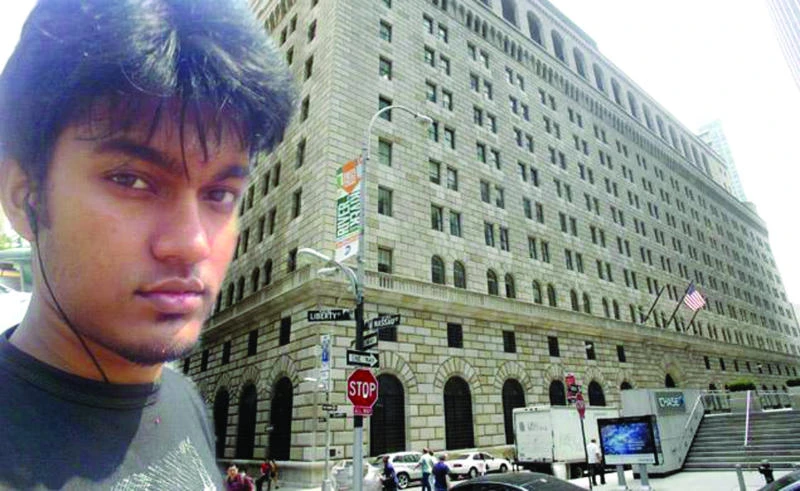
DHAKA/NEW YORK: The family of a Bangladeshi man sentenced Friday for attempting to bomb the US Federal Reserve in New York said they were shocked at the 30-year jail term handed down.
Quazi Mohammad Rezwanul Ahsan Nafis, 22, had earlier pleaded guilty to attempting to use a weapon of mass destruction and admitted under oath that he intended to use a cell phone to detonate the 1,000-pound (450-kilogram) device.
"We heard the verdict from the BBC and after hearing the verdict Nafis' parents have become sick," Tawfiq Alam, brother-in-law of Nafis, told AFP.
"We are shocked because we expected a lighter jail term. We still believe he was set up, he can't do this thing," Alam, a doctor, said.
The stiff sentence was even more of a blow to the family as it came during the Eid al-Fitr festival marking the end of the holy fasting month of Ramadan, he said.
"This 30-year jail term will ruin his life," he added.
Nafis' plot was foiled by an FBI undercover agent posing as an Al-Qaeda facilitator.
Unaware that he was being recorded, Nafis repeatedly declared that he had come to the United States to carry out a terrorist attack.
The 22-year-old Bangladeshi man who begged for leniency after pleading guilty to terrorism charges for trying to blow up the Federal Reserve Bank in New York was sentenced Friday to 30 years in prison.
"I'm ashamed. I'm lost. I tried to do a terrible thing. I alone am responsible for what I've done. Please forgive me," Quazi Mohammad Rezwanul Ahsan Nafis said before his sentence was handed down in Manhattan federal court. He apologized to the judge, the United States, New York City and his parents.
Nafis became radicalized at his university in Bangladesh and came to the US with aspirations of jihad, according to lawyers on both sides. He said personal problems also were a factor.
The defendant had said in a five-page typed letter to Judge Carol Bagley Amon that he no longer believed in radical Islam.
"My actions are inexcusable and cowardly," he wrote. "After giving a deep thought I truly hate my actions and I know that I will never pursue such behavior again that is not only un-Islamic, but also destroyed my family and my life."
He was charged in October with attempting to use a weapon of mass destruction and attempting to provide material support to Al-Qaeda. He pleaded guilty in February.
Nafis told the judge he had a stammering problem and no real friends in his native country.
"For being a very simple guy I fall for people very easily," he wrote in explaining how he fell in with a group of radical students at his university there. "I was becoming religious but never realized that I was misguided slowly but surely with the wrong teachings of Islam."
He originally came to the United States to study cybersecurity at a Missouri college where he also became vice president of the school's Muslim student association. But he was put on probation because of poor grades, he said, and came to New York to find a job. While in New York, he discovered a woman he cared about back in Bangladesh was cheating on him, he said.
It made him suicidal, which is forbidden in his religion, he said, and pushed him over the edge. Authorities say Nafis adopted increasingly more radical views and began using Facebook and other social media to seek support for a terror attack. One of his contacts turned out to be a government informant who notified authorities.
While under investigation, Nafis spoke of his admiration for Osama Bin Laden and talked of writing an article about his plot for an Al-Qaeda-affiliated magazine. He also talked about wanting to kill President Barack Obama and bomb the New York Stock Exchange, officials said.
As the plot progressed, Nafis selected his target, drove a van loaded with dummy explosives to the door of the bank and tried to set off the bomb from a hotel room using a cellphone he thought had been rigged as a detonator, authorities said. No one was ever actually in danger because the explosives were fakes provided by the government.
Nafis said he has been shown great kindness while in the US — and in prison. "Everybody is very respectful towards religion," he wrote. He has been allowed to pray, and given halal food and fresh fruits.
"Truly after being in prison, my viewpoints toward America has really changed," he said. "I want to say to Your Honor that I love Americans."
His parents, who live in Dhaka, pleaded for mercy in letters to the judge. His mother, Rokeya Siddiqui, described her son as shy, ridiculed and unfocused. He was, she said, "just a kid." ''He doesn't have any idea around the world."
Family shocked as Bangladeshi gets 30 years in US prison