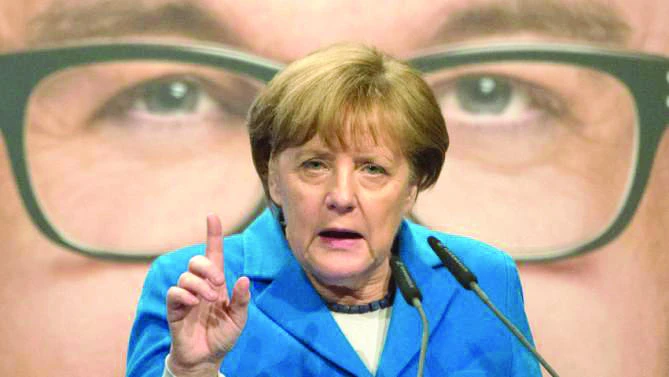
BERLIN: Three German states voted on Sunday in the first significant political test since the country saw a massive influx of migrants. A nationalist party is expected to perform strongly amid unease over Chancellor Angela Merkel’s liberal approach to Europe’s migration crisis.
Some 12.7 million people are eligible to vote for state legislatures in three diverse regions: Baden-Wuerttemberg in the southwest, an economic powerhouse; neighboring Rhineland-Palatinate; and relatively poor Saxony-Anhalt in the ex-communist east.
Polls suggest the results will be uncomfortable for both Merkel’s conservative Christian Democratic Union party and her partners in the national government, the center-left Social Democrats.
They predict the three-year-old Alternative for Germany party, or AfD, which has campaigned against Merkel’s migrant policy, will easily enter all three state legislatures, winning as much as 19 percent of the vote in Saxony-Anhalt.
Germany registered nearly 1.1 million people as asylum-seekers last year as Merkel insisted “we will manage” the challenge. While her government has moved to tighten asylum rules, she still insists on a pan-European solution to the migrant crisis, ignoring demands from some conservative allies for a national cap on the number of refugees.
For “all those who want a constructive solution, who want to move things ahead, AfD is completely the wrong party,” the chancellor says.
Vice Chancellor Sigmar Gabriel, the Social Democrats’ leader, called Saturday for a big turnout in the vote and predicted that a large majority of voters will choose “democratic parties.”
“There is a clear position that we stand by: humanity and solidarity,” he said. “We will not change our position now because of 10 percent right-wing radicals.”
Merkel’s party leads Saxony-Anhalt’s government. It hopes to oust center-left governors in the other two states, but its chances of doing so appear to have dimmed.
Merkel’s CDU ran Baden-Wuerttemberg for decades until 2011, when it finished first but lost power to a Green-led coalition.
This time, polls suggest it could be beaten to first place by the left-leaning Greens, who are benefiting from the popularity of the state governor, Winfried Kretschmann. Many prefer Kretschmann, who has a more conservative image than many Greens, to little-known CDU challenger Guido Wolf.
Germans vote in 3 states elections