- Experts question reasons for inaction more than a month after New Delhi revoked valley’s special status
- Former Chief Minister of Jammu and Kashmir Farooq Abdullah was arrested on Monday
NEW DELHI: In a first major intervention, India’s Supreme Court on Monday urged the central government to restore normalcy in Jammu and Kashmir in the “national interest” of the country.
"We direct Jammu and Kashmir to make every endevour to make sure normal life returns," a three-judge bench headed by Chief Justice Ranjan Gogoi said on Monday.
"We ask for restoration to be on selective basis keeping in mind national interest," the judges said.
The intervention followed a petition filed by Executive Editor Anuradha Bhasin Jamwal of Kashmir-based English newspaper, Kashmir Times.
In her petition to the apex court, Bhasin said that she was not able to publish her newspaper from Srinagar because the “communication has been crippled”.
She added that even a month after the abrogation of Article 370, restrictions continue to be in place and she faces difficulties in running the newspaper.
“Some restrictions have been eased but the situation in the valley is still not normal and in the absence of free mobile connectivity and Internet, publishing the newspaper is difficult,” Jamwal told Arab News.
On Monday, the Supreme court allowed senior opposition Congress leader Ghulam Nabi Azad to visit four districts of the Kashmir valley without indulging in any political activity.
The main opposition party has been critical of the Supreme Court for postponing crucial matters.
It follows comments made last week by party spokesperson Anand Sharma who said: “It has been seen, not in one case but many, that the country’s judiciary, even on sensitive issues, instead of taking them up and deciding, is putting them off. There is neither denial, nor action and there is continuous delay.”
Meanwhile, on Monday, former Chief Minister of Jammu and Kashmir Farooq Abdullah was arrested under a draconian Public Safety Act, which bars an individual from seeking bail for at least two years. Abdullah is already under house arrest.
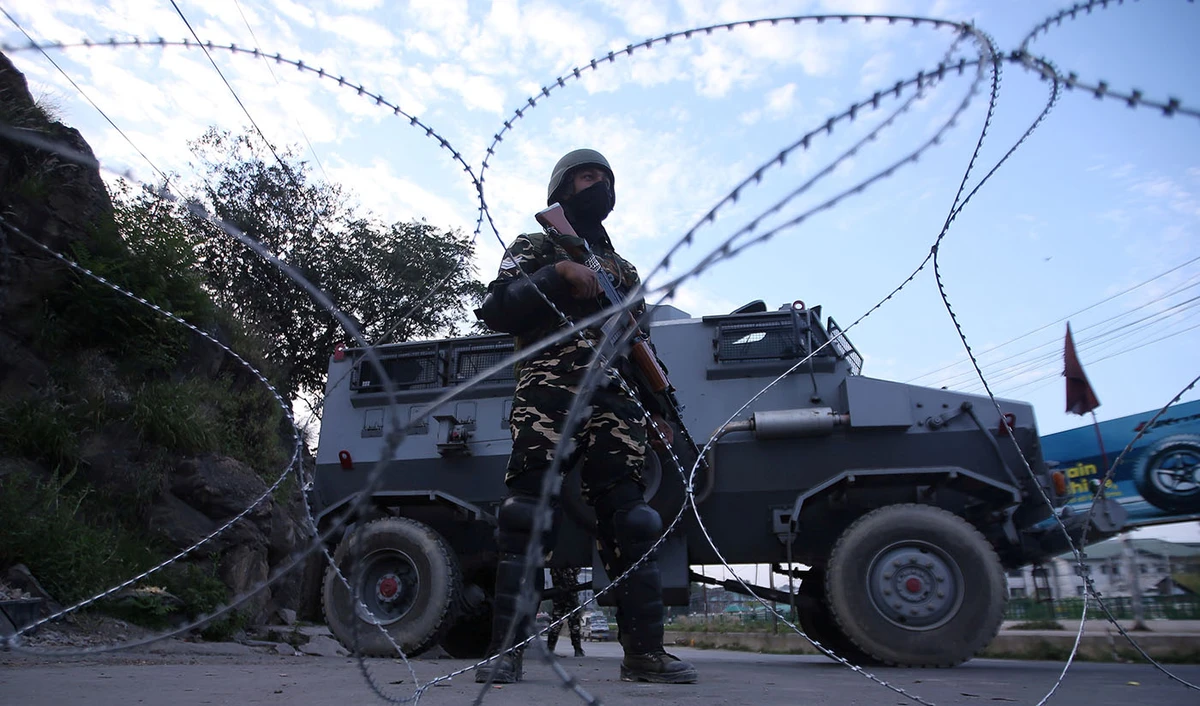
Kashmir has been under a heavy lockdown since August 5 when New Delhi repealed Article 370 of the Indian constitution which accorded a special status to Jammu and Kashmir.
For more than a month since then, all communication networks have been cut off across the valley, with landline phone connectivity restored for the first time last week.
“The situation is one in which the uncertainty in Kashmir has been heightened and what is disconcerting in this situation is that Delhi also seems to be uncertain as to where it has taken the country toward,” Siddiq Wahid, a Srinagar-based professor who traveled to New Delhi on Sunday after spending more than a month in the valley, told Arab News.
“The situation in the valley is not normal at all. No one can predict when it would be normal. A population which has been held in complete contempt by the government in this situation to talk about normalcy is not acceptable. No one can predict anything now,” he said, adding that the valley was experiencing “civil disobedience with a Kashmir flavour to it.”
“The approach is that whatever the government wants to do, people do the opposite. If the government orders opening of the shop people do it opposite. Its civil disobedience with a Kashmir flavor to it,” he said, expressing
anguish at the Supreme Court’s lack of action over the crisis in Jammu and Kashmir.
“The Supreme Court is one of the pillars of democracy, but it does not give you the impression that it has exercised its supreme rights as one of the pillars of democracy. It should have acted but its delayed action. Justice delayed is justice denied,” he said.
Jamwal, for her part, questioned “how the government can think of restoring normalcy when it keeps on arresting mainstream politicians”.