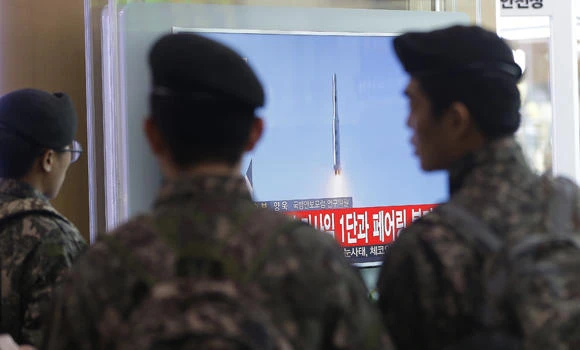
MOSCOW/BEIJING/SEOUL: North Korea’s backers joined the chorus in condemning the rogue state’s launch of a long-range rocket, with Russia saying the move was a serious blow to regional security including that of Pyongyang.
China also “expressed regret” over the launch, which it said flies “in the face of international opposition.”
North Korea earlier confirmed that it had successfully put a satellite into orbit, with the rocket launch widely condemned as a ballistic missile test for a weapons delivery system to strike the US mainland.
The launch, which violated multiple UN resolutions, amounted to the North doubling down against an international community already struggling to punish Pyongyang for its nuclear test a month ago.
Condemnation was swift, with the United States calling the launch “destabilizing and provocative,” while Japanese Prime Minister Shinzo Abe slammed it as “absolutely intolerable.”
In New York, diplomats said the UN Security Council would meet in emergency session later Sunday.
South Korean President Park Geun-Hye said the Council should respond quickly with “strong punitive measures” against what she called a grave challenge to global peace and security.
“Audacious disdain”
In a statement, Russia’s foreign ministry said: “It is obvious that such actions lead to a serious aggravation of the situation on the Korean peninsula and Northeast Asia on the whole...(and) inflict serious damage to the security of the countries of the region, first and foremost North Korea itself.”
Russia, which is one of the few backers of the isolated Stalinist country and with which it shares a border, said that Pyongyang had once again demonstrated “audacious disdain for the norms of international law.”
“The course chosen by Pyongyang cannot but cause a decisive protest,” the foreign ministry said.
“We urgently recommend that the North Korean leadership think whether the policy of placing yourself in opposition to the international community is in the country’s interests.”
China said that while North Korea has the right to the peaceful use of space, “that right is limited by the relevant United Nations Security Council resolutions.”
China is North Korea’s sole major ally and main trading partner, but relations between the two have been strained in recent years by Pyongyang’s ongoing nuclear program.
China’s foreign ministry spokeswoman Hua Chunying called for “all relevant parties to deal with the situation calmly” and for “dialogue and consultations” about the Korean peninsula.
China has been wary of provoking its neighbor by cutting off trade, and analysts say Beijing fears a possible influx of refugees across its border should the North Korean regime collapse.
China expressed “opposition” to North Korea’s nuclear test last month.
Dual use
The rocket, carrying an Earth observation satellite, took off at around 9:00 a.m. Pyongyang time (0030 GMT), according to the South Korean defense ministry which was monitoring the launch site.
Its pre-orbital flight arc was planned to traverse the Yellow Sea and further south to the Philippine Sea, with both South Korea and Japan threatening to shoot it down if it encroached on their territory.
Multiple UN Security Council resolutions proscribe North Korea’s development of its ballistic missile program.
Despite Pyongyang’s insistence on a peaceful space mission, its rockets are considered dual-use technology with both civil and military applications.
The United States, along with allies like South Korea and Japan, had warned Pyongyang it would pay a heavy price for pushing ahead with launch, but analysts said the North’s timing was carefully calculated to minimize the repercussions.
With the international community still struggling to find a united response to the North’s January 6 nuclear test, the rocket launch — while provocative — is unlikely to substantially up the punitive ante.
“North Korea likely calculates that a launch so soon after the nuclear test will probably only incrementally affect the UN sanctions arising from that test,” said Alison Evans a senior analyst at IHS Jane’s.
Failed tests
North Korea last launched a long-range rocket in December 2012, placing an Earth observation satellite in orbit.
Western intelligence experts said the satellite had never functioned properly, and argued that this proved the mission’s scientific veneer was a sham.
Despite Pyongyang’s bellicose claims to the contrary, the North is still seen as being years away from developing a credible inter-continental ballistic missile (ICBM).
Orbital rocket launches, experts say, are relatively straightforward compared to the challenge of mastering the re-entry technology required to deliver a payload as far away as the United States.
“An ICBM warhead, unlike a satellite, needs to come down as well as go up,” said aerospace engineer John Schilling, who has closely followed the North’s missile program.
“North Korea has never demonstrated the ability to build a re-entry vehicle that can survive at even half the speed an ICBM would require,” Schilling said.
“If and when they do, what is presently a theoretical threat will become very real and alarming,” he added.
N. Korea triggers fresh fury with space rocket launch