STOCKHOLM/LONDON: Sweden and Britain on Friday rejected the findings of a United Nations panel opinion that Wikileaks founder Julian Assange was a victim of arbitrary detention.
The UN Working Group on Arbitrary Detention panel ruled that the “detention” of Assange should be ended after nearly four years in Ecuador’s embassy in London, and that the Wikileaks founder should be able to claim compensation from Britain and from Sweden.
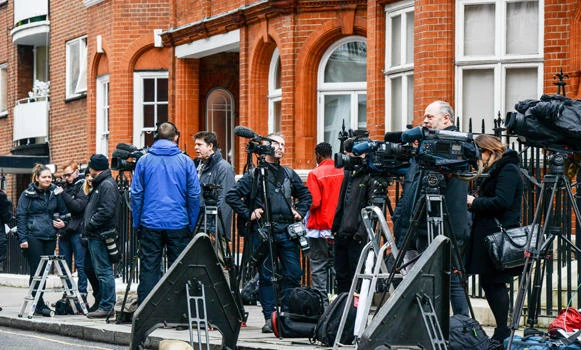
The 44-year-old Australian sought refuge in June 2012 in the embassy, in London’s exclusive Knightsbridge district, to avoid the threat of arrest and extradition to Sweden, where he faces questioning over a rape allegation.
He has lived there in self-imposed confinement ever since in a small office room with a bed, computer, sun lamp, treadmill, and access only to a small balcony.
Sweden said it did not agree with the UN panel. In a letter to the panel, Sweden’s foreign ministry said the body does not have the right to “interfere in an ongoing case handled by a Swedish public authority.”
Swedish prosecutors have said that the UN panel’s opinion “has no formal significance for the ongoing investigation under Swedish law.”
Britain said it would contest the panel’s opinion and warned that the computer hacker would be arrested if he left the embassy.
“This changes nothing. We completely reject any claim that Julian Assange is a victim of arbitrary detention. The UK has already made clear to the UN that we will formally contest the working group’s opinion,” a government spokesman said.
“He is, in fact, voluntarily avoiding lawful arrest by choosing to remain in the Ecuadorean embassy,” the spokesman said. “An allegation of rape is still outstanding and a European Arrest Warrant in place, so the UK continues to have a legal obligation to extradite him to Sweden.”
Vindication
Assange’s lawyer in Stockholm, Thomas Olsson, said: “If Sweden expects other countries to abide by UN recommendations, then they must also respect those decisions.
“We can ask the prosecutor for a review of the arrest warrant but we will first let the prosecutor have a chance to show that they respect the UN report,” he said.
In a statement Thursday, Assange said that a ruling in his favor should lead to “the immediate return (of) my passport and the termination of further attempts to arrest me.”
Moments before UN panel’s announcement, Assange told French radio station France Inter that a ruling in his favor would be “a vindication for what I’ve been saying over the last five years.”
He added: “I’m confident in my argument.”
Swedish authorities want to speak to him about a rape allegation whose statute of limitations does not expire until 2020.
But he fears that he could then be sent to the US and face prison there if he gave himself up for questioning.
Havoc caused by Wikileaks
Wikileaks’ activities — including the release of 500,000 secret military files on the wars in Afghanistan and Iraq and 250,000 diplomatic cables — have infuriated the US.
The main source of the leaks, US Army soldier Chelsea Manning, was sentenced to 35 years in prison for breaches of the Espionage Act.
A hero to some and a dangerous egocentric to detractors, the computer programmer and hacker, whose celebrity supporters include fashion designer Vivienne Westwood and artist Yoko Ono, founded anti-secrecy group WikiLeaks in 2006.
Ecuador granted Assange asylum in 2012, and on Thursday President Rafael Correa told a news conference the expected UN decision “shows we were right, after so many years.”
Britain has spent millions of pounds maintaining a 24-hour guard outside the embassy to immediately arrest Assange if he set foot on British soil.
The guard was withdrawn last year, but police said they would strengthen a “covert plan” to prevent Assange slipping away.
The decision by the UN panel was made in December but has only now been published.
It follows a complaint by WikiLeaks against Sweden and Britain in September 2014 in which they claimed Assange’s confinement in the embassy was unlawful and that he was a “political refugee.”
Though the panel’s rulings are not legally binding, the Justice for Assange support group said it had influenced the release of prominent figures including Myanmar’s Aung San Suu Kyi and former Maldives president Mohamed Nasheed.
Sweden, UK reject UN panel's ruling on Wikileaks case