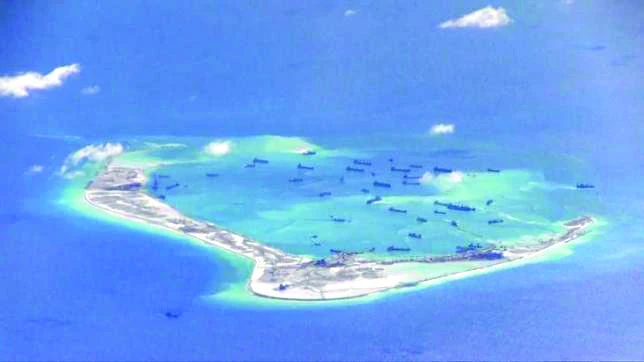
WASHINGTON: The United States has seen Chinese activity around a reef China seized from the Philippines nearly four years ago that could be a precursor to more land reclamation in the disputed South China Sea, the US Navy chief said on Thursday.
The head of US naval operations, Admiral John Richardson, expressed concern that an international court ruling expected in coming weeks on a case brought by the Philippines against China over its South China Sea claims could be a trigger for Beijing to declare an exclusion zone in the busy trade route.
Richardson told Reuters the United States was weighing responses to such a move.
China claims most of the South China Sea, through which more than $5 trillion in global trade passes every year. Vietnam, Malaysia, Brunei, the Philippines and Taiwan have rival claims.
Richardson said the US military had seen Chinese activity around Scarborough Shoal in the northern part of the Spratly archipelago, about 200 km west of the Philippine base of Subic Bay.
“I think we see some surface ship activity and those sorts of things, survey type of activity, going on. That’s an area of concern ... a next possible area of reclamation,” he said.
Richardson said it was unclear if the activity near the reef, which China seized in 2012, was related to the pending arbitration decision.
The Philippine Foreign Ministry said it had yet to receive a report about Chinese activities in Scarborough Shoal.
A Philippine military official who declined to be identified because he is not authorized to speak to the media said he was unaware of a Chinese survey ship in the area.
“China already has de facto control over the shoal since 2012 and they always have two to three coast guard ships there. We are also monitoring their activities and movements there,” the official told reporters.
“There are no indications China will reclaim Scarborough Shoal.”
Richardson said China’s pursuit of South China Sea territory, which has included massive land reclamation to create artificial islands elsewhere in the Spratlys, threatened to reverse decades of open access and introduce new “rules” that required countries to obtain permission before transiting those waters.
He said that was a worry given that 30 percent of the world’s trade passes through the region.
Asked whether China could respond to the ruling by the court of arbitration in The Hague by declaring an air defense identification zone, or ADIZ, as it did farther north in the East China Sea in 2013, Richardson said: “It’s definitely a concern.
“We will just have to see what happens,” he said. “We think about contingencies and ... responses.”
Richardson said the United States planned to continue carrying out freedom-of-navigation exercises within 12 nautical miles of disputed South China Sea geographical features to underscore its concerns about keeping sea lanes open
The United States responded to the East China Sea ADIZ by flying B-52 bombers through the zone in a show of force in November 2013.
US detects new Chinese activity around disputed sea reef