KIEV/MOSCOW: Russian forces tightened their grip on Crimea on Sunday despite a US warning to Moscow that annexing the southern Ukrainian region would close the door to diplomacy in a tense East-West standoff.
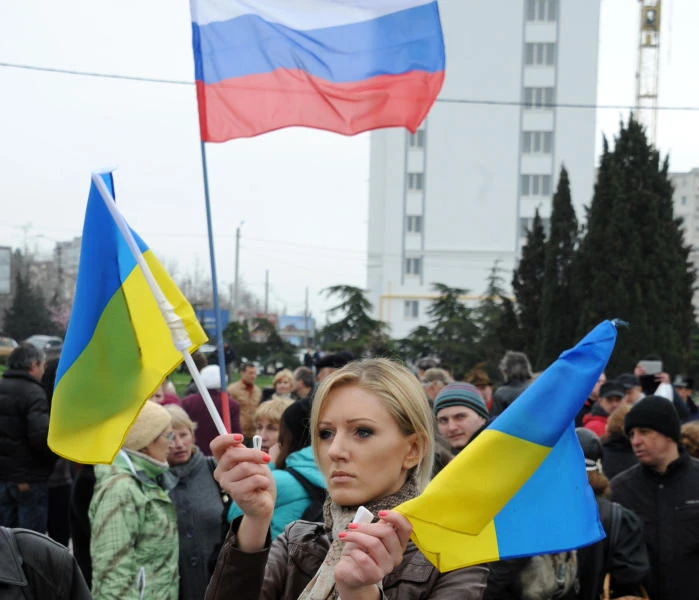
Thousands took to the streets for rival pro- and anti-Kremlin rallies across Ukraine on Sunday as the West and Moscow dug in their heels over a deepening crisis in Crimea.
The protests come after a new marathon round of phone calls by US President Barack Obama seeking to defuse the Cold War-style standoff in the ex-Soviet state.
Tensions in Ukraine’s Black Sea peninsula of Crimea, which has come under de facto control by Russian forces, have resulted in a new face-off between Russia and the West, with each side imposing sanctions or warning of further prohibitive measures to force the other to back down.
Foreign observers have failed to get into Crimea, a majority Russophone region of Ukraine, to get a first-hand look at the situation on the ground and were forced to turn back on Saturday after pro-Kremlin gunmen fired warning shots.
Ukrainian border guards said Saturday that about 60 Russian military lorries had entered the rugged peninsula of two million in the last 24 hours by land and sea, a sign that Moscow was far from pulling back.
They also said “Russian extremists” had attacked a Crimea radar post, in the latest move by pro-Russian forces who have surrounded Ukrainian military bases and taken at least one missile defence unit.
“Armed attackers in military uniform and civil clothes broke the door and entered the building. Radio technic units and telecommunication cables were dissembled and destroyed,” the border guards said in a statement in English on their website.
Sunday marks the 200th anniversary of the birth of Ukrainian poet Taras Shevchenko and patriotic rallies were planned in Kiev and, in a show of defiance toward Russia, in Crimea’s key cities of Simferopol and Sevastopol.
A senior Russian official appealed to the West on Sunday to help prevent “neo-fascists” coming to power in Ukraine after a far-right leader said he planned to run for president.
Dmytro Yarosh, leader of the Right Sector paramilitary movement which played a big role in three months of protests that toppled Ukraine’s Moscow-backed president, announced his candidacy for the May 25 election on Saturday.
The rallies are also significant ahead of controversial plans by Crimea’s regional pro-Moscow government to hold a referendum on joining Russia on March 16, which could lead to a formal annexation of the territory.
Late Saturday, Obama made a fresh round of phone calls to key European allies in the latest diplomatic attempts to resolve the Ukrainian crisis, which began with Yanukovych’s ouster last month after three months of protests that left some 100 dead.
Obama also spoke to the leaders of former Soviet states Lithuania, Latvia and Estonia.
Russia’s expansive moves, its first military campaign against a neighbour since a brief 2008 conflict with Georgia, have left the Baltic states jittery.
Moscow’s promises to “defend” ethnic Russians in Crimea have especially set off alarm bells in Latvia and Estonia, where Russian-speakers make up around a quarter of population. One 72-year-old man in the Lithuanian capital Vilnius, Gucas, told AFP that Russian President Vladimir Putin was a “madman” who “won’t stop until he’s stopped by force.”
As the crisis has escalated, Washington has imposed visa bans on targeted Russians and Ukrainians and warned of wider sanctions against Russia, while the EU has halted visa and other talks with Moscow.
US Secretary of State John Kerry warned Russia’s Foreign Minister Sergei Lavrov again Saturday that “continued military escalation and provocation in Crimea or elsewhere in Ukraine, along with steps to annex Crimea to Russia would close any available space for diplomacy.”
Lavrov has meanwhile told the West not to take “hasty” action or impose sanctions over Ukraine, warning this would “inevitably have a boomerang effect.”
A Russian defence official on Saturday said Moscow may halt foreign inspections of its vast nuclear arsenal in response to “threats” from the United States and the North Atlantic Treaty Organization (NATO).
Street violence flared in Sevastopol, home to Russia’s Black Sea Fleet, when pro-Russian activists and Cossacks beat and kicked a group of Ukrainians at a meeting.
Russian forces’ seizure of the Black Sea peninsula has been bloodless but tensions are mounting following the decision by pro-Russian groups that have taken over the regional parliament to make Crimea part of Russia.
The operation to seize Crimea began within days of Ukraine’s pro-Russian President Viktor Yanukovich’s flight from the country last month. Yanukovich was toppled after three months of demonstrations against a decision to spurn a free trade deal with the European Union for closer ties with Russia.
Ukrainian Prime Minister Arseny Yatseniuk will visit Washington this week for talks, a White House official said.
In the latest armed action, Russians took over a Ukrainian border post on the western edge of Crimea at around 6 a.m. (0400) GMT, trapping about 15 personnel inside, a border guard spokesman said, revising an earlier figure of 30.
The spokesman, Oleh Slobodyan, said Russian forces now controlled 11 border guard posts across Crimea, a former Russian territory that is home to Russia’s Black Sea fleet and has an ethnic Russian majority.
In Sevastopol, several hundred people held a meeting demanding that Crimea become part of Russia, chanting: “Moscow is our capital”.
Across town at a monument to Ukrainian poet Taras Shevchenko, violence flared at a meeting to commemorate the 200th anniversary of his birth, when pro-Russian activists and Cossacks attacked a small group of Ukrainians guarding the event and the police had to intervene.
Footage from the event showed a group of men violently kicking one of the Ukrainians as he lay on the ground and a Cossack repeatedly hit him with a long black leather whip.
In Simferopol, Crimea’s main city, pro- and anti-Russian groups held rival rallies.
Several hundred opponents of Russian-backed plans for Crimea to secede gathered, carrying blue and yellow balloons the colour of the Ukrainian flag. The crowd sang the national anthem, twice, and an Orthodox Priest led prayers and a hymn.
Vladimir Kirichenko, 58, an engineer, opposed the regional parliament’s plans for a vote this month on Crimea joining Russia. “I don’t call this a referendum. It asks two practically identical questions: Are you for the secession of Ukraine or are you for the secession of Ukraine? So why would I go and vote?”
Around 2,000 Russian supporters gathered in Lenin Square, where there is a statue of the Soviet state founder, clapping along to nostalgic Soviet era songs being sung from the stage.
Alexander Liganov, 25 and jobless, said: “We have always been Russian, not Ukrainian. We support Putin.”
President Vladimir Putin declared a week ago that Russia had the right to invade Ukraine to protect Russian citizens, and his parliament has voted to change the law to make it easier to annex territory inhabited by Russian speakers.
Speaking by telephone to German Chancellor Angela Merkel and British Prime Minister David Cameron on Sunday, Putin said steps taken by authorities in Crimea were “based on international law and aimed at guaranteeing the legitimate interests of the peninsula’s population,” the Kremlin said.
At a rally in the eastern city of Donetsk, home to many Russian speakers, presidential candidate Vitaly Klitschko, a former boxing champion, said Ukraine should not allowed to split apart amid bloodshed.
“The main task is to preserve the stability and independence of our country,” he said.
The worst face-off with Moscow since the Cold War has left the West scrambling for a response, especially since the region’s pro-Russia leadership declared Crimea part of Russia last week and announced a March 16 referendum to confirm it.
US Secretary of State John Kerry, speaking to Russia’s foreign minister for the fourth day in a row, told Sergei Lavrov on Saturday that Russia should exercise restraint.
“He made clear that continued military escalation and provocation in Crimea or elsewhere in Ukraine, along with steps to annex Crimea to Russia, would close any available space for diplomacy, and he urged utmost restraint,” a US official said.
Rallies in Ukraine as crisis deepens