


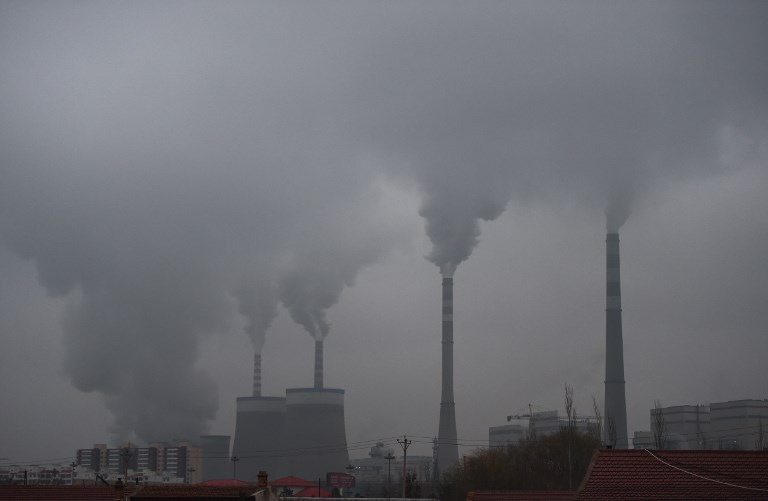
World leaders are making final preparations for the annual UN climate summit, which starts in Poland on Sunday. The meeting, on the three-year anniversary of the inception of the landmark Paris deal, is as urgent as it is important, with two areas of crucial business to transact.
Firstly, leaders need to deliver a clear political signal of the need for ratcheting up collective climate ambition into the 2020s. And, secondly, they must agree the so-called “Paris Rulebook,” which is key to giving full effect to the 2015 deal agreed in France.
This rulebook is the framework of operating procedures for how countries should fulfill their obligations under Paris. The deadline set for this is the end of the Polish summit, and there is still much work to do after an emergency meeting in Thailand on this issue in September made only “limited” progress.
While this rulebook will require great technical and negotiating skill to resolve in the coming days, the issue of the need to send a political signal for ratcheting up collective climate ambition requires genuine global statesmanship by the leaders present. This is because the summit comes in the context of the release of a UN environment report on Wednesday that showed the largest gap yet between where global efforts to tackle climate change are today and where they need to be.
This so-called emissions gap report says that, in 2017, economic growth helped drive the first rise in carbon dioxide emissions for four years as global efforts to cut carbon faltered. To meet the goals of Paris, the study says it is crucial that global emissions peak by 2020, but the analysis says that this is now not likely even by 2030.
Moreover, last month, the Intergovernmental Panel on Climate Change (IPCC) released a hard-hitting report that asserted there may be only a dozen years to prevent the worst impacts of so-called “runaway” global warming. This argued that only urgent, unprecedented action can avoid the worsening risks of climate change.
Take the example of the Middle East and North Africa, which the Max Planck Institute for Chemistry forecasts will see summer temperatures rising more than twice as fast as the global average. It predicts that extreme temperatures of 46 degrees Celsius or more will be around five times more likely by 2050 than at the beginning of the millennium. In this context, it is not just hotter temperatures but also more dust storms and longer droughts that will unfortunately greet the region.
While the Paris Agreement is far from perfect, it nonetheless has kept the process 'alive'.
Andrew Hammond
In these circumstances, pessimism may yet grow about the future of global efforts to combat climate change. Yet, while the scale of the challenge is huge, and growing, actions that are affordable and feasible can still be taken collectively by governments, businesses and individuals to potentially turn this situation around under the flexible Paris treaty, which has the potential to be ratcheted up.
In the three years since it was drawn up, critics of the deal — from different parts of the political spectrum — have already sought to diminish its significance. However, the agreement deserves to be defended robustly for, as then-US President Barack Obama asserted in 2015, it may prove to be “the best chance we have to save the one planet we’ve got.”
For those who argue that Paris is not ambitious enough, it needs to be remembered that the long-running UN-brokered talks nearly collapsed several times over the years. While the agreement is far from perfect, it nonetheless has kept the process “alive,” the importance of which cannot potentially be underestimated.
Other critics of the deal, such as Donald Trump, have also lambasted the agreement, albeit for different reasons. Despite the now-overwhelming scientific evidence about the risks of global warming, Trump and many others argue that climate change is at worst a grand hoax, or at best an unwelcome distraction from other key issues.
While there is always uncertainty with science, these critics are misguided. Even if, remarkably, it turns out that the vast majority of scientists in the world are wrong about global warming, what the Paris deal will help achieve is moving more toward gradually cleaner energies, making the world a less polluted and more sustainable place.
Here it appears that Trump is losing this argument, even within the US itself, with the private sector and many state and city governments pushing for decarbonization. Indeed, in 2017, Trump’s first year in office, the US Environmental Protection Agency asserted that the amount of greenhouse gases emitted in the US dropped by 2.7 percent. This reflects a broader drop-off since 2007, driven largely by market forces inasmuch as power plants have been transitioning to natural gas, which is a cleaner, cheaper energy than coal.
Taken overall, tackling the challenges posed by global warming remains a massively ambitious agenda that will require comprehensive and swift actions from governments and the corporates if it is to have any prospect of being achieved. While this is uncertain, the fact remains that Paris created a window of opportunity and what is now needed is political, business and civic leadership to help ensure effective implementation, and holding the public and private sectors to account so that the treaty truly delivers.
- Andrew Hammond is an Associate at LSE IDEAS at the London School of Economics


