DUBAI: The significance of the Lincoln Continental Concept’s reveal at the Dubai International Motor Show (DIMS) recently cannot be overestimated. Despite the limited size of the regional markets compared to China and the US, the company places great emphasis on the potential high growth rates and higher demand for luxury vehicle in the region.
Lincoln has big ambitions for the Continental model when it arrives in the region in 2016. Lincoln was keen to show off its Concept design at DIMS recently, introduced to the Arab media in a special event hosted by Kumar Galhotra, president of Lincoln.
“The Continental Concept showcases the promise of quiet luxury from Lincoln going forward. It also is a strong indication of what’s to come next year as we introduce our new Lincoln Continental full-size luxury sedan,” Galhotra said in Dubai.
The new Continental will use a 3.0-liter V6 EcoBoost engine, which combines to create a premium driving experience especially when joined by the Lincoln Drive Control and Active Front Steering, Enhanced Park Assist with 360-Degree Camera, Adaptive Cruise Control with stop and go, and a 19-speaker Revel audio system.
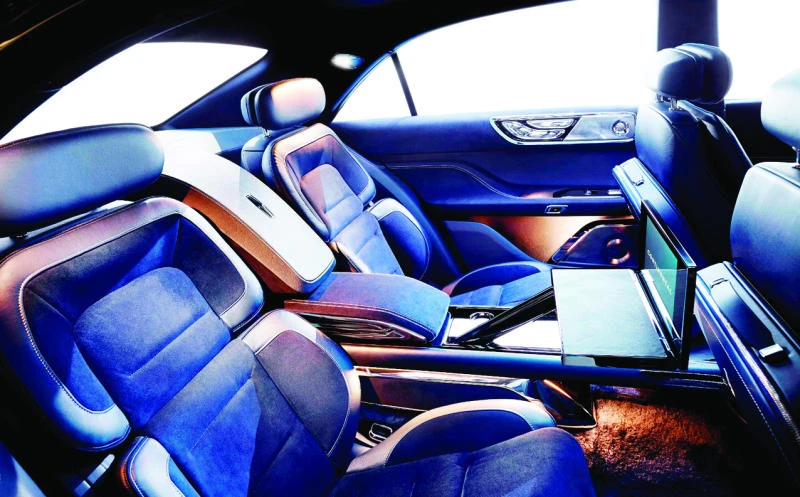
The concept’s interior includes 30-way adjustable seats, reclining rear seat, Venetian leather, tone-on-tone monochromatic color treatment, a through-center console extending from the front to the rear and a docking station for mobile phones or tablets.
Lincoln is smaller than other luxury brands, reportedly selling 94,500 cars in 2014.
However, it is growing fast with a 16 percent rise last year in a luxury market that grew only by eight percent.
Glorious history
The current efforts are geared to restore the past glory of the Lincoln brand that stood shoulder to shoulder with the world’s most prestigious auto brands back in the 1950s and 1960s.
The first few generations of the Continental were integral in creating those glory days. The model was originally designed as a one-off for Ford chief Edsel Ford for a trip to Europe in 1938. Ford later tasked designer E.T. “Bob” Gregorie with designing a new car that was “strictly continental.”
The result was so attractive and popular with onlookers that Ford approved it for production and sent it rolling off the lines in 1940, driven by a 120-hp V12 engine.
In 1955, Ford briefly spun off Continental into its own brand, selling the hand-built Mark II, which stood alongside the likes of Rolls-Royces as the most expensive, premium cars of the era. Owners included Elvis Presley, Elizabeth Taylor and Frank Sinatra.
The 1960s brought arguably one of the most significant iteration of the Continental.
The Lincoln Continental introduced in 1961 became what is still regarded as the pinnacle of Lincoln design and one of the defining automobiles of the 1960s.
The new flagship sedan should give luxury car buyers a very credible alternative to the luxury types they have become accustomed to in the past few years.
The Continental Concept’s cabin is trimmed in premium materials from ceiling to floor.
These include Venetian leather seat and door panels, Alcantara seat inserts and armrests, a satin headliner, shearling wool carpet and Rose Gold instrument cluster trim. The Approach Detection system activates interior and exterior lighting to greet the owner as he or she gets close to the car.
Lincoln crafted the concept’s interior with the Chinese market in mind.
The focus, therefore, is on the comfortable rear passenger seats, where the owner will be sitting as his chauffeur does the driving.
The passenger-side rear seat is particularly comfortable thanks to its ability to recline when the unoccupied front seat is moved forward at the push of a button.
The rear seats are equipped for work and leisure with a slide-out tablet tray in the center console.
Another feature designed specifically for use by the rear passengers is the SmartGlass tinting roof panel.
The passengers control the amount of sunlight that shines and Lincoln says increasing the tint level can drop the cabin temperature by as much as 18° F (10° C) while blocking 99 percent of UV rays.
Lincoln Continental Concept: The car with big ambitions