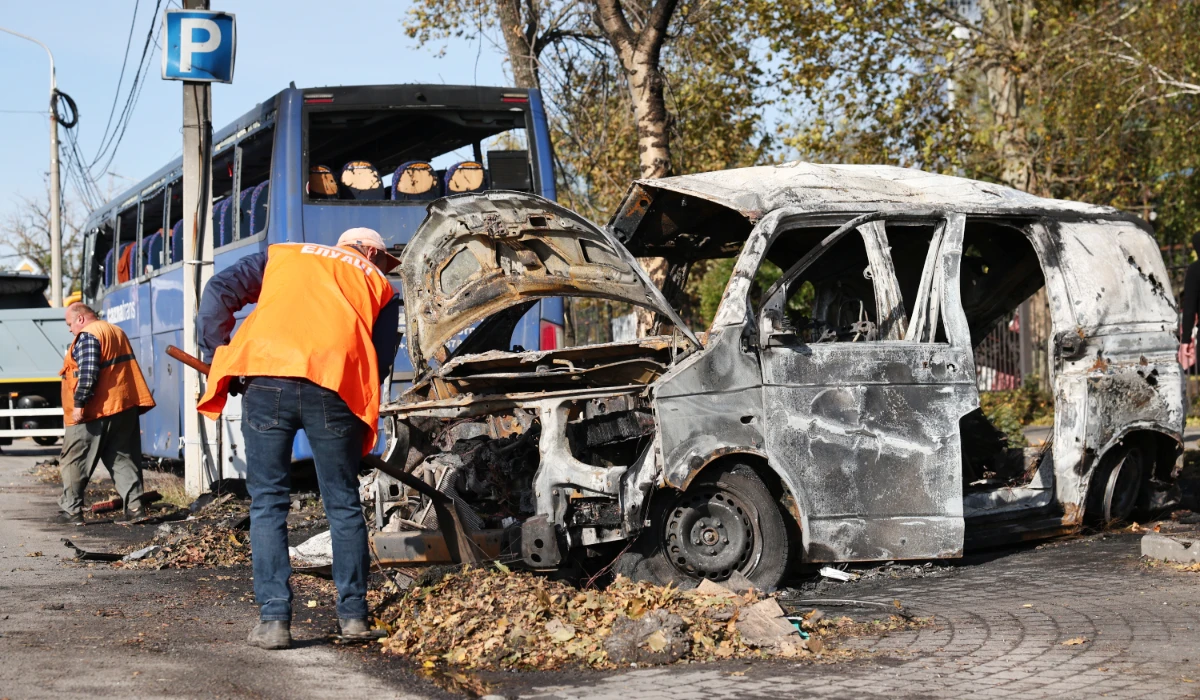
NABLUS, West Bank, 1 August — In another dangerous escalation of the Middle East conflict, Israeli occupation forces yesterday killed two prominent Hamas leaders and eight other Palestinian civilians in less than 48 hours after the Jewish state carried out a massacre at the Farah village, murdering six Fatah men.
Israeli forces fired two missiles at an office of the Hamas in the West Bank town of Nablus, killing two of its leaders and four other activists.
The Hamas leaders were identified as Jamal Mansour, 41, and 42-year-old Jamal Salim, who was decapitated by the blast.
The attack also killed two young brothers and seriously injured their mother as they were passing the downtown apartment building where the Hamas office was located. The strike sparked vows of revenge from Palestinian leaders, who accused Israel of using “political terrorism” to achieve its ends and warned the blast would escalate the crisis.
Palestinian President Yasser Arafat urged world leaders to send international monitors to Palestinian territories.
“This is a very dangerous conspiracy to liquidate our cadets...,” Arafat told Reuters at Amman civilian airport after talks with King Abdallah during a brief visit to Jordan.
“I refer the steps (that should be taken) to the Arab and Islamic nations and to the G-8 summit to implement its resolution as soon as possible and send international observers,” he said. Two other Palestinians were killed by Israeli forces in the Gaza Strip, one an Islamic Jihad fighter shot dead in a firefight and the other a policeman gunned down near a flash point Jewish settlement, Palestinian sources said.
A Palestinian, suspected of collaboration with Israel, was killed late yesterday by masked men in the West Bank village of Beit Sahur near Bethlehem, Palestinian sources said. Thousands of furious and shocked Palestinians massed near the scene of the Nablus blast as people scrambled through the wreckage to retrieve the bodies of the dead and some 15 people injured in the blast.
Six Palestinians, including a 15-month-old baby girl, were injured when hundreds of Palestinians, enraged by Israel’s killing in Nablus held demonstrations throughout the West Bank. The baby was hit in the chest during a round of fire between Israeli soldiers and Palestinians near the West Bank town of Nablus. A 72-year-old Palestinian man was struck by bullets in Beit Sahur near Bethlehem during a round of fire between the Israeli military and gunmen, Palestinian sources said.
Near Ramallah, Israeli rubber bullets wounded four Palestinians during a 2,500-strong demonstration, which called for the Hamas and Palestinian leader Yasser Arafat’s Fatah to avenge the Israeli attack.
The protesters marched from Ramallah to El-Bireh in autonomous Palestinian territory and threw stones on an Israeli military post. Soldiers retaliated by firing rubber bullets, injuring the four.
Hamas leader Ahmad Yassin, said Israel would pay the price for the attack, warning “our blood is not cheap”.
The Palestinian leadership accused Israel of using “political terrorism” and said the attack would only serve to “strengthen our people’s unity and determination to continue our national struggle to end the occupation and settlements”.
Israel insisted however that the Hamas activists were responsible for previous attacks on the Jewish state and were in Nablus plotting fresh violence. The government has given the green light to its security forces to kill or kidnap Palestinian activists.
The Palestinian authorities declared two days of official mourning following the Nablus killings. Israel tightened its blockade on several Palestinian cities, including Ramallah, Bethlehem and Tulkarem, while a Palestinian security chief said Israeli tanks had moved into a Palestinian area of the Gaza Strip. A young man was wounded on the Egyptian side of the frontier town of Rafah during a gunfight.
The United States and France yesterday condemned the latest escalation of violence in the Middle East.
Meanwhile, Arafat is continuing a regional tour to garner support for an emergency Arab summit on the crisis.