WASHINGTON/KABUL, 9 October — American warplanes pummeled Afghanistan for a second day yesterday, as the United States went on high alert and braced for reprisals in the long-haul war on international terrorism. The new strikes came as Washington served notice it could extend its campaign to other states, and sometimes-violent anti-American street protests swept several Islamic countries.
US officials said five land-based B-1 and B-2 Stealth bombers, as well as 10 carrier-based tactical aircraft and 15 Tomahawk cruise missiles, struck at Afghan targets in a second day of reprisals for the Sept. 11 terror attacks on the United States.
British Defense Secretary Geoffrey Hoon said missiles and bombers hit 30 targets across Afghanistan, and a senior official for the Northern Alliance said all Taleban radar installations and air defenses were destroyed.
US Air Force Gen. Richard Myers, chairman of the Joint Chiefs of Staff, said the targets were the same as Sunday, when US and British forces hit airfields, air defense units, communications centers and terrorist camps.
Frightened Kabul residents said they heard jets roaring overhead and Taleban gunners responding with long bursts of anti-aircraft fire. Witnesses reported bombs hitting targets on the outskirts of the city and near the airport as Taleban anti-aircraft batteries opened up on fighter jets that could be heard roaring across the night sky.
The Pakistan-based Afghan Islamic Press (AIP) agency said the strikes had targeted television towers just outside Kabul, but added that one bomb had fallen near the city’s main 400-bed hospital. Electricity was cut in Kabul soon after the strikes began at around 8:30 p.m. (1600 GMT).
Thousands of Kabul residents ignored the Taliban’s bravado, choosing to flee the city in crowded buses, on foot or in donkey carts for the safety of the drought-ravaged countryside toward Iran. "Only God knows what has happened," said one resident. "I am leaving. I will sleep under the sky rather than stay in the city for another night."
A disabled old man at a bus station said he was too frightened to stay in a city already battered by more than two decades of war. "We are leaving because it is no longer safe here — thanks to America," he said.
Many people tried to resume their normal daily life, opening their shops. Taleban guards were in their usual positions outside government offices. As Kabul mosques opened for early morning prayers, calls rose for a jihad (holy war) against America. "We have to sacrifice ourselves for our country and Islam," was the call at one mosque.
US media reported that the Taleban’s southern stronghold of Kandahar and the eastern city of Jalalabad were also hit in the latest strikes on the Taleban regime for protecting terror suspect Osama Bin Laden and his Al-Qaeda network. And US officials said the Americans were again preparing to couple their strikes with a second drop of 37,000 food packages for Afghan refugees in remote reaches of the country.
US President George W. Bush said Sunday’s strikes, which reportedly were aimed at 30 targets, went "as planned." Defense Secretary, Donald Rumsfeld, described them as "very successful."
"All the aircraft returned safely, the humanitarian food and medicine drops were successful ... so we feel that thus far it has been a very successful effort," Rumsfeld said. But he warned the global effort will likely last "years."
Unlike Sunday, Britain played only a logistical role yesterday. But British Prime Minister Tony Blair told his Parliament that "we are in this for the long haul" along with other allies, including Spain, France, Germany, Australia and Canada.
The new wave of airstrikes came shortly after diplomats at the United Nations said Washington had signaled it could hit other countries in retaliation for the terror attacks on New York and Washington. "We may find that our self-defense may require further actions with respect to other organizations and other states," said a letter sent to the United Nations on Sunday.
At the United Nations, Washington said it was still looking into who was behind Sept. 11 attacks on the United States and may have to launch military strikes on other nations and groups beyond Afghanistan and the Al-Qaeda network. "We may find that our self-defense requires further actions with respect to other organizations and other states," US Ambassador John Negroponte said in a letter to the 15-nation UN Security Council.
But Britain, Washington’s closest ally in the military campaign launched on Sunday, quickly insisted the action was limited to targets in Afghanistan.
"The agreement at the moment is that (the strikes) are confined to Afghanistan. That is where the problem is and that is the military action in which we are involved," British Foreign Secretary Jack Straw said in Luxembourg when asked about the US statement.
European diplomats said any attempt to extend the campaign by targeting Iraq, as some US officials have suggested, would blow apart the global coalition against terrorism, and alienate not only Arab and Muslim states but also key European partners including Russia. The White House said the Negroponte letter was only the latest such warning from the Bush administration.
"The letter states what the president has been saying very publicly all along, that the United States reserves the right to defend itself wherever it is necessary," Bush spokesman Ari Fleischer told reporters.
Russian Ambassador Sergei Lavrov, asked how Moscow would react to US strikes on more countries, reserved judgment. "Well, we have to see, because the letter clearly links this phrase to the need for more investigation. We have to wait until the investigation is over," Lavrov said.
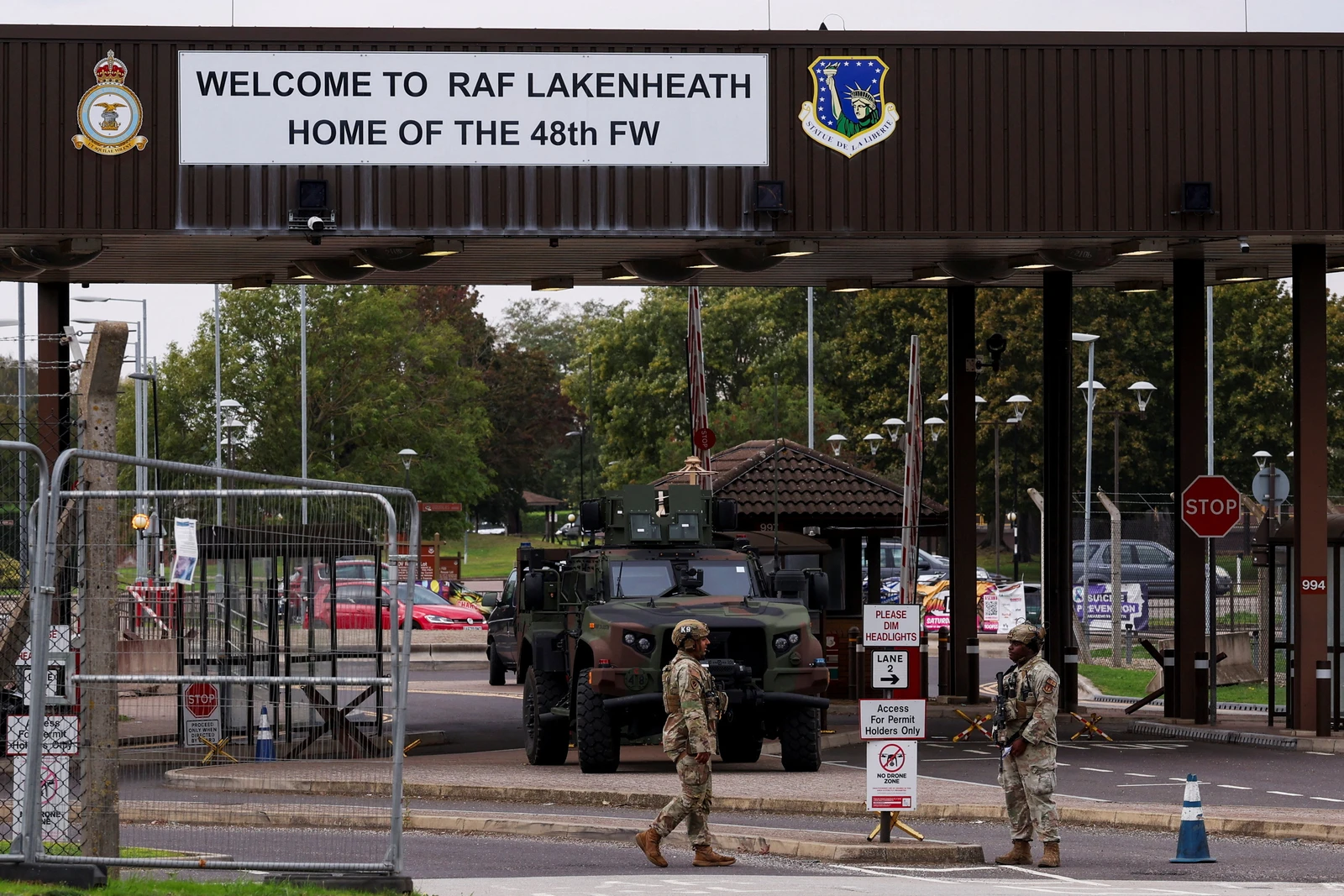
US officials have warned of the threat of new terrorist attacks here as Washington pursued its campaign, and Attorney General John Ashcroft put the United States on its highest alert yesterday. "We are taking strong precautions and other appropriate steps to protect the American people while we win this war," Ashcroft told a news conference.
He said some 18,000 law enforcement agencies and 27,000 corporate security services had been notified of the alert. Sensitive industries, including nuclear, chemical and petrochemical facilities, were under special watch.
Bin Laden and his Taleban protectors vowed revenge and a holy war. But they looked increasingly isolated as most Arab and Muslim states remained circumspect — only Iraq and Iran openly denounced the US-led military action.
Still, street demonstrations erupted in several Islamic countries yesterday as crowds protested the attack on a fellow Muslim country. Two young people, aged 13 and 21, were shot dead and at least 200 people injured in clashes in the Gaza Strip between Islamist students and Palestinian police, hospital and police officials said.
In Egypt, the closest ally of the United States in the Arab world, about 10,000 students demonstrated at universities around the country, with some protesters calling for holy war. Violent anti-US protests broke out throughout Pakistan, with the army using tear-gas to disperse demonstrators. Some 10,000-15,000 students and hard-liners in the western city of Quetta burned down a police station, a UN building, three cinemas, a police station, shopping plaza and a fire station, officials said. One person died and eight were injured.
The Taleban, meanwhile, vowed to wage a drawn-out guerrilla war after the attacks, which it said left more than 25 people dead Sunday, including women, children and the elderly. "We will fight the Americans the way we fought the Russians," a Taleban spokesman in Kabul was quoted as saying by the Afghan Islamic Press, referring to the 1979-89 Soviet occupation that cost Moscow dearly.
But jubilant forces of the Afghan opposition Northern Alliance, boosted by the strikes, unleashed an onslaught on Taleban positions north of Kabul, predicting the Afghan capital would fall in days. Abdullah Abdullah, the Alliance’s foreign minister and chief spokesman, told reporters: "We rather prefer at the moment not to press ahead (on Kabul) and to choose a better time. "The situation in Kabul will depend ... on the depth of the airstrikes by the international alliance," he said.
The British government indicated yesterday that the Northern Alliance could form the next administration of Afghanistan, just days after stating that they were unfit to rule. Last week Tony Blair was adamant that the Alliance would not have Britain’s backing if it seized power. Foreign Office and Ministry of Defense officials maintained that the Allies would prefer the exiled King Zahir to take part in a Loya Jirga, an assembly of military and political leaders, to decide the country’s direction. The Afghan opposition also said it was shelling Taleban positions in the strategic northern city of Mazar-e-Sharif in conjunction with the US strikes.
President Pervez Musharraf of Pakistan, erstwhile backers of the Taleban and the only country to still recognize the regime, warned that Afghanistan could be plunged once again into anarchy. "Certainly the Northern Alliance must be kept in check so that we do not return to the period of anarchy" that prevailed between feuding militias before the Taleban seized power in 1996, he said. A future government in Afghanistan should be "friendly" to Pakistan, he told reporters. Pakistan’s subcontinent rival India, meanwhile, put its forces on heightened alert.
The Taleban envoy to Pakistan, Abdul Salam Zaeef, condemned the overnight air raids as "horrendous terrorist attacks" that targeted "the whole Muslim world" and would have "severe" consequences for the attackers. "To the best of my knowledge the consequences are ... so severe that no one can determine it," Zaeef said in Islamabad. Bin Laden and Taleban spiritual leader Mullah Muhammad Omar survived the attacks, Zaeef said, although Bin Laden had not been in touch since. The military action against Afghanistan will last for weeks, British Foreign Secretary Straw said. They "will continue until there is an assessment made by President (George W. Bush) and our prime minister as to their effectiveness in terms of dealing with the threat of terrorism," he told BBC radio.
While global and domestic support for the US strikes was near unanimous, fears of immediate reprisals gripped the US and its allies. Former Pennsylvania Gov. Tom Ridge Monday took the oath of office as director of homeland security, a post Bush created after Sept. 11 to protect the United States from terrorist attacks.
Police in Britain stepped up security in London and its airports and appealed to people to go about their business as usual. Moscow security services prepared to foil possible terrorist bombings as well as chemical and biological attacks, the Interfax news agency said.
Japanese police threw a security cordon around the US and British embassies in Tokyo and deployed about 400 riot police to Okinawa to provide special security for the huge US base there. And in a surprise move after the overnight air raids, the Taleban yesterday released British journalist Yvonne Ridley, arrested on Sept. 28 for "illegal entry" into Afghanistan, and handed her over to Pakistani border authorities, a Pakistani official said.
UN Secretary-General Kofi Annan noted Washington had framed the military strikes as authorized by the UN Charter. But he did not offer his own view, emphasizing instead a recent Security Council resolution reaffirming UN members’ "inherent right of individual or collective self-defense." To defeat terrorism, "we need a sustained effort and a broad strategy that unites all nations and addresses all aspects of the scourge we face," Annan said.