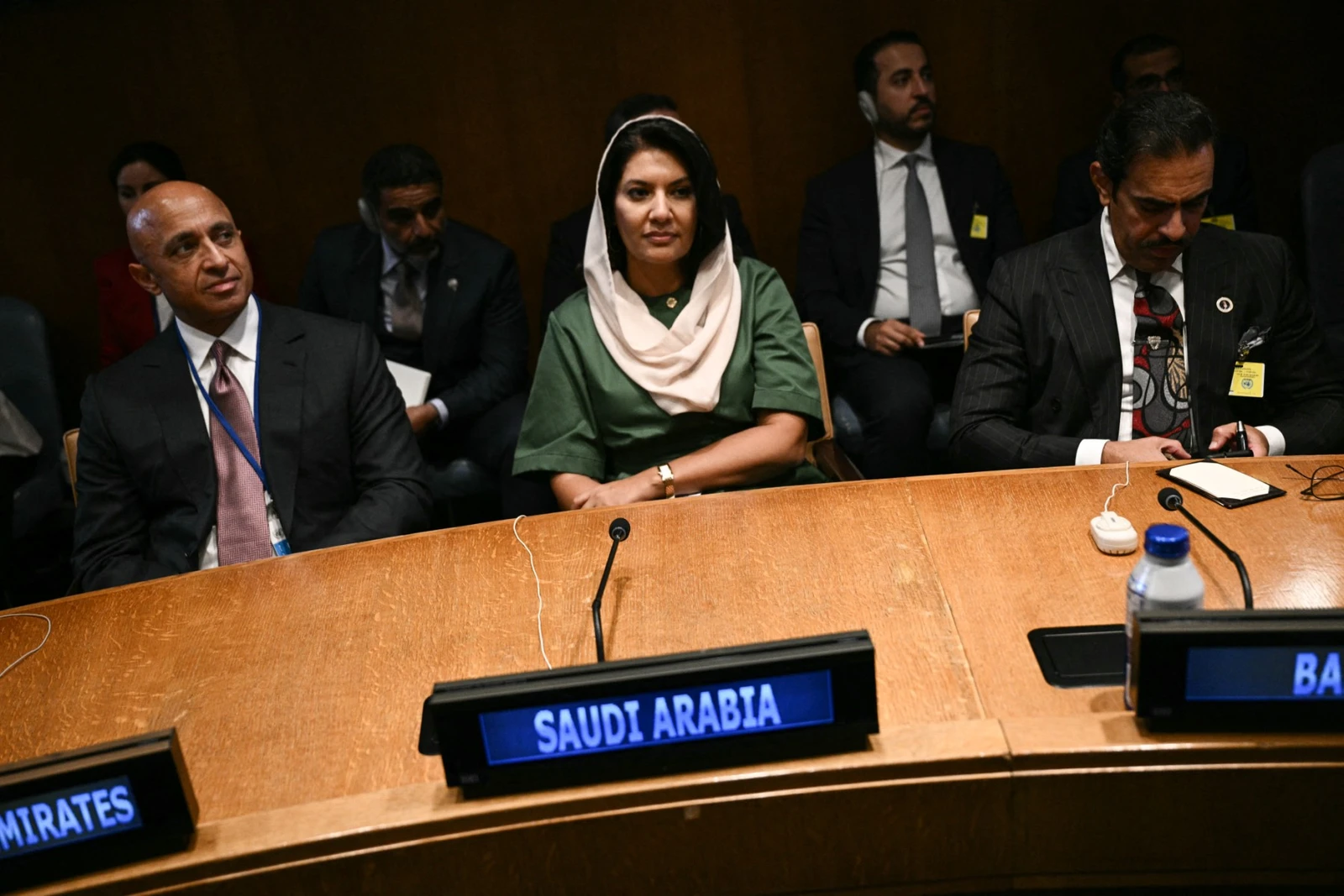
RIYADH, 17 January — Saudi and US officials pledged yesterday to work together against what they termed “bad media publicity” in both countries.
“We in the Kingdom are certain that any questioning of the depth and strength of our relationship will be short-lived because our friendship is based on common interests and shared goals,” Minister of Finance and National Economy Ibrahim Al-Assaf said.
He was delivering his keynote address to the annual meeting of the Saudi-US Business Council.
Assaf reaffirmed the Saudi government’s determination to address the challenges created in the aftermath of the Sept. 11 attacks. He said reforms will be carried out in the civil service and fiscal discipline will be enforced. A draft income tax law is also under discussion, while the customs tariff regime is being streamlined as part of comprehensive measures to overcome the budget deficit.
Prince Abdullah ibn Faisal Al-Turki, governor of the Saudi Arabian General Investment Authority, and US Ambassador Robert Jordan were the other speakers at the meeting attended by a large gathering of Saudi and American businessmen.
The council meeting coincided with a visit by US Assistant Secretary of State for Political and Military Affairs Lincoln Bloomfield to the Kingdom.
“He is here for consultations with the Saudi government to review our presence here and to discuss what we need and what we don’t need,” US Ambassador Jordan told reporters.
Asked if Washington was considering a pullout of US forces from Saudi Arabia, Jordan said: “We were going to reduce our troops after the Gulf War anyway.” He did not elaborate.
Saudi officials and the US envoy said both countries had received bad publicity that questioned the depth of their bilateral ties, which date back to the 1930s. “Both our countries have been targeted. There are many who have sought to use these events to drive a wedge between us,” said Abdulaziz Al-Quraishi, head of the council.
“We should do everything we can to let the world know that this partnership still thrives, even in adversity,” he said.
Saudi officials have decried a hostile campaign by the US media and pro-Israeli senators, who have accused the Kingdom of being soft on terrorism.
Jordan told the council the “enormous and often erroneous media attention” given to perceived failures in the partnership should galvanize the leaders of both countries to work together. “The serious issue before us is how we can overcome the corrosive and negative publicity that has arisen in both countries,” he said.
Jordan dismissed as “mere rumors” reports that many Saudi students had left the United States after the attacks, that US authorities were singling out Arabs for bad treatment, and that Saudi accounts had been frozen.
“Bad press hurts. Since Sept. 11, I am sorry to say that the US has received bad press in Saudi Arabia and the Kingdom had bad press in the American media,” he said.
“We need to reach out to broader audiences and present the positive side of the US-Saudi relations.”
Assaf expressed the hope that the Saudi-US council would continue to play its role in promoting business and economic cooperation opportunities between the two countries.
Referring to the challenges ahead, the minister said the private sector would continue to be a major player in the Saudi economy, with an annual growth rate of six percent. “This reflects the increased maturity of the private sector and its reduced dependence on the public sector,” he said.
“The country’s broader economic potential is immense. Indeed, Saudi Arabia is the largest economy in the region, with a GDP of over $170 billion,” he added.
Earlier, Prince Abdullah Al-Turki explained the role of the General Investment Authority in promoting overseas investment in the Kingdom.