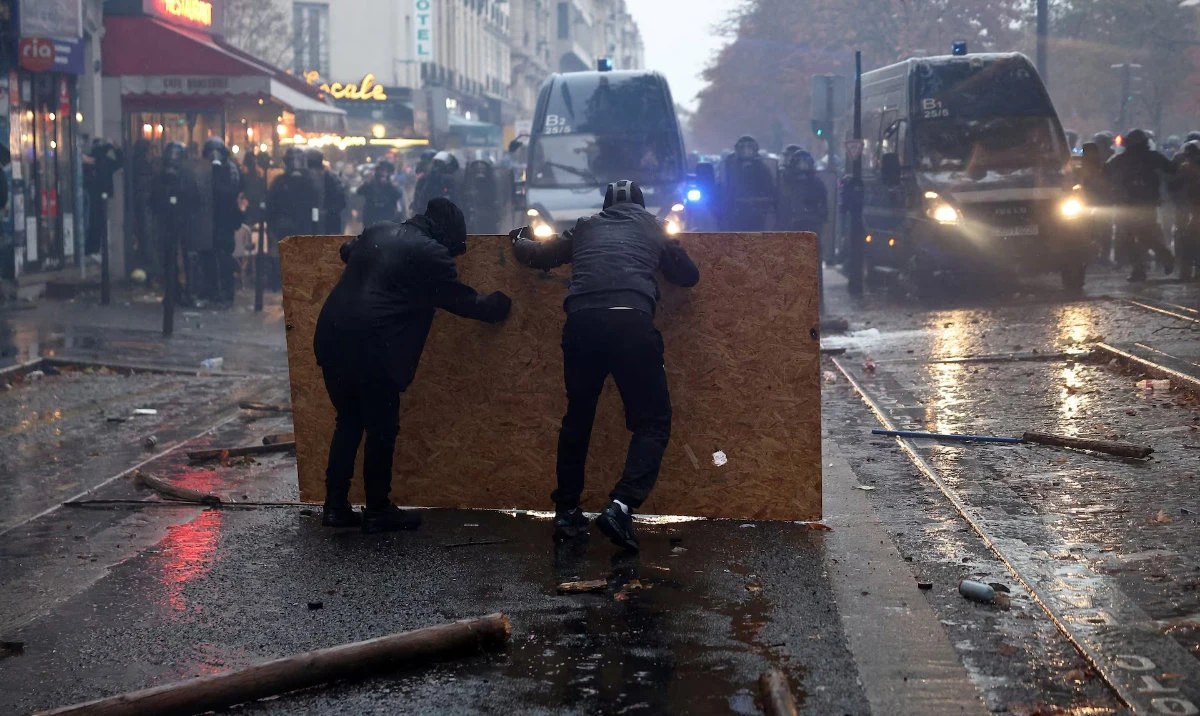
KARACHI, 2 August — As anxiety mounts about prospects of change through October elections, there are fresh intimations of disorder in the Pakistani society. In the wake of a gang rape ordered by a local council and the trade-off of girls as blood money in the rural sector of Punjab, incidents of agitation that led to violence on the part of the police have been reported this past week from Islamabad and Lahore.
Four persons were killed and many injured on the outskirts of Islamabad on Monday when bulldozers arrived to demolish houses in two villages to launch a new housing project. It led to a clash between the villagers and the police. Also on Monday, police used batons in Lahore against male and female teachers protesting the denationalization of educational institutions.
Essentially, the general sense of disquiet and, even, alarm, is rooted in the country’s historical experience. The transition from a military regime to democratic governance is bound to be hazardous, particularly when the military ruler is anxious not only to preside over this transition but also to retain his authority in some form in the new dispensation. And this would demand a strategy to block the success of leaders or parties seen to be antagonistically opposed to the military regime.
For President Gen. Pervez Musharraf, these leaders are the two former prime ministers, Benazir Bhutto and Nawaz Sharif. A number of laws and regulations have been introduced to ostensibly achieve this purpose. But all parties, including the Pakistan People’s Party (PPP) of Benazir Bhutto, are going through the motions of fulfilling the electoral requirements. But the PPP has gone a step further. It has held the mandatory party elections — and has elected Benazir as unopposed chairperson.
Indeed, the plan for Benazir’s dramatic arrival in Pakistan from her self-exile is at present the most exciting subject of political discourse. She is facing a number of corruption cases and has been convicted in absentia in one of them. It is almost taken for granted that she would be arrested on arrival but this in itself, plus her physical presence in Pakistan, could raise a political storm.
As for memories of a transition from military rule to civilian government, there has been a subtle reminder of the fateful elections held by military ruler Gen. Yahya Khan in 1970 and their cataclysmic consequences. The irony here is that the 1970 elections were universally accepted as fair and transparent, almost a unique experience in Pakistan. But the passions that these elections generated finally led to a bloody civil war and the loss of East Pakistan with the creation of Bangladesh. There was an international outrage on Pakistan Army’s suppression of the Bengali resistance.
During his official visit to Bangladesh, President Musharraf on Monday expressed regrets over “the excesses committed” during the 1971 civil war and referred to the traumatic events as “unfortunate”. He also told the citizens of the former East Pakistan that “your brothers and sisters in Pakistan share the pains of the events of 1971”. While it is significant that a military leader should express these thoughts, after longstanding demands for an apology from Pakistan by Bangladeshi nationalists, this undoubtedly welcome initiative could awaken unhappy memories and abrasive controversies.
Another example of the exit strategy of a military ruler, that of Gen Zia-ul-Haq in 1985, is also not very inspiring. Gen. Zia had used the dubious device of a referendum to stay as president after the non-party elections but after he sacked a prime minister of his own choice in May 1988, the crisis became irreconcilable and was resolved only with Gen. Zia’s death in a mysterious air crash.
Irrespective of these problems of transition, elections have a nature of releasing unpredictable forces and creating unforeseen situations. The present government has been careful in not yet allowing open political activities and though elections are just over two months away, there are still many uncertainties about the entire process and the final draft of constitutional amendments.
These crucial decisions are expected within the next few days, after President Musharraf’s return from his regional tour.
Many of the challenges that Pakistan is facing, particularly in the economic sphere, have been identified in the World Bank’s Country Assistance Strategy, released on Tuesday. This report is largely based on the Bank’s interaction with the civil society of Pakistan. It takes a very dim view of the law and order situation and the corruption that is rampant in the Police Department.
Incidentally, this report also has a focus on transition, tough of a different kind. It talks about the fundamental transition of Pakistan to a moderate and modern Islamic state with macroeconomic stability. Ideally, the transition to democracy should also ensure the transition to a modern polity. But outgrowth of Pakistan’s alliance with America’s war against international terrorism has so clouded the entire scene that visibility has become very poor.