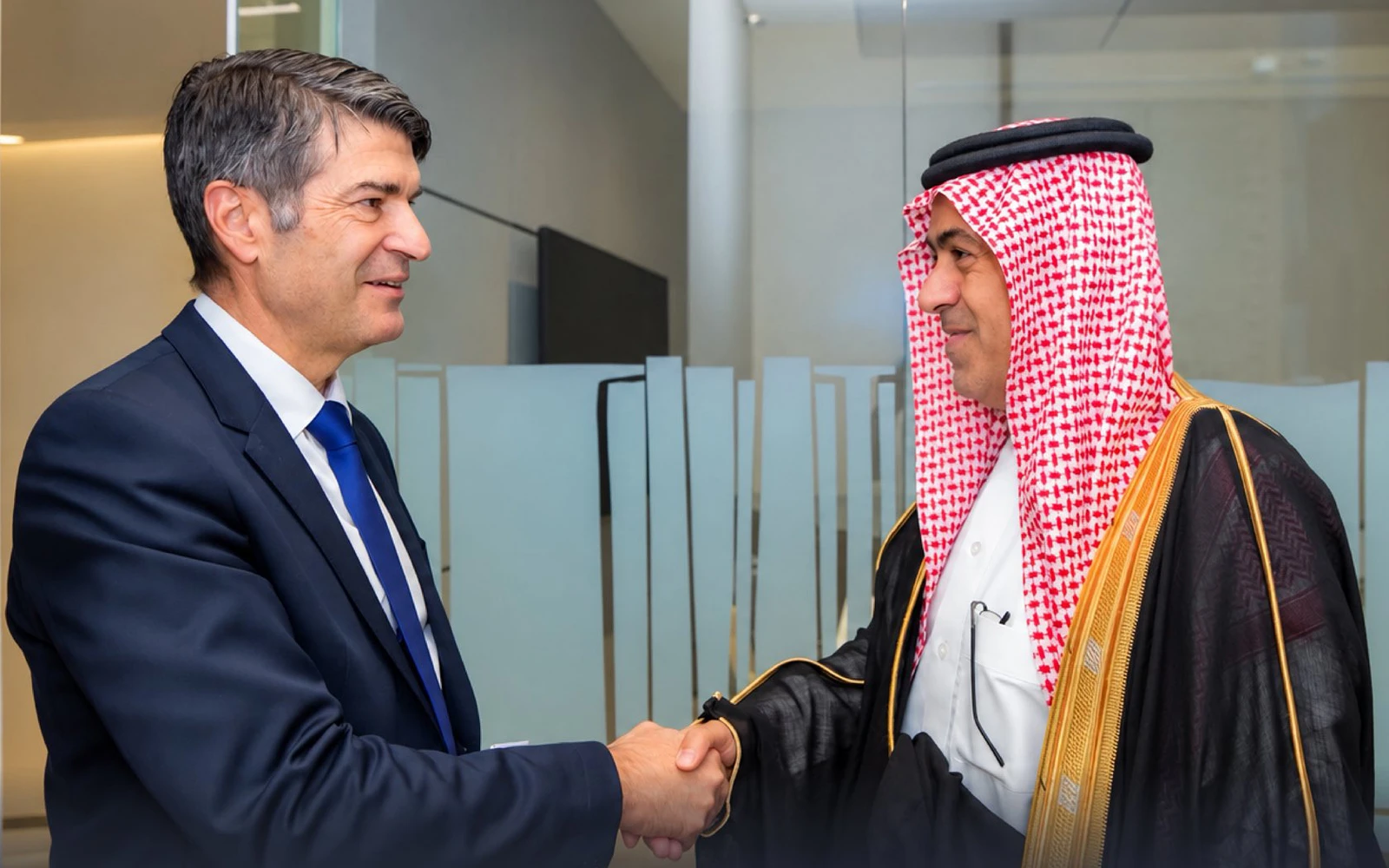
RIYADH, 16 November 2002 — Dr. Mohammed Asaad Tawfiq, president of Saudi Geological Survey Authority, has cautioned the public of possible minor tremors in the Kingdom’s western regions as they are located in the Arabian Plate.
In an interview with Arab News, he said most Saudi buildings lacked standards that could resist tremors.
“The Kingdom is hit by minor jolts occasionally without the knowledge of its residents,” he said.
He said earthquakes registering more than six on the Richter scale had been recorded in some Red Sea areas and the Gulf of Aqaba.
“Saudi Arabia comes under the Arabian Plate region whose border areas are hit by earthquakes as we see in Iran and Turkey and other areas,” he pointed out.
“The western region of the Kingdom, especially the northwestern and southwestern regions, are more prone to tremors,” he explained.
Tawfiq classified the Kingdom among the regions that are threatened by minor and medium earthquakes.
“The regions located on the coast of Red Sea and the Gulf of Aqaba are prone to tremors,” he said, adding that the Kingdom’s interior regions enjoy some kind of stability, except some parts.
He said quake-prone areas are identified by analyzing data, collected with the help of seismic observation centers and geological studies.
The latest earthquake occurred in the Gulf of Aqaba on Nov. 22, 1995 with 7.2 on the Richter, causing destruction in some regional cities and villages. “People in Madinah and Yanbu also felt that quake,” he said.
There are four seismic observation centers in the Kingdom. They belong to SGSA, the King Abdul Aziz City for Science and Technology, King Saud University and King Abdul Aziz University.
“The location of these centers were selected considering seismic activity and geological structure,” he said.
No scientific method is available up till now to know about tremors before they occur, he said. However, he pointed out that concentration of radon gas in the region having seismic activity will increase before the tremor as happened in Aqaba in 1995.
“But more studies are required on this matter as many quakes have taken place without recording any increase in the concentration of radon gas,” he added.
Changes in certain natural phenomena including in magnetic power and behavior of certain animals have been identified as signs of impending tremors.
“An early quake warning system has been developed in some countries like Japan,” he said.
The system aims at providing quick information to the civil defense, health centers, and other authorities on possible earthquakes so that precautionary measures can be taken.
Tawfiq said SGSA planned to establish a network of modern seismic observation centers covering all parts of the Kingdom.
The SGSA chief disclosed that a number of buildings have been partly damaged as a result of tremors that occurred in the Gulf of Aqaba. “History books have also recorded that certain areas have been affected by tremors.”
He emphasized the need for constructing quakeproof buildings. “Most human casualties during tremors are caused by collapse of buildings, bridges and dams and breakout of fires,” he added.
A majority of buildings in the Kingdom are not designed to resist earthquakes, he said. However, he expressed satisfaction over the growing trend to construct quake-resistant buildings and apartments.
Tawfiq said his organization would conduct more studies especially in coastal areas and near strategic projects to detect possible tremors.
He confirmed that the quake belt expands to other places at the rate of several centimeters annually.
“When a tremor occurs one should first pray to God for help, get out of houses and other buildings and stay in open areas, avoid using of elevators, close gas cylinders and switch off electric supply,” he advised.
“If anyone happens to be on bridges or inside tunnels he should rush to get out of them quickly,” Tawfiq said, adding that people trapped inside buildings should stay under strong materials in order to avoid injuries.
The SGSA chief said one of the primary aims of his organization was to identify the areas having seismological activity.
There is good cooperation between the authority and the national seismic information center under the American Geological Survey Department.
“We have also signed memoranda of understanding with similar authorities in Egypt, Yemen, Britain and South Africa and other agencies.
“Our organization has always tried to inform the public on unusual seismic activities, which take place now and then, by publishing reports in local newspapers with the aim of enlightening the public,” he said.
Here are the typical effects of earthquakes in various magnitude ranges: Less than 3.5 on Richter generally not felt, but recorded; 3.5-5.4 often felt, but rarely causes damage.
Less than 6.0 causes slight damage to well-designed buildings and can cause major damage to poorly constructed buildings over small regions.