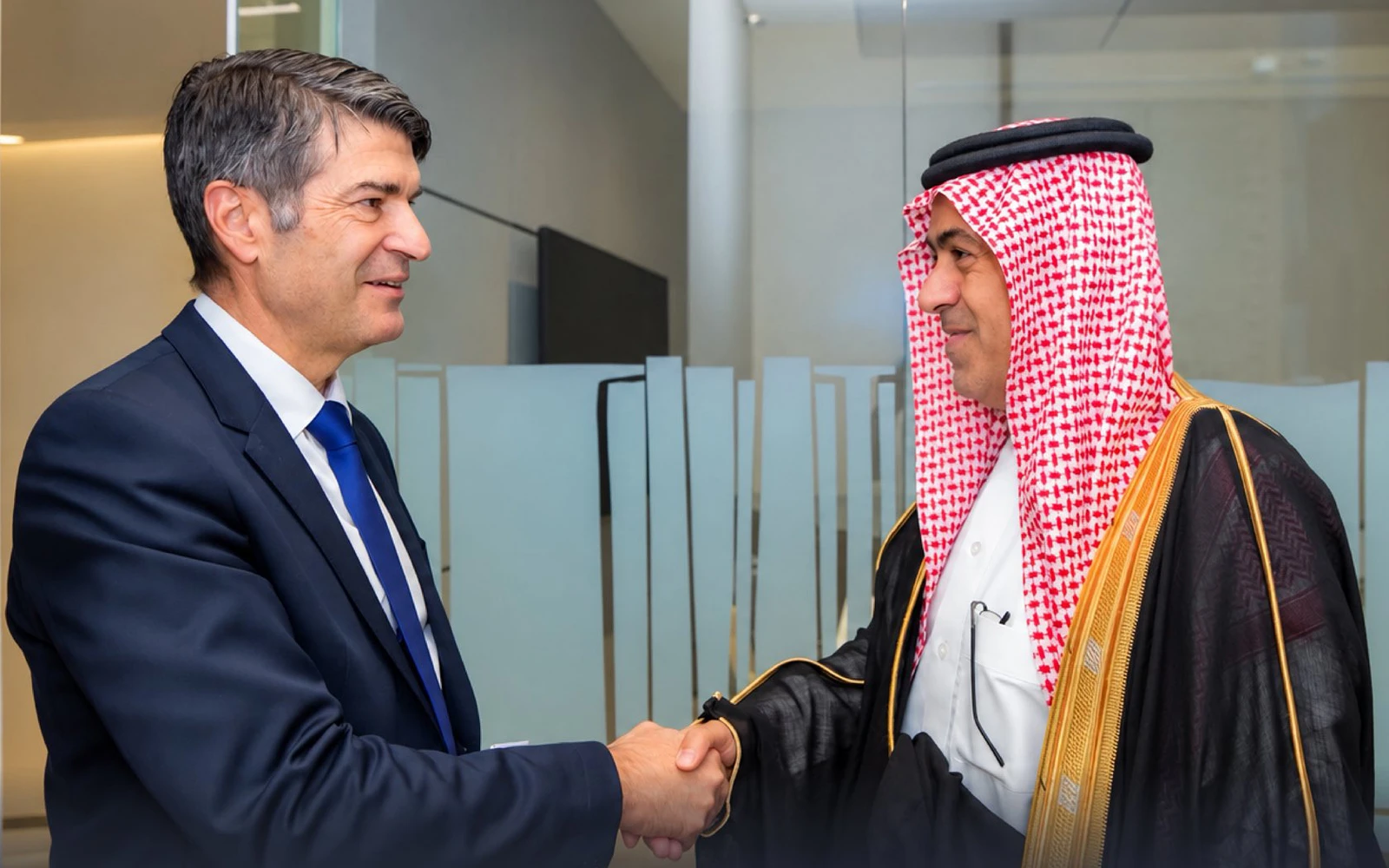
JEDDAH/WASHINGTON, 25 November 2002 — A US official has denied reports that the two Sept. 11 hijackers were allegedly funded by Saudi personalities vindicating the Kingdom’s stand that it had no link with the funding.
A Justice Department official said it was unthinkable that Saudi officials supported a terrorist organization which is inimical to them also.
Adel Al-Jubeir, foreign policy adviser to Crown Prince Abdullah, deputy premier and commander of the National Guard on Saturday denied that the Saudi government had sent money to two of the hijackers in the Sept. 11 attacks and said his country was pursuing Al-Qaeda mercilessly. He said investigations were continuing to determine whether the Saudi money reached the hijackers and how.
US senators, meanwhile, piled pressure yesterday on the Bush administration to pursue investigation into the alleged funding of 9/11 hijackers by Saudi charitable donations.
Al-Jubeir told CNN from Riyadh that Saudi officials had worked closely with the FBI in investigating the funding allegations when they first emerged “seven or eight months ago”.
The US Federal Bureau of Investigation has launched a probe into whether charitable funds from the Kingdom had been funneled to two suspected hijackers who took part in the Sept. 11 attacks.
According to US sources, a congressional inquiry into issues related to last year’s Sept. 11 attacks was investigating a possible money trail from the Saudi government to two of the hijackers, Khalid Al-Mihdhar and Nawaf Al-Hazmi. Asked if the Saudi government had sent money to the hijackers, Al-Jubeir replied: “There is no evidence to that effect whatsoever.”
Newsweek magazine reported that payments of about $3,500 a month reached a Saudi student who knew the hijackers. The student received the money from an account in the name of Princess Haifa Al-Faisal, wife of the Saudi ambassador to Washington. Newsweek said the FBI had found a steady stream of payments to the family of one of the students, Omar Al-Bayoumi, beginning early in 2000. It said Bayoumi had befriended the hijackers in San Diego several months earlier.
Al-Jubeir said an investigation by Princess Haifa’s office had shown that the money appeared to have reached the students via another person, a woman who was on a list of recipients of charitable and other donations regularly made by the princess. He said it was not clear who the woman was or how her name had come to be on the list of recipients. Investigations were continuing, he said.
“Princess Haifa is a very generous woman ... she donates large amounts of money to charities,” Al-Jubeir said.
The Washington Post reported in its Sunday edition that Saudi officials had acknowledged that Princess Haifa gave money to the family of Osama Basnan to help defray medical costs. Bayoumi was a friend of Basnan, the paper said. Basnan is back in the Kingdom after being cleared of visa violation charges. He is receiving medical treatment in Jeddah.
The newspaper cited a Saudi Embassy official as saying that Princess Haifa had provided $15,000 to Basnan in 1998 and followed up with $2,000 monthly checks to Basnan’s wife. The paper said Saudi officials said there was no evidence any of the money made it into the hands of the hijackers and that embassy officials were still poring over bank records to see if any checks sent to the Basnan family were endorsed over to Bayoumi.
Al-Jubeir said Saudi Arabia was working closely with the United States in the broader hunt for members of Osama Bin Laden’s Al-Qaeda group, accused of carrying out the attacks. “I don’t believe that there are any two governments that are cooperating more closely than your government and my government on this matter,” Al-Jubeir said.
Al-Jubeir said the Saudis had thought the money trail issue was closed. “So we find it surprising that now out of the US Congress they repackage this and push it as new evidence, which leads me to believe that the people who are behind this are more interested in scoring political brownie points than they are in arriving at the truth,” he said.