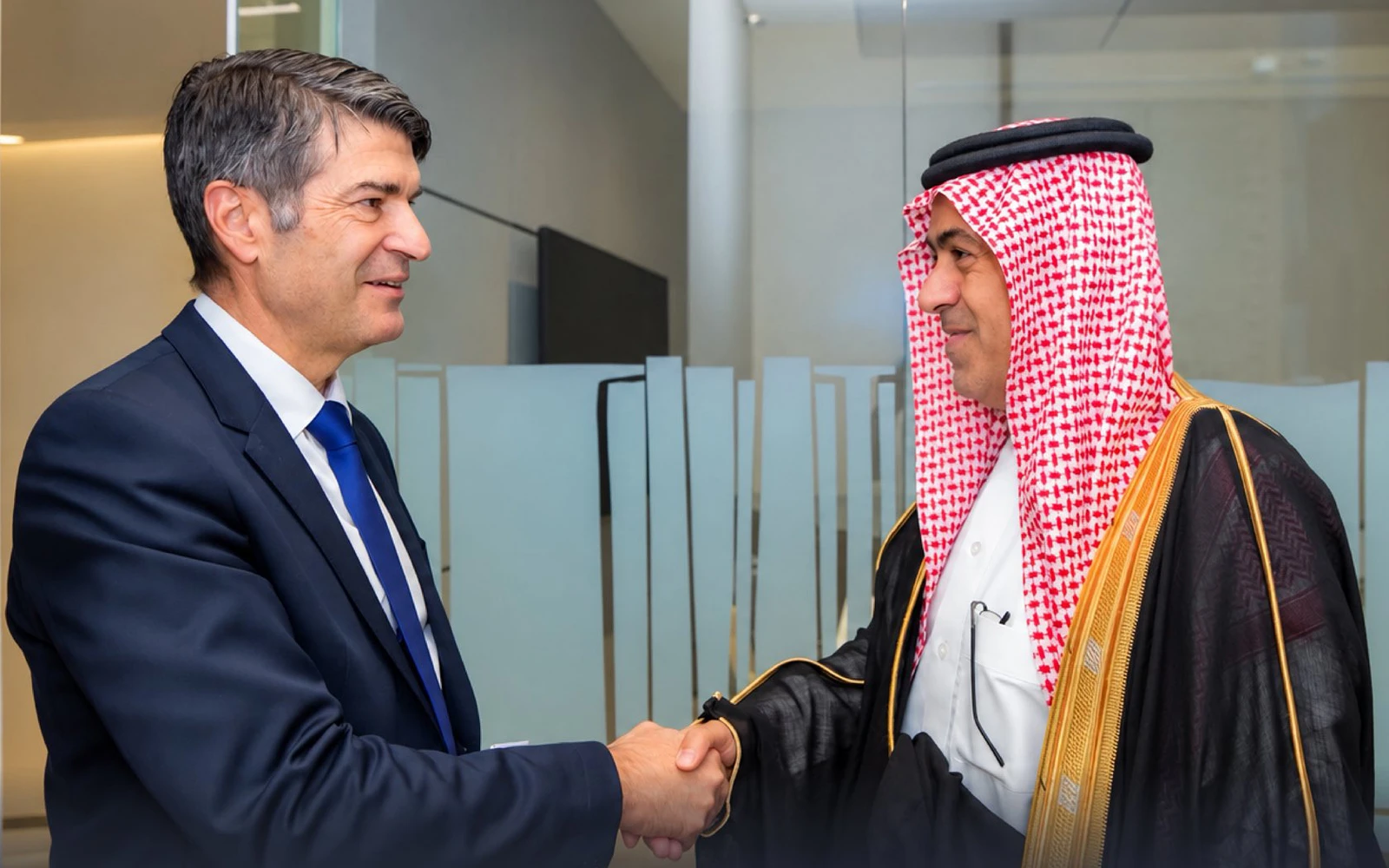
WASHINGTON, 4 December 2002 – Reacting to sharp media attacks against the Kingdom, Saudi spokesman Adel Al-Jubeir took on the Washington press corps yesterday to speak out on Saudi Arabia’s counterterrorism activities and attempt to clear up allegations that it is complacent on terrorism.
He insisted that the Kingdom would be merciless in its handling of terrorists, countering allegations that the country had been uncooperative in a recent terror financing probe. “We will be vigilant. We will be determined. And we will be merciless when it comes to dealing with terrorism and those who perpetrate it,” Al-Jubeir said.
Addressing reporters at the Saudi Embassy yesterday, Al-Jubeir tackled unfair and visceral attacks against the Kingdom, US-Saudi joint efforts against terrorism and President Bush’s stand against critics of Islam.
This is not the first time the embassy took on the unfair attacks against the Kingdom, but yesterday they released a detailed overview on what Saudi Arabia has done to fight terrorism.
“Initiatives and Actions taken by the Kingdom of Saudi Arabia in the Financial Area to Combat Terrorism,” is a nine-page document detailing Saudi Arabia’s fight against global terrorism.
The Kingdom’s efforts to combat terrorism, as described at the news conference and in the official booklet, include: Freezing $5.6 million in assets in 33 accounts held by three individuals; setting up a “high commission” for oversight of all charities and drafting procedures, which are not yet finalized, to manage Saudi charitable contributions and donations to ensure that they do not get diverted to terrorism.
Al-Jubeir said one problem the Saudi government has faced deals with its exchange of anti-terrorism information. The problem, he said, is that the different US government offices are not communicating between themselves.
He suggested the need to create a clearinghouse where all branches of the US government would share, through one center, information given by the Saudis.
Asked if Saudi Arabia would allow the US to use its bases if they attack Iraq, he left the door open by saying if Iraq does not comply with the UN resolutions on arms control, the Saudi government would comply with UN conclusions. “We will support whatever decision the UN makes,” he said.
The Saudi government had interrogated over 2,000 people regarding questionable financial donations and the Al-Qaeda terrorist group; Al-Jubeir added over 100 people had been placed in detention.
The Saudi spokesman used the press conference to repeatedly stress the close relations between the two countries. “I have no doubt that Saudi Arabia and the US have been the two countries that have worked the closest together on terrorism.”
He also blasted some members of the US media for their “feeding frenzy” and “let’s bash the Saudis” attacks. “We have been found guilty without any evidence. When you level a charge, or have a suspicion, it should be backed up with proof,” he said. “The issue of taking action against someone needs to be balanced with equity.”
Asked if some of the problems between the US and Saudi Arabia could be because the Saudi definition of terrorism isn’t the same as America’s, Al-Jubeir shot back that there is a “universal definition of terrorism we all adhere to,” and added the Qur’an states that anyone who takes the life of an innocent soul takes the life of all humanity.
Regarding the issue of child custody, Al-Jubeir said Saudi Arabia had less than 1% of the 1,000 cases registered at the US State Department, and questioned why Congressman (Dan) Burton has focused solely on Saudi Arabia, when majority of the US cases are mainly against European countries, and Canada and Mexico. “Is Chairman Burton serious or this is a publicity stunt?” he asked.
Many Saudis feel Saudi Arabia had been unfairly maligned by the American press regarding the terrorist attacks of 9/11, said Al-Jubeir. “Osama Bin Laden had tried, and almost succeeded, in driving a wedge between the US and Saudi Arabia.”
Al-Jubeir, who has lived in the US for over 20 years, said he had “never seen this side of Americans, which borders on hate. I have never seen such visceral attacks, and the attitude that if it’s Saudi, it must be bad.”
He said he could understand the anger of Americans against those who committed the 9/11 attacks, but not “the deliberate distortions and criticism against Saudi Arabia.”
But he was quick to note that President Bush, and many members of his administration, have “attested to the positive relationship between the two countries.”
Following 9/11, the president had been quick to visit a mosque, and show his solidarity with Muslims, “despite the fact that he was severely criticized” for doing so, noted Al-Jubeir. “President Bush is a God-fearing man, an honorable man, a man with a sense of justice, and has shown compassion and concern to Saudi Arabia,” he said.
The United States yesterday welcomed the Kingdom’s announcement of new steps to crack down on charitable contributions that may be financing terrorists and said senior US and Saudi officials would meet next month to explore further steps.
“We believe that such improved oversight of financial transfers as announced and discussed today by the Saudis is essential to reduce and impede financial support for terrorism originating in Saudi Arabia,” deputy State Department spokesman Philip Reeker said.
“We strongly support a comprehensive monitoring of charitable organizations based in the Kingdom to ensure that well-intentioned donations are used for their intended purpose and not to finance or abet terrorists,” he said.
“The United States is encouraged by Saudi efforts and will continue to provide technical cooperation to Saudi Arabia and other allies in the region as we all work to improve the capabilities in monitoring and countering the financing of terror,” Reeker told reporters. Such cooperation will be a main topic of conversation at a meeting of the “US-Saudi joint working group on terrorism” to be held in Washington in early January, he said.
“We believe that this will further improve and formalize our cooperation in countering terrorism,” Reeker said.