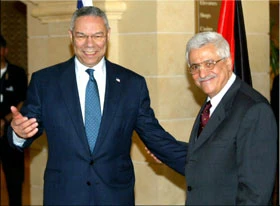
JERICHO, West Bank, 12 May 2003 — Palestinian leaders have put aside reservations to parts of the US-developed plan for peace with Israel and are ready to get started on it, Prime Minister Mahmoud Abbas said yesterday, heeding an appeal by US Secretary of State Colin Powell.
“We have accepted it as it is,” Abbas said. “True, maybe we have some reservations. But in order to give a way for the peace process, we have dropped down all our reservations, and we said that we accept it as it is.”
While other Palestinian leaders accused Israel of hedging in its acceptance, Abbas spoke forcefully about continuing with the plan to gain a Palestinian state within three years on land still partly ruled by Israel.
Abbas also was clear about his goals: “We look forward to stopping, ending, totally ending settlement, ending the siege, ending the separation wall, assassinations, the collective punishments, destruction of farms and the infrastructure and restricting the movement of citizens and Palestinian institutions and to set out to free thousands of Palestinian prisoners.”
For his part, Israeli Prime Minister Ariel Sharon said, after conferring in Jerusalem with Powell, that Israel soon would meet with Palestinians, “and with the help of the Americans, we will be able to achieve a settlement that will lead to peace.”
Sharon repeated his commitment to “painful concessions,” but suggested that a full withdrawal from lands Israel captured in the 1967 Mideast War — something more dovish Israeli governments had discussed — was unlikely. Israel is a “small country” he said.
But Sharon said: “When it comes to security, the security of the citizens of Israel, and the security of the state of Israel, Israel will not be able to make any concessions, and there are no compromises, when it comes to security; not now, and not in the future.”
Powell was asked later yesterday on an Israeli television channel whether a Sharon-Abbas meeting is in the works. “I leave encouraged by my conversations with both of them that this can happen in the near future,” he said.
Nabil Shaath, a longtime top Palestinian official, said on CNN’s “Late Edition” that the two leaders would meet so Abbas could urge Sharon “to start together to implement this road map, each of us implementing his share of these obligations and responsibilities.” “We see no other game in town,” Shaath said. “This is the only way available now for peace.”
Under the peace blueprint, or road map, Palestinians must rein in militants, and Israel must remove illegal Jewish settlements and freeze construction in more established Israeli communities in the West Bank and Gaza Strip.
In the first phase of the plan, Israel must also affirm its commitment to an independent Palestinian state, while the Palestinians must reiterate their support for Israel’s right to exist.
Israel made overtures during Powell’s visit. It said it was releasing dozens of Palestinian prisoners; easing roadblocks that hamper Palestinian travel and work restrictions for those employed in Israel; and expanding Palestinian fishing rights off Gaza.
On the ground, the violence did not stop. Palestinian gunmen killed an Israeli motorist in the West Bank, and Israeli troops raided a Palestinian town.
Summing up his busy day, Powell said he had found “sufficient good will to get started” toward implementing the road map. The plan was developed by the United States, the European Union, the United Nations and Russia in an effort to end 31 months of conflict, commit Israel and the Palestinians to stop the violence, and establish a Palestinian state.
Powell plans to confer today in Jerusalem with Christian Jouret of the European Union, Terje Rowed Larsen of the United Nations and Andred Vdovin of Russia, the US partners in the so-called quartet, on the state of the process and results of his talks.
Powell then goes to Egypt, Saudi Arabia and Jordan to urge Arab leaders to back his diplomacy and to use their influence with the Palestinians to stop attacks on Israel.
Yasser Abed Rabbo, a Palestinian minister, suggested the path ahead would not be smooth, noting that the Israelis are insisting on reopening the road map for a number of revisions. His Cabinet colleague, Shaath, said, “What’s missing is not where the US stands, it’s where Israel stands.”
Abbas’ emergence as the Palestinian leader with whom the United States intends to deal is not universally accepted. European leaders contend that Yasser Arafat, as head of the Palestinian movement, should not be shunned. Abbas made a public demand in Powell’s presence that Israel remove its travel restrictions on the chairman of the Palestinian Authority. Israel currently has Arafat isolated in his Ramallah headquarters, heavily damaged by Israeli Army.
Earlier, in Jerusalem, Powell reaffirmed the US position of shunning Arafat. He said that with Abbas “we see a new dimension” in Palestinian leadership, and “we will do everything we can to enhance his authority to get the job done.”
He said he was “in close touch and contact” with European foreign ministers and “made it clear to them we believe this is the time to invest in new leadership. I hope that with the passage of time, my European colleagues will see the wisdom of acting in that way.”
Also yesterday, Powell said the United States would provide $50 million to Palestinians living in the West Bank and Gaza to create jobs, rebuild the infrastructure and revive their economy. That money is along with the $75 million in US aid this year, and more than $700 million since 1996.