
“The world’s economy is becoming more volatile. Volatility is not bad in itself. It can create opportunities and some companies thrive in volatile times. To thrive in a volatile economy what is needed is the capacity to respond and create, not the ability to predict the future. Companies must create, connect and respond, which in turn leads to more creation. Agile, adaptive, flexible enterprises thrive in volatile times. Right now those businesses that are open to change will thrive.”
So said management consultant Eric Mankin, PhD, president, Innovation and Business Architectures, at the conference of the Bahrain Businesswomen’s Society, which concluded yesterday at the Diplomat Radison SAS Hotel, Manama. Mankin was one of more than two dozen speakers, many from outside Bahrain, giving presentations on the conference theme “The Economy in Light of Present and Future Events.”
The conference was held with the support of Bahraini King Shaikh Hamad ibn Isa Al-Khalifa. The event was presided by Shaikha Sabeeka bint Ibrahim Al-Khalifa, chairwoman of Bahrain’s Supreme Council for Women and the honorary chairperson of the Bahrain Businesswomen’s Society, who spoke in the opening session on Wednesday.
“The establishment of peace today is the most prominent and difficult challenge facing the peoples of the world, yet it is one which holds the key to achieving prosperity in all aspects of life,” she said.
These words were of high impact coming so soon after the violence in Riyadh. Many Saudi businesswomen participated in the conference and they were in total agreement with Shaikha Sabeeka’s comments. Lately, Saudi women have had a stronger presence at conferences held around the region. This in part is due to the increase in their economic activities locally.
“It is very important for us to be at this conference,” said Princess Mashael bint Faisal ibn Turki ibn Abdul Aziz, president, Businesswomen’s Forum of the Eastern Province. “This gives us a chance to meet all the experts who are talking about the economy in the region. We can get firsthand information and learn about movement within the business community. For myself, most of my investments are in the areas of education and women’s services. The information from the conference will give me an idea of the chances of continuing success for past investments and allow me to have advice on where to invest for the future. I also hope that our group can use the information gained from the conference to advise other women on the best investments. I would like to thank Shaikha Sabeeka for inviting our group to the conference, even though we are not officially recognized in Saudi Arabia. I hope to see this kind of event happening in our country.”
Because the event was sponsored by the Bahrain Businesswomen’s Society, it might be assumed that this conference was only for businesswomen and about women in business. Nothing could be further from the truth. Many men were participants and presented papers at the conference, which broadly focused on business and investment. There were critics of such a direction. Some female participants wished that more presentations of relevance to small business owners had been scheduled. Several also mentioned that advice on business development and promotion would have been welcomed. One audience member publicly stated to the organizers that she had heard presentations from “too many businessmen marketing investment in their mega-projects to women.” The clear sentiment at the conference was that local women want to have an active decision-making role in the corporate world and they are demanding that companies make such opportunities available — if those companies hope to have community support.
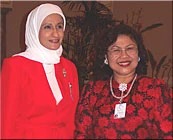
Despite the fact that men outnumbered women as conference presenters, it is certainly fitting that the event’s most dynamic speaker was a woman. Rafidah Aziz, Malaysia’s minister of international trade and industry, gave the conference’s keynote speech. Her outspoken, insightful comments concluded to huge applause. In part, she said:
“It cannot be denied that today, trade issues have become increasingly contaminated by, and interlinked with extraneous and non-trade elements. There continue to be attempts to bring into the WTO processes, rules to govern issues that do not entirely relate to trade as such, and are motivated by considerations which are more political than economic. Developing countries need to fully comprehend the developments... in order not to be marginalized in the negotiating processes, or to be compelled, by default, to accede to agreements, which have provisions detrimental to national interests and national policy directives.
“Today, as we gather at this conference, a ‘new world economic order’ is being shaped by those who now see themselves as the world’s policemen, and the pivot of what they want to create as a unipolar world. This evolution is not the product of global consensus, nor is it the outcome of multilateral dialogue and negotiations. The ‘new economic order’ for the world was spawned out of the aggression on Iraq, where the victors have now begun to lay the terms and ground rules for sharing the legacy of the war... Markets can be opened or closed depending on political affiliations, and military and political might will dictate terms. Countries can either fall into line, and be in favor, or voice dissent, with good reason and be marginalized.”
Strong words from a strong woman, speaking from a position of influence in a strong nation. But Rafidah Aziz was not the only strong woman at the conference. In the audience there were many women who had struggled to succeed.
“I came from a conservative family but I succeeded through persistence and logic,” said Dr. Mona Al-Zayani, chairperson, Gulf University College. “I was the first Bahraini girl to go to a co-ed university. When my father saw my excellent marks on graduation from high school, he agreed to my request. The University of Baghdad was the most conservative co-ed university he could find, but fortunately it allowed me the challenge I needed. Now, look how far I’ve come.
“Women can play very important roles in society if given a chance and now the chances are available. Women are proving themselves and the success stories are trickling in. I am very optimistic about the future. Think of how our mothers were, and how we were just a few years back. Now things are moving at a fast pace. For women to move forward requires part ability and part challenge. Our women are capable and they want to prove themselves to the whole world — not just to men in this part of the world.”
Arab News Features 16 May 2003