CASABLANCA, 18 May 2003 — The bingo caller was shouting out numbers and waiters had just served paella at Casablanca’s upscale Casa de Espana social club when the deafening explosions went off.
What followed was horror.
“People were severely wounded, crawling in the street, completely burned and disfigured,” said Sabah Mazouzi, a 33-year-old Moroccan teacher who was in the club at the time but unscathed. “I saw one person missing his jaw,” she said.
Just days after US officials warned of worldwide Al-Qaeda terror attacks, a string of four nearly simultaneous suicide bombing assaults in the economic capital of Morocco killed 41 people — a quarter of them terrorists, officials said. Seven foreigners, all Europeans, were reported to be among those who perished.
An investigation showed that all four attacks involved suicide bombings and that car bombs had not been used, according to a government official who spoke on condition of anonymity. Government officials had earlier reported that at least three of the attacks were caused by car bombs.
Three suspects, all Moroccans, were apprehended Friday night. Police yesterday arrested 27 Islamists in connection with the attacks.
Forty-one people were killed and about 100 were injured in the blasts, the news agency added.
Belgian Foreign Minister Louis Michel said that his country does not believe it was a target and that the consulate was “collateral damage.” Michel said a restaurant across the street from the consulate was the likely real target. The Positano restaurant is owned by a French Jew of Moroccan origin. Moroccan officials had no immediate comment on the theory.
The Moroccan government did not directly implicate Osama Bin Laden’s Al-Qaeda network in the nearly simultaneous explosions, but the attack confirmed fears that terrorists have plans to strike lightly defended sites.
The attacks, just after 9 p.m. local time Friday, threw Casablanca, Morocco’s economic center, into chaos. “It’s a catastrophe, a tragedy,” said Raphael Bermudez, president of a social club that was attacked.
“The doorman, poor thing, they cut his head off, like this, with a big knife...then they left one, two bombs,” Bermudez told Spanish radio. “Tables turned upside down, everybody was bleeding, some were on the ground, others without their heads, without arms, it was horrible,” said Bermudez, 58.
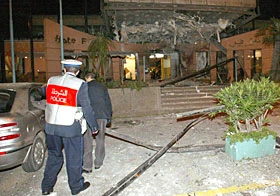
In the minutes after the blasts, police and rescue workers rushed to the sites to care for dazed, blood-splattered survivors. The dismembered bodies of victims were scattered on the wreckage-strewn streets.
The charred husks of burnt-out vehicles were at the four sites near consulates and restaurants in the center of the city. At the hotel targeted by the blast, guests hastily left an elevator and walked over broken glass to get out, as police moved in to secure the area.
Spanish National Radio reported that 15 people had died in the attack on the Spanish restaurant, making it the bloodiest of the five assaults.
“They were terrorists, suicide bombers,” Mostapha Sahel, the interior minister, told reporters. “These are the well-known signatures of international terrorists.”
Sahel did not name Al-Qaeda, but cities across the globe had been bracing for the possibility of attacks by the group.
Sahel said that his country would not be intimidated. “The Kingdom of Morocco will never surrender to terrorists and will not allow anyone to disturb its security,” he told reporters.
Foreign leaders expressed outrage. Custodian of the Two Holy Mosques King Fahd denounced the attacks and expressed his condolences.
A spokesman for the Russian Foreign Ministry said the attacks showed the world should consolidate its anti-terrorism efforts.
“Such events can only reinforce our common determination to battle without pause against international terrorism,” French President Jacques Chirac said in a statement.
The blasts came just four days after a series of suicide bombings in Riyadh, killed 34 people at three foreigners’ housing compounds. Morocco has been a staunch US ally, but expressed regret that a peaceful solution could not be found in the Iraq crisis. The Moroccan public turned out in large numbers for anti-war protests against the Iraq war, including one in the capital, Rabat, in March that drew 200,000 people.
The blasts came hours after US President George W. Bush warned of “killers on the loose”. “It is certainly a wake-up call to many that the war on terror continues,” Bush told reporters.
A Bush administration official said it would help Moroccan authorities find those responsible for the bombings. The official would not say how Washington would help in the investigation. An FBI spokesman said: “The FBI is prepared to provide support and assistance if requested by Moroccan authorities.” Because no American citizen is killed or injured, the FBI would not have jurisdiction to investigate and would have to be asked in by the Moroccan government.