
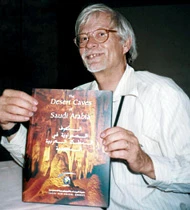
“After living in France for a year, during which time it rained almost continuously, my wife and I were looking for a nice dry place. So in 1981, I took up an assignment at King Fahd University of Petroleum and Minerals in Dhahran. We left all our caving equipment behind in France because we thought there was nothing but sand in Saudi Arabia. We were so wrong,” said John J. Pint, Cave Exploration Unit, Saudi Geological Survey.
For more than two decades John Pint and his wife, Susy, have dedicated themselves to the exploration and protection of the Kingdom’s caves. These Saudi geological treasures have been largely undiscovered. The Pints have worked hard not only to document their journeys underground, but also to attract other scientists to come and investigate the wonders the caves have to offer.
After years of working as an English teacher and exploring caves as a hobby, Pint finally landed his dream job when the Saudi Geological Survey (SGS) convinced him to teach cave exploration techniques to Saudi geologists.
“About the end of 1999, the team at SGS found my website, saudicaves.com,” said Pint. “They were surprised by what they saw there and telephoned me to ask, ‘How do you know about Saudi caves and we don’t? We’re SGS. We’re supposed to know everything about geology in the Kingdom!’ I was happy to share my findings with them. Soon I was on the way to Jeddah to earn my living doing something I love.”
Shortly after starting work at SGS, Pint was asked if he could write a book documenting the cave exploration that has taken place in the Kingdom over the past 20 years. He agreed and the resulting effort, “The Desert Caves of Saudi Arabia,” produced under the auspices of SGS and published by Stacey International, has just become available across the Kingdom. The book contains about 150 photographs and its short explanatory paragraphs have been produced in Arabic and English to accommodate as many interested readers as possible. The caves are presented in the order they were discovered by the Pints.
“Most of the caves featured in this book are in the Summan Plateau, 300 km north of Riyadh. The caves are all around the small town of Maaqala, which is more or less at the center of a large limestone bed,” explained Pint. “When I set out to do the book I found that I had an enormous amount of material. So perhaps there will be books two and three in the future. Now in Jeddah we are working to map the caves located in lava fields. These underground lava tubes were formed 1-2 million years ago. Many have never been seen by humans.”
The Kingdom’s 89,000 sq. km. of lava fields are located in the Western Province and may provide extraordinary insight into life on the Arabian Peninsula. The lava fields are made of both “aa lava” or chunks of basalt and “pahoehoe lava” or smooth lava. The lava tubes are located in the pahoehoe lava. When Pint and his team entered a lava tube for the first time, they discovered strange formations rising up from the floor of the underground passage. These “guanomites” turned out to be collected excrement from rock doves. Over centuries the birds consistently made their nests in the same niches in the cave walls and their droppings fell and adhered to the same areas below, rising with time.
“Over millions of years sediment has collected layer by layer on the floor of the lava tubes. While this sediment is of no interest to geologists, it is of considerable importance to those scientists who study pollen, seeds and artifacts. I am actively looking for professionals to participate in research focused on the sediment layers of these caves,” commented Pint. “For example, in one lava tube we recently discovered a skull surrounded by petrified hyena droppings. Further studies showed the skull to belong to a female of indeterminate age. As the top of the skull was sliced off, we are certain that she was murdered, but we don’t know why. Was her death part of an ancient ritual or a prehistoric crime? Without inquiry from other scientists, we’ll probably never know.”
The longest lava tube that Pint’s team has mapped so far is a little over 500 meters. They are investigating another area that might have a tube 25 km long. The SGS team also plans to do research in northern Saudi Arabia, near the border with Iraq, which is thought to host a network of limestone caves.
Pint’s work with Saudi geologists is an important example of technology transfer and development. He learned the essentials of cave exploration through trial and error, including a fair share of close calls and near catastrophes. For improved safety, before going out to the field, the SGS team practiced basic cave exploration techniques in a converted squash court fitted out with ropes and ladders. They also continue to test new equipment on the squash court before using it in the caves.
“But nothing is close to the real experience of crawling down a tiny hole or slithering through a tight passage underground,” said Pint. “To develop ideal skills, cave exploration requires hands-on practice under supervised guidance. There is no other substitute. It has concerned me that over the years as experienced expatriate cavers have left the Kingdom, their skills have been lost. I would like to see a caving club started for those outside SGS who are interested in cave exploration. In that manner cave exploration could be pursued in a safe, organized manner in the Kingdom. Learned techniques would be passed on over the years as club members came and went, and discoveries would be logged for future reference.”
Pint is concerned that adventurers do not go off at random to explore local caves. The photographs in “The Desert Caves of Saudi Arabia” make these natural wonders appear magnificent and inviting. Beautiful the caves are, but Pint cautions that a trip into the Earth could be a final journey for the inexperienced. Those with a yen to try caving should contact Pint through saudicaves.com for advice and contacts.
Arab News Features 11 July 2003