BAGHDAD, 19 July 2003 — One US soldier was killed in Iraq yesterday as a leading Shiite cleric poured scorn on the fledgling US-imposed governing council and occupying forces marked 100 days since they entered Baghdad to declare Saddam Hussein’s rule over.
The soldier was killed when his armored vehicle was struck by an improvised explosive in the restive town of Fallujah, west of Baghdad, the scene of regular clashes in recent weeks and a pro-Saddam rally Thursday. Residents were seen at the site of the attack chanting anti-US slogans.
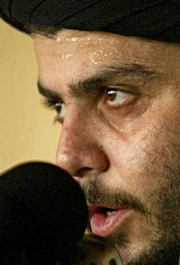
The latest fatality pushed the number of US combat deaths in the Iraq conflict above those from the 1991 Gulf War — 148 compared to 147 — amid mounting concern at home over troops getting embroiled in a guerrilla-style war that has shown no sign of abating. Efforts to restore order and get rebuilding work under way faced a further challenge with leading Shiite cleric Moqtada Sadr delivering a fiery broadside to the US-led occupation, blasting the US-imposed executive as illegitimate.
“They have delivered this peaceful Muslim country to the foreign forces,” he said in his first Friday sermon since the coalition unveiled Iraq’s new executive governing council last weekend. The outspoken attack comes as a disturbing turn for the United States, which has counted on Iraq’s Shiite majority — long repressed under Saddam — to support its efforts to wipe out regime loyalists and rebuild Iraq.
Sadr, a fierce opponent of Saddam’s regime who had his father assassinated, is known for his confrontational style and is seen by some as a threat to US ambitions to impose a Western-style democracy in Iraq.
Thousands of Sunnis meanwhile protested in Baghdad against the governing council as Sunni imams used their weekly sermons to accuse the Shiite-dominated body of planting the seeds of civil strife.
With elections still at least one year off, Iraqis have been increasingly clamoring for the democracy promised to them since US tanks rumbled into central Baghdad 100 days ago.
The United States is open to proposals to give the United Nations a bigger role in Iraq, especially if they encourage other governments to contribute more to peacekeeping and reconstruction, a spokesman said yesterday.
“We’re open to this prospect. We’re indeed talking about it with other people, but at this point I can’t draw to a conclusion,” State Department spokesman Richard Boucher said.
India and Russia have both suggested they might consider contributing troops to help US forces in Iraq if the United Nations adjusts the current system, which gives the United States and Britain the dominant role in postwar Iraq. The United States insisted on that system after overthrowing the government of President Saddam Hussein but it is facing a high cost in cash and casualties as it tries to control the country.
US Secretary of State Colin Powell said on Wednesday he had discussed the idea of a new UN mandate with UN Secretary-General Kofi Annan and visiting foreign ministers but the initiative was not coming from the US side.
Washington maintains that the existing arrangements, enshrined in Security Council Resolution 1483, should be enough to persuade other countries to help there.
It also appears to have doubts about whether a new mandate really would encourage others to participate.
— Additional input from Agencies