JEDDAH, 3 August 2003 — The question of whether Saudi women should be allowed to drive has generated a heated debate. One of the main arguments given against allowing women to drive is that they themselves do not in fact want to, mainly because they do not feel protected from personal harassment. Another put forward is that, in the eventuality of an accident there would be no female police officers to attend. The latter is easily fixed; employ some. The former however is a more intractable problem with its cause deep in the social system.
A depressingly frequent spectacle on Jeddah’s fashionable Tahlia Street is women, covered in their abayas and seated respectably in the back of a car, being trailed or even chased by a dozen or more young, and frequently not-so-young, men in their cars.
Recently, a small station wagon carrying three college-aged women and their driver was recently tailed on Tahlia Street for over one kilometer by no less than 15 cars. This armada did not stop for any of the red traffic lights and went unchallenged by three police officers posted along the route. The procession went on for a few minutes at a snail’s pace, blocking the flow of traffic, before the station wagon was forced off the road and into a parking lot.
There, two young men emerged from their late-model Mercedes and attempted to open the rear doors of the car carrying the women. The women lowered their windows and screamed for help from a security guard. As he alerted the police, some of the drivers left, while others parked their cars and followed the women in to a mall.
Quite apart of the damming social comment made on Saudi males by a gaggle of testosterone-fuelled men trailing women like a herd of hopeful Tomcats, the threat and intimidation to the targets of their attentions must have been nerve-wracking to say the least. Is the Saudi male so frustrated that he takes to this? The frequency and volume of anecdotal evidence and the number of incidents we witnessed in one evening lends support to the answer “yes.” The potential threat seen from the women’s’ perspective seems to justify any claim to not wanting to drive from a perceived lack of security.
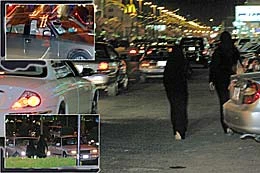
An Arab News investigation has revealed that this problem is not only linked to women driving, but to all women who go out in public — even walking — in Saudi Arabia in general. Two Arab News interns, Fatima Balgheet and Fatima Aqeel, went undercover as decoys for a drive along Tahlia Street. Behind the interns, in another car, was Arab News staffer Roger Harrison, equipped with a camera and telephoto lens.
In the first 20 minutes, three men attempted to exchange phone numbers with the women, but since they were ignored they soon gave up. The interns commented that the majority of male drivers, if ignored, usually gave up their pestering. However, some women encouraged the boys, they added, and that is what at times leads to situations that quickly get out of control.
After being driven around for another 15 minutes, Fatima Aqeel said: “What is happening now with these cars is nothing. You should see what happens when we walk.”
The row of shops along the northern side of Tahlia Street west of Madinah Road was chosen as the area where the interns should walk as if they were going about their shopping. This area has police officers stationed every few hundred meters on foot as well as policemen roaming the area in patrol cars and on horses.
This large police presence did little to deter the onslaught of hopeful males, which began within seconds of the interns exiting the car. As the interns made their way west along the row of shops they were followed by nine cars. One man in a maroon Grand Marquis followed them for half-an-hour. He became increasingly aggressive in his speech and his driving, coming within centimeters of bumping into the interns several times.
So persistent was he that, even though he saw both photographer and camera, he still insisted on pressing his suit.
Part of the experiment was to see whether the police are aware of this problem, and what they do about it when it happens right under the noses.
The answer is that they did precisely nothing. Indeed, the only action they took was to question this journalist, demanding to know why I was taking pictures of the women. The fact that I was wearing clothing that normally would have been worn by an Asian ex-pat driver and carrying a camera worth the equivalent of five years of his wages didn’t seem to them worth commenting on or checking. Actually walking the ground, another problem manifested itself as a direct contributor to harassment. There are no pavements to walk on. Outside the shops, marble terraces of differing heights form a disconnected crazy paving. Walking on the road next to the shops is impossible — cars are parked tight up against the broken walkways. The only place it is possible to walk unobstructed is in the road itself.
This could be misinterpreted as a provocative action or advertising your ‘availability’ by cruising drivers. In reality, it is placing yourself in the way of an accident as well as unwanted attentions. The simple pleasure of walking in the street ‘window shopping’ is actually is often an impossibility in this 21st century city.
Parked across the street in the eastbound lanes was the maroon Grand Marquis, 45 minutes after the driver, still living in hope, had initially tried to get the attention of the two interns.