
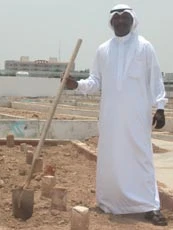
JEDDAH — For Hassan Ibrahim Al-Kiyadi, life is dedicated to dealing with the dead. Once a Saudi naval officer, he now digs graves, and washes corpses. “Caring for the dead is my life, and I won’t give it up for anything,” he told Arab News in an exclusive interview.
When Hassan’s father died almost eight years ago, he took it upon himself to wash and bury his father according to Islamic teachings. “The experience changed my life. I quit the Navy, went home to my wife and kids and told them I was going to become a gravedigger,” he told Arab News.
His wife and children supported his decision immediately, and off he went to Prince Miteb Mosque in the Al-Nuzlah district, where he was trained and earned his certification. He applied to the Jeddah Municipality, or Baladiyah, and was hired on a significantly lower pay scale than that offered by the Navy. “When someone chooses to do this work, it is not for the pay, or for any social status or special benefits. It is simply for the reward Allah gives those that do it. Most of my friends accept what I do and have no problem with it as they are educated, but some avoid me, preferring even not to shake my hand. They treat me as if I have a disease called ‘death’,” he said.
Hassan took the decision to work with the dead on his own. However, Khalid Ahmed Al-Yanbuawi, once a supervisor with a desk job at the Baladiyah building and at the fruit market, was called in to his boss’ office and told he was going to be assigned to the Faisaliyah Cemetery. “I didn’t have a choice, and working with the dead was the last thing on my mind. But I have been here two months. My boss at the Baladiyah saw this as a promotion and assigned me here. I have helped Hassan wash and bury some people, but I’m still waiting for the training and certification course. In the meantime, I do it as a hobby.”
“Now that I am here, I feel that this is the best job for me. It pays the same and there is also the reward from Allah,” he added.
Hassan has worked at various cemeteries in Jeddah, but is now assigned to the Faisaliyah Cemetery where he comes in for 10 hours daily and is on call 24 hours a day. On one occasion he left his family in the hospital to attend to a burial. Over the past seven years he has washed and buried over 2,000 people.
“At first, I couldn’t sleep because I kept seeing all the images of the bodies damaged in accidents in my mind, but after a while I became used to it. I still do have a little bit of a hard time with seeing dead children. It helps me sometimes to remind myself that this is Allah’s will.”
Hassan explained, that, according to Islamic law, if a body is cut into pieces, burned, drowned or in bad condition, because of decomposition due to the body’s late discovery, the body is not washed, but simply wrapped in cloth and buried. “After three days, the human body begins to bloat. The municipality has a long-standing directive that bloated bodies are to be brought here to Faisaliyah. It is sad when these come in, because they are usually loners, with no friends or family to care for them,” Hassan said with a lowered voice.
“Islam teaches us to treat the dead with the same dignity and respect as the living. When washing I cover the person’s privates and scrub the body gently, making sure the water temperature is the same as it is when I bathe myself or my children. I choose never to wear gloves when performing this duty. If Allah wills for me to become diseased because of my contact with the dead, then so be it. If He wants me to catch something, then there is no measure I can take to prevent it. I don’t want to give the impression that I am fatalistic, but I do not fear death,” he said.
Hassan comes to the cemetery around seven o’clock in the morning and stays until five. “On average, we do at least five burials a day, but I’ve had days with as little as three, or as many as 13. Thursdays and Fridays are usually the busiest days.”
“Most of the time the bodies are already washed and wrapped when they are brought to us. When they come in, we take them to the mosque across the street and the congregation prays for them when they are next gathered to pray. Immediately after the prayer service is finished, the body is transported back to the cemetery and carried by the relatives and friends and anyone else that wants to help to the grave. There, one of the relatives or one of the cemetery workers step into the grave and help carry the body in. The shroud covering the face is removed to allow decomposition to begin. Then cement slabs are placed over the grave’s opening and those are covered by dirt. That is it. “Someone could die in the afternoon, and be buried by the evening. The death certificate and burial permit are obtained immediately at the hospital. It really is a quick process,” he said. “We always follow the directives from the municipality regarding environmental concerns when we bury. We have two kinds of graves for two kinds of burial methods,” he continued.
One method is called ‘lahd’. In the ‘lahd’ method, the body is lowered into a grave and covered with cement and dirt. The grave is never again opened or used for anyone else and the body stays there for eternity. Most families prefer this method of burial for their loved ones as they are never disturbed. However, others prefer the ‘shaq’ method of burial. In the ‘shaq’ method, the body is lowered into the grave and placed on top of the dirt two meters below ground level. Again, cement and dirt are used to cover the grave. However the difference between ‘lahd’ and ‘shaq’ is that with ‘shaq’, the grave is opened every 18 months to see if the body has been reduced to bone. If that is the case, the bones are gathered together in a small pile and buried under the dirt they were lying on. Then the grave is used to bury another body.
“Thin people usually take one and a half years to decompose, but fatter people take sometimes three years. But sooner or later, everyone decomposes, putting to bed the legend that truly devout people do not decompose. In death, according to Islam, we are all equals. We bury royalty and VIPs in the same method and graves as we bury everyone else. There are different sections in the cemetery for different-sized people, and separations between the sections holding men, women and children. We even have an area for body parts separated from still-living humans.”
Over the years, Hassan has seen and dealt with on a daily basis with situations that most people hope never to go through in a lifetime. “Death is never an easy thing. People handle it in different ways. I remember a son who entered his mother’s grave to help place her in it refusing to get back out. He was hugging her and crying, refusing to let go of the body. After speaking to the son for several hours, I talked him into letting go and climbing back out. She was the only family he had,” he told Arab News.
Despite his “eerie” occupation, Hassan is a cheerful, outgoing person. He loves to smile and laugh. He enjoys drinking Powerhouse energy drinks and tea. He told Arab News: “This place is not spooky. In all my years here, I have never seen ghosts or heard disembodied voices. All the stories about cemeteries have so far proven to be nothing but lies or products of the overactive imagination of very bored people. I don’t have any stories of anyone coming back to life on the washing table, or any such nonsense.”
- Arab News Features 21 August 2003