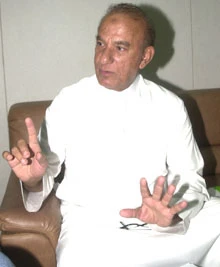
JEDDAH, 12 September 2003 — When retired Capt. Mohammed Saeed Bukhari was given a US visa in Jeddah on July 10, 2002 and subsequently visited the US in August and October 2002, he had no idea that the Philippine Bureau of Immigration had already put him on a blacklist and watch list for allegedly supporting Islamic extremists.
Ironically, he was placed on the blacklist at the request of the US Embassy in Manila, which claimed it had received an anonymous letter accusing Bukhari of talking about wanting to attack US interests in the Philippines. The US Embassy asked the Philippine government to detain and investigate Bukhari the next time he attempted to enter the Philippines.
And travel to the Philippines Bukhari certainly would. As a pilot for Saudi Arabian Airlines, Bukhari first started visiting the Philippines in 1980, flying Tristars and then Boeing 747s to Manila. After retiring from Saudia in 1997, he kept visiting the Philippines as a businessman, setting up a factory for wooden doors in Marikina City and exporting his products to Saudi Arabia.
Bukhari now thinks that his problems with Philippine immigration officials stem from a business deal gone sour. In an interview with Arab News, Bukhari explained he had arranged to buy some doors from another supplier. The deal was made with two Filipinos and an Indian national, with Bukhari paying them a 20 percent advance for his order. The doors were never delivered and his deposit never returned. Unable to recoup his money, Bukhari was forced to sue the three for breach of contract and fraud.
Being Arab, Saudi, Muslim and a commercial pilot was enough, Bukhari believes, for anyone bent on harassing him to accuse him of being a terrorist and supporter of Islamic extremism. Bukhari is convinced that it was one of the three former business partners that sent the written allegations against him to the US Embassy in Manila.
But Bukhari knew none of this when he arrived in Manila on Jan. 8, 2003, and was informed by an immigration officer at Ninoy Aquino International Airport that his name was on their blacklist and watch list. But instead of putting him back on a plane to Jeddah, immigration officers surprisingly let him into the country, telling him to visit the Bureau of Immigration headquarters in Intramuros.
After several visits to the BI, Bukhari found out that he was being accused of supporting Islamic extremists. Who his accuser was and what evidence the Philippine government had against him, if any, he didn’t know. So on Jan. 14 he wrote a letter to Immigration Commissioner Andrea Domingo requesting that his name be lifted from the blacklist and watch list. Another letter, this time from his attorney, Renato V. Peralta, was also sent to Domingo on Jan. 16.
More than a month went by, and Bukhari’s name was still on both lists. He visited the BI headquarters in Intramuros so often that many of the staff now recognized him and would say, “Here comes the Arabiano!”
A visit to the Saudi Embassy in Manila proved initially fruitless, with Saudi diplomats there recommending that Bukhari fight on his own to get his name cleared, without help from the embassy. He accepted the advice, asking only that the embassy’s lawyer give him moral support by appearing in court with him in future if necessary.
On Feb. 18, Peralta wrote another letter to Domingo demanding a reply. He also filed a petition for a “declaratory judgment on the validity of the inclusion of petitioner’s name in the blacklist and watch list, with application for the issuance of writ of preliminary injunction.”
As Bukhari waited for the court to act on his petition, he turned to the Philippine and Saudi press to get his story out. Articles on Bukhari’s plight appeared in the Philippine Star, Today, Arab News, Okaz and Al-Watan.
On July 1, Immigration Commissioner Domingo issued an order for Bukhari’s name to be removed from the watch list at the recommendation of Bukhari’s lawyer Peralta.
Alerted to Bukhari’s plight, the Saudi consul general in Manila, Khaled Karakutly, met with Bukhari and assured him that the Saudi government would help him. After talks with the Department of Foreign Affairs, in which Karakutly vouched for Bukhari’s honesty and integrity, a meeting was arranged on July 3 between the consul, Bukhari and Ambassador Amable R. Aguiluz, President Gloria Macapagal-Arroyo’s special envoy to the Gulf Cooperation Council.
During that meeting, Karakutly asked Aguiluz to help get Bukhari’s name lifted from both lists in the interest of the friendly relations between the Philippines and Saudi Arabia.
On July 18, 2003, Immigration Commissioner Domingo, on the recommendation of Aguiluz, finally issued an order lifting Bukhari’s name from the blacklist.
But Bukhari’s problems were not yet over. Despite Domingo’s order, his name still appeared on both lists on the BI’s main computer in Intramuros. He could do nothing except wait. Finally on Aug. 15 and Aug. 19, his name was taken off the blacklist and watch list respectively. He flew back to Jeddah on Sept. 7, having missed the wedding of one of his daughters, but happy and relieved to be home surrounded by his family.
Bukhari describes himself as a victim of US President George W. Bush’s worldwide campaign against terrorism. It is unclear why the Philippine government so readily included Bukhari’s name on its blacklist and watch list when it had no hard evidence against him.
Despite his ordeal, Bukhari is determined to return to the Philippines: “I plan to go back next month. I have to go back soon as I have a business there and I need to show that I have nothing to hide and have no reason to stay away. I’m not a terrorist and never have been,” he said.