Sakaka is the home of the Abdul Rahman Al-Sudairy Foundation, founded by Prince Abdul Rahman ibn Ahmad Al-Sudairy during his 41-year governorship of Al-Jouf. It took as its simple goal the development of the local community, and manifests itself most visibly in the form of a large public library and research center that is a meeting point for archaeologists and researchers from around the world. Less obviously, the foundation has a network of agricultural, social and educational projects that have modeled the community over the last 60 years.
The foundation started as a simple public library with just 3,000 volumes in 1963, a pioneering step at the time. However, it was greeted with deep suspicion by many local community leaders.
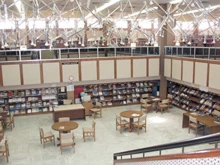
In 1983, the foundation was established by royal decree and an impressive new library and cultural center building was constructed. Challenging accepted mores, the building housed — both then and now — two libraries, each a mirror image of the other. One is for men, the other for women.
“What started as a library has developed into a major cultural center,” said Nabil Shabaka, the library director.
Apart form the library services and a stock of over 105,000 books, it now acts as a center for the cultural activities of the foundation.
“We have a good throughput of readers, averaging 2,000-3,000 each month,” Shabaka adds.
Up to 3,000 new titles are added to the book stock annually. The library currently subscribes to 250 international periodicals, journals and newspapers in English and Arabic.
“Part of the emphasis of the library is on actively providing education, academic and cultural resources for the community,” said Nabil. “We also act as a resource center for academics who visit the area for its archaeology and history, and this has led us to store and display some of the local archaeological finds.”
As encouragement to the local community to engage with their history, many of the works of early Western travelers to the area are being translated. Palgrave, Captain William Shakespeare and Gertrude Bell, among many others, visited the area and wrote studies of the history. Five works have so far been published, and more are on the way.
The founder, Prince Abdul Rahman, spent nearly 50 years following what he felt strongly to be his duty, namely to provide what he could with his resources for the people and the community. No idle public relations exercise, the influence of the foundation manifests itself in the subsidized hotel for visitors and tourists to the area, clinics, stocks of school books for use by local students, and practical skills courses for women.
Complementing a program of public lectures in the 380-capacity lecture theater, the foundation (through the library) publishes MA and PhD theses of postgraduate students who have specialized in aspects of the history of Al-Jouf and the wider Arab world.
In 1990, the foundation began publishing Al-Juba, a semi-annual periodical intended as a forum for discussion of issues of public interest. After 13 issues, the resources were reinvested in a more focused publication, Adumatu (an early name for Dumat Al-Jandal), which covers the vast but little-known field of archaeology in the Arab world with a particular focus on Al-Jouf.
Saudi professors of archaeology head the journal’s board, and the advisory board has a worldwide spread of contributing archeologists.
With the intention of keeping the flow of interested and qualified contributors to the foundation’s increasing knowledge base, it finances outstanding students to study at universities with specialized faculties, relevant to the history of the area.
At least one student a year is financed to the sum of $100,000 to cover a course of study that will eventually contribute to one area of the foundation’s interest.
However, funding students for graduate study is only the result of a broader base laid some years previously. Opening a number of kindergarten schools in the area with great success, the foundation decided to open primary schools for boys and girls. Rapid take-up on places encouraged the building of secondary education facilities and the opening of the Al-Rahmaniyah schools that supply a stream of students for higher education elsewhere in the Kingdom.
A characteristic of the founder’s ingenuity at introducing change is that much was competed for by the community, rather than imposed as charity.
The advent of machine-made products threatened the existence of traditional crafts and rendered ancient agricultural practices redundant and non-competitive.
In 1963, Prince Abdul Rahman organized a camel race and rug exhibition, enlivening a tradition that had died out. He personally funded the prizes for the winners. Simultaneously, he instituted a farmer’s competition, sensing the potential in a relatively water-rich area and hoping to settle the nomadic Bedouin, raising the standard of living for all.
The prizes were both cash and in kind, and the competitions were designed to introduce modern techniques and technology to local farmers. The competition soon became fiercely contested, and companies that serve the farming sector came forward to increase the value of the prizes substantially.
These local competitions, the first of their kind in the Kingdom, developed into the Al-Jouf Week, now an established annual event.
Added to the farming and craft interests, book fairs and symposia have established a presence. Guided tours for visitors introduce a widening audience to the history and rich heritage of the area.
The acceptance of technology and rekindling of a dying craft were the result of a local demand driven by a competitive spirit. It was underpinned by an understanding that, however worthy a cause, for it to succeed the people must want it.
It was the same idea — development by encouragement of competition — that Prince Sultan ibn Abdul Rahman Al-Sudairy (Prince Abdul Rahman’s successor) established a new prize in the name of the founder for exceptional male and female graduates from the schools and institutes in Al-Jouf. The prizes now take the form of grants for study abroad and to female students going to Saudi universities.
During his tenure as governor of the province for 41 years, the foundation, with generous finance from King Fahd, spent $80 million on public works expressly for the local community and the preservation of the rich heritage of the area.
Immediately next to the library stands the Al-Rahmaniyah Mosque, a sharply delineated geometrical building of glistening marble, two slender minarets and copper-colored domes. Completed in 1995, this starkly beautiful building has a subtle link with the traditions of the area.
The roshan-like stone lattice work that relieves the massive rectangular buttresses on the outer wall and adds a delicate decoration to the minarets is actually part of the cooling system of the mosque. Shunning modern air-conditioning, the mosque is the largest building in the world to be cooled by traditional evaporative cooling towers — a respectful nod to the ingenuity of early Arab engineers in adapting to this harsh environment.
In the best traditions of a community headed by a benevolent leader, Al-Jouf has benefited in many visible and invisible ways from a vision coupled with an energy sustained over half a century.
- Arab News Features 18 September 2003