
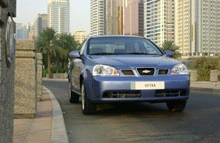
General Motors executives recently stopped just short of saying they would stake their careers on the success of the three new Chevrolet models with which they hope to capture a new segment of the Asian market.
At a lavish press launch in Beirut, the Aveo, Optra and Epica were given a dramatic release into the Middle East market, complete with dry ice, deafening music and a dumb show that suggested the cars represent a stage each in the life of an upwardly mobile professional.
The Aveo, the show suggested, was the ideal vehicle for a fuzzy-haired student of business management. The Optra, when he has graduated, will carry him and his fragrant young wife from their dinner date home to their executive flat, and the Epica will carry the young-ish executive’s nuclear family to school, to the hairdresser’s, to the office.
GM executives rather ruefully admit that they have no hopes of the three new models entering the crowded European market, but their designs for the Asian market are all the greater. For the first time, the three Chevrolets target the lower end of the market, a segment that the manufacturer in better days thought it could leave to the Japanese. No longer.
GM — with all its brands including Cadillac, Saab and Opel — sells more cars than any other manufacturer with eight million vehicles a year. Given how unpopular American cars appear to be outside the US, that figure may seem counterintuitive to many.
The appeal of GM’s models, and American cars in general, has been hampered by two factors: Their reputation for guzzling gas like there’s literally no tomorrow and their — to non-American eyes — atrocious design. Particularly when hoping to make inroads into the uncharted terrain of cheap cars, the first is perhaps the more important for GM to sort out, and sorted it out they have.
The Aveo consumes, in l/100 km, 8.7 MT or 9.6 AT in an urban environment, going down at 90 km per hour to 5.8/6.0. The Optra eats 7.6 MT and 8.1 AT in its 1.6 liter version, and the Epica, in urban driving, needs 11.0 MT and 13.0 AT.
What, then, about the vexed question of design? For decades the hallmark of American cars was the long, low flat boot that looked like something out of a bachelor pad, a waterbed perhaps. Its purpose has never been clear, but it was the very awkwardness of this feature that made American cars instantly recognizable. The Aveo’s four-door version, despite having a dashboard stripped to its bare essentials and in every other way resembling a nippy Japanese city car, retains a little flat behind.
The Optra is so middle-of-the-road all round that despite input from Pinifarina design of Italy nothing really registers on the eye. For the Epica, GM have gone all out and hired Giorgetto Giugaro’s design house of Milan, and Giugaro has built them essentially a slick European car. Only some of the colors — notably a shade known as melange beige — retain a distinctive American awfulness.
Perhaps Chevrolet has been saved by the forces that make all cars look more and more like one another.
The only thing that will sell a car in this market segment is if the price is right. The Epica, for example, is intended “for people who aspire to owning a luxury car” — according to Chevrolet Brand Manager Ahmed Amer — but frankly can’t afford one. Appealing to the social climber in the customer is an ancient marketing principle — in the world of magazines all the readers of Just Seventeen are 15-year-old girls, and so on — and it may just work here, especially in a market as status-conscious and upwardly mobile as the Asian one.
That in any case is what Jim Cnossen, GM’s Middle East marketing director, believes. In a punchy speech accompanied by a PowerPoint presentation with more font sizes than the front page of an Arabic newspaper, he said: “We expect a substantial share of a market where we’ve not had a significant presence before.”
Earlier, GM Managing Director Middle East Paul Johnson said GM’s pipeline was “full of exciting, innovative new cars and trucks.”
After two days of being pampered at a new hotel just outside Beirut and given photo opportunities in front of breathtaking scenery near Byblos complete with pneumatic model in skimpy clothes, the attending journalists were almost ready to believe they could be excited by a truck. Privately, however, one or two admitted that the cars themselves had been “nothing special”. Nor are they supposed to be. They aim to enter a market segment where none of the competition is anything special either, and where being the new kid on the block may well work for rather than against them.
— Arab News Features 25 September 2003