
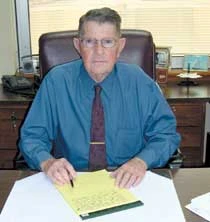
Most expatriates come to the Kingdom on two-year work contracts. Stays of a decade though are common. Then there’s John A. McStay, who’s been out here for 40 years.
“I came to Bahrain in June 1959 and from that time I was constantly in and out of Saudi Arabia,” said John McStay. “In 1964, I moved to Saudi Arabia to work full time. Saudi Arabia then wasn’t what it is now, but it was a challenge and it was fun too. Every day we worked hard and then we worked some more. It was a good life though and I enjoyed it. So I stayed.”
John came to the Kingdom as the Eastern and Central Regional Manager for Zahid Tractor. His work focused on construction and engineering, and the heavy machines essential to civil works. John was not alone in his endeavor. His wife Dawn and their second son, Rod, joined him for the adventure. They would eventually add to their family Jane Ann, born in Bahrain.
John, a Canadian, had met Dawn in England in 1943 where he was stationed with the Seaforth Highlanders, part of the Canadian 1st Division, to fight in World War II. After he survived action in the Mediterranean and Europe, in March 1946, his lovely bride chose to marry him, for better or worse. Coming to the Middle East with young children in the early 1960s was a leap of faith for any woman.
“The basics were available but it wasn’t easy. I have to give my wife and the other ladies so much credit for making this place a home,” said John. “My wife came to a portable surrounded by empty sand and in a year with Rod’s help and a local gardener pitching in they grew a jungle. There were no supermarkets — only the Family Grocery in Alkhobar. When that store got a new shipment it was an event. People came from Riyadh to shop there. For fresh produce we went to the vegetable market. The prices of all the fruits and vegetables were one riyal for one kilo. Sweet water had to be brought from Aramco.”
“But there was a lot of trust and camaraderie back then,” John continued. “If you went to the vegetable market and the stall owner wasn’t there, you bagged what you needed and left the money for him to find later. If you saw something you liked in a shop and you didn’t have the cash in your pocket, you took the item home and paid for it later. The phones were hand crank and unreliable. If a week went by and our Saudi friends hadn’t heard from us, they’d send around a driver to check on us.”
For expatriates, perhaps the greatest difficulty with life in Saudi Arabia was education. As there were no local international schools, Dawn and the children had to take an apartment in Beirut where well-established schools were available. John flew to Beirut as often as possible and the family continued this arrangement until 1976 when serious violence erupted in the city. Dawn was forced to evacuate to Amman with the children.
By this time John was working with Binladen Brothers Co. and was building airports in Al-Jouf and Arar. Word of his family’s evacuation from Beirut was relayed to him by radio from Jeddah. The family then relocated to Nicosia, Cyprus.
In 1982, Dawn returned to her husband’s side. For a while they had a plan to retire and bought a house in Savannah, Georgia, USA. John actually did retire from Binladen in 1985 — for a few weeks. He’d known the Tamimi family since 1964. When they asked if he’d come to complete the Rafha Airport Project he agreed and so started the next chapter in his career. John is now vice president for Tamimi, based in their Dammam head office.
“I know that not everyone enjoys working in Saudi Arabia but I have,” said John. “That is due in large part to the three excellent Saudi families I have worked for during my career. The Zahid family has always had the best dealership in Saudi Arabia and the Middle East. The Binladens are a fine family. I know some people outside Saudi Arabia will raise their eyebrows reading this, but that’s because they don’t know the Binladens. The Binladens built so much of the infrastructure in the Kingdom. They did good work in the past and they continue to do good work. People should remember that. As for the Tamimis, if there was one man who I could say was self-made, it was Ali Tamimi. He built his business with his own hands and his own sweat, a tradition carried on to this day by the Tamimi family. I have been fortunate to have had wonderful years working with such good people.”
John has fond memories of days gone by in the Kingdom. He explained that there was a certain sense of adventure in decades past that is lacking now.
“When I first came here I had to be innovative especially in areas like repair and maintenance. There wasn’t a spare parts shop around the corner back then,” said John with a smile. “Working here was always fun and creative. If it hadn’t have been, no one would have stayed. I must admit though that now I do like looking around and seeing all the wonderful things rising up out of the ground and knowing that I helped to build some of them.”
John has a full life in the Kingdom. Happily, his son Rod and his family live in Alkhobar. Yesterday, John went to watch his grandson play little league baseball, a game that John has supported actively. John chats animatedly about all his grandchildren. He is in regular contact with Jane Ann’s two children in Georgia and his oldest son John’s three children in Nova Scotia.
Spending an hour listening to John reminisce was a joy. By far though, of all his stories, the ones he told of his wife, Dawn, were the most touching.
“To be an expat’s wife, especially married to one in the construction business, a woman had to be strong and tough and full of courage,” John commented quietly. “Dawn put up with a lot. In fact, thinking about it now, I really don’t know why sometimes she put up with what she did. She made us a family. I can’t express enough how grateful I am to her and how lucky I have been to have her by my side.”
— Arab News Features 3 October 2003

