
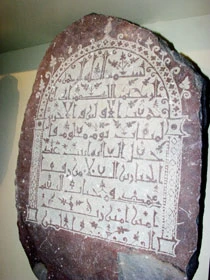
IF you don’t know the history of your history, you won’t have a clear vision of your future,” said Dr. Abdullah Al-Saud, Director of the National Museum in Riyadh. Deeply committed to developing the still young institution — it opened only five years ago — he regards education and an understanding of the weight of history as a vital element in the development of the Saudi state and the young people who will eventually become its adult citizens.
“History is more or less bunk,” was Henry Ford’s opinion in the early 1900’s — the crass remark itself becoming history immediately. Perhaps only a man who was the product of a culture with a history spanning a few centuries rather than scores of millennia could have said that. Tony Blair once observed that those “who seriously believe that we cannot improve on words written in 1918 when we are now in 1995 are not learning from our history but are living it.” Ironically, under his government, history has been made an optional subject in English schools.
A topic often spawning differing opinions, history is the reason the National Museum in Riyadh was built and collections of artifacts representing 100,000 years of continuous human habitation of the Arabian Peninsula assembled. Learning from it is the core function of the museum.
Custodian of the Two Holy Mosques King Fahd officially opened the National Museum in Saudi Arabia in January 1999 — 100 years after his father, King Abdul Aziz, united the Kingdom under the Saudi flag.
The National Museum is the cornerstone of the massive King Abdul Aziz Historical Center (KAHC,) a centennial heritage project. It is the largest museum in the Kingdom, located in the center of the city and spreads over 28,000 square meters on a site of over 360,000 square meters.
The National Museum and the Darat Al-Malik Abdul Aziz — a Memorial and Research Center for King Abdul Aziz — together feature more than 10,000 square meters of new exhibits incorporating early Pre-Islamic history and continues up to and including Saudi Arabia’s role as home to the two holy mosques. The KAHC has been constructed on the site of the Al-Murabba Palace — the administrative center for King Abdul Aziz.
The museum is housed in a striking sandstone building, built on the reassuringly monolithic design expected from a national repository, but retains a spacious and airy interior.
Eight galleries arranged in chronological order present the history, geology, and archaeology of the Kingdom from the earliest period are laid out in a connected walk that engages the visitor’s attention from the start.
The “Man and the Universe” gallery immediately next to the entrance, with samples of meteorites, rocks, minerals, precious stones and fossils, includes a striking complete mastodon skeleton and fossil trees. Stone Age tools and artifacts from Neolithic settlements in Arabia put within touching distance solid evidence of the occupation of the peninsula, which lies on the migration routes of early man out of Africa. The museum houses only a fraction of the archeological treasures in the Kingdom. Many are still in their original sites, for example at Dumat Al-Jandal.
The accessibility of the exhibits is one of the charms of the museum. Many of them are substantial enough to allow children to climb on — adding a new dimension for young minds to build imaginary kingdoms and involve them in their heritage. Unlike most museums, no one here interferes with the sometimes overwhelming desire to touch an exhibit and connect with the stele or pillar from some ancient dwelling that is part of all our histories and only by chance in the custody of the Kingdom.
Leading off the first gallery is “Arabian Kingdoms” where archaeological evidence from civilizations which once flourished in this part of Arabia is displayed. Treasures from the Queen of Thaj, pottery and domestic utensils are displayed and signposted in Arabic and English. A particularly sophisticated lion’s head sculpture, hollow-cast in bronze and found in the Najran region, testifies to the metalwork skills of the inhabitants of the area 2,500 years ago. The third gallery focuses on the “Jahiliya” period — the pre-Islamic period labeled the “age of ignorance.”
The fourth is “The Prophet’s Mission” — a walk-through gallery which highlights the rise and spread of the message of Islam. The main feature is a vast mural depicting the migration of the Prophet Mohammed (peace be upon him) from Makkah to Madinah.
“Islam and Arabia,” which represents Islam and its history as well as the establishment of the Islamic states leads into the next gallery, “First and second Saudi Dynasties,” which shows the establishment of the first Saudi dynasty by Imam Muhammad ibn Saud and the cooperation of Sheikh Mohammed ibn Abdul Wahab to spread the message of unification and later the establishment of the first Saudi rule with its capital at Diriyah. The seventh gallery concerns the “Unification of the Kingdom” from the capture of Riyadh by King Abdul Aziz in 1902 to the unification of the country under the flag of the Kingdom of Saudi Arabia.
“Haj and the Two Holy Mosques,” is the theme of the final gallery and is majestic in scale. For non-Muslims, it is an opportunity to observe in detail examples of craftsmanship and Islamic architecture that they cannot see in Makkah and Madinah. The dominating features are a pair of intricately worked doors and sections of the carved stone arches from the Prophet’s Mosque in Madinah. The gallery traces the development of the Haj from the earliest Islamic era until the present day to the recent extension of the two Holy Mosques in Makkah and Madinah.
Concentrating on the peninsula and its indigenous Arab civilizations, the museum does achieve a wider range of coverage than many visitors expect. “Many of our visitors are surprised at what we have on display here,” said Dr Abdullah Al-Saud, “They have a limited idea of what a museum is, perhaps some clothes or other trinkets. When they see what is actually here, they are surprised.”
He sees the lack of public awareness of the function of a museum as not confined to Saudi Arabia. “There is a general lack of public awareness as to what a museum does. Not just here necessarily, but in many countries, public awareness in general is not that good.”
Schools do visit the museum, but usually for only a very brief tour and as a break from the school routine. Museum visits — even the large sections of the history covered by the museum — are not part of the national curriculum.
“Everybody here should learn Islamic history — the history of his country. We have tried to convince the teachers to come with the children, not to rush, to take their time. The main problem is they come only for an hour or so. The children do not see what we would hope.
“A big part of the museum’s role is education. We have to pay a lot of attention to this.”
Significantly, the visitor profile reflects the reluctance of schools and residents to visit their national museum, whether from lack of public awareness or lack of desire. In the four years since opening only 160,000 visitors have experienced the displays and walked the galleries — that’s about 100 a day. Half of those have been expatriates.
In an attempt to increase public awareness of the institution and its research links with the Ministry of Antiquities, the museum has established links with foreign museums and travel organizations. In five years however, progress has been painfully slow.
Plans, fine buildings and a wealth of fascinating exhibits are part of any national museum and its attempt to acquaint a nation with its history. But visitors are the evidence that the connection is being made successfully.
Saudis, whose present culture is only the contemporary phase of a long journey, are not inclined to visit the museum. “They come, but not in the numbers we hoped,” Dr Al-Saud said.
That matters because, to improve on history rather than live it and repeat its mistakes, as is often said, you have to know it.
— Arab News Review 9 October 2003