
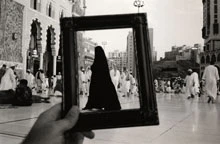
FENETRE sur la Mecque (Window on Makkah) is the title of a newly published book of photographs in France. The photographer, Benyoucef Cherif, is Algerian, and he has worked for the last ten years with such international photo agencies as Sygma and Gamma.
In 1996, he accompanied his father to Makkah for Umrah and the result of that trip is his book, “Window on Makkah.”
Photography remains one of the most lasting instruments of documentation; as the French writer Roland Barthes observed, “Pictures become a kind of writing as soon as they are meaningful.” Before the invention of photography, painting was the method of documenting. In its more than 150 years of existence, photography has left us an extensive archive people and places. During the latter part of the 19th century, Arab and Muslim photographers visited the holy cities of Makkah and Madinah and their images provide us with an insight into its population and architecture at the time. One of the earliest photographers to visit the two cities was Muhammad Sadek Bey. An Egyptian, he accompanied a caravan on the occasion of the yearly Haj, and his photos date from as early as 1880. Other photographers active in Makkah and Madinah during that period were G. Courtellemont — a Frenchman who converted to Islam), Mirza and Sons — Turkish — C. Snouck Hurgronje — a Dutch photographer who became Abd Al-Ghaffar when he became a Muslim — and Ibrahim Rafaat.
The visual history of Islam’s holiest cities has been further enriched by contemporary photographers. Over the last few years, Reem Muhammad Al-Faisal has photographed the Haj surely the first female photographer to do so. Another photographer of Makkah is the Iranian Abbas whose book “Allah O Akbar” (Phaidon, 1994) is a photographic journey lasting seven years through a number of Muslim countries. In 1997, thanks to the support of Prince Majed ibn Abdul Aziz, the Japanese photographer Ali Kazuyoshi Nomachi took stunning images of Makkah and Madinah. Aperture, the prestigious New York publisher, produced his work in an extraordinary book entitled “Makkah the Blessed, Madinah the Radiant.”
“Window on Makkah” is different from the other photography books and is more like visual truth and fiction. When Benyoucef Cherif arrived in Makkah, he was overwhelmed and “enlightened” by the diversity and unity of a place where Muslims from all over the globe come together. He found it impossible to overcome the instincts of a photojournalist, but lacking authorization to take photos he had to find a way to solve his problem. He had two weeks and one day. While walking in the souk of Makkah, he found a small frame. He bought it and after removing the glass and picture, he used it to take his pictures secretly. With his arms outstretched, he held the empty frame in front of himself while holding the camera with the other hand. “I could see the world through this window,” he said. The result is a picture within a picture: One seen inside the frame and a second outside the frame. His technique has the advantage of endowing the image with several dimensions and adds a geometrical and decorative element to each picture. Benyoucef Cherif described the work as follows: “This photographic experience enabled me to open a window to let the light in, and that is my way of perceiving Islam.”
— Arab News Review 9 October 2003