
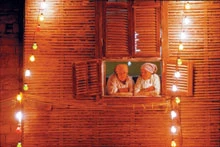
The French Senate organized a spectacular exhibition this summer entitled "Crossing Destinies" presenting the work of the renowned photojournalist, Reza. "Crossing Destinies" is a retrospective of Reza's journeys from the Bosphorus to the Great Wall of China, from Lebanon to Afghanistan, from the Philippines to Central Asia, from Rwanda to Sarajevo. The exhibition took place from June 1st through Sept. 30 in the beautiful Luxembourg Gardens in the heart of Paris. The 89 original prints of 120X180 cm that comprised the exhibition were suspended on the gates of the garden. "Crossing Destinies" attracted over four million visitors in four months and the exhibition has now moved to Marseilles.
A photojournalist, Reza was born in Tabriz (Iran) in 1952. A self-taught photographer, he bought a camera at the age of 14. Later he studied architecture and from 1971 to 1978 he photographed rural society and architecture in Iran. He was imprisoned in 1974 for more than three years under the Shah's regime for having taken photos of poverty and oppression. His first journalistic assignment was for the French Press Agency for whom he covered the Iranian Revolution. At the time of the Iranian hostage crisis, he was the only photographer in the world outside the US embassy. Reza gained immediate recognition and was correspondent in Iran for Newsweek from 1978 to 1981. In 1981, he risked jail once again by the new Iranian regime for his photographs of Kurdish repression and the beginning of the Iraq-Iran war. He was forced into exile and settled in France.
From 1983 to 1988 Reza worked for Time as a Middle East correspondent and since then, his camera has been focused on wars and conflicts in the Islamic world. His work has been published in such famous publications as Life, Le Monde, Paris Match, L'Express, Stern, The Observer and he has worked regularly with the National Geographic since 1993. He had also contributed to a number of books, given courses and led photojournalism workshops in such institutions as Georgetown University (Washington, D.C.), Ecole Nationale d'Art (Paris), Istanbul Fine Arts University. He has been awarded several prizes, among them the World Press Photo - the world's most prestigious annual press photography contest.
As a recording photographer, he has witnessed wars, revolutions and political upheavals. Reza has also been involved in humanitarian work. In 1990, he worked as a consultant to the United Nations on a food distribution program in Afghanistan. Between 1989 and 1995 he reported for UNICEF. In 2001, with his wife, Rachel Deghati, and a number of French intellectuals, he set up an NGO (AINA) whose primary objective is the promotion of education, cultural expression and an independent media in Afghanistan. Supported by UNESCO and the European Community and with a budget of nearly $2 million, AINA has offices in Washington, Paris and Kabul. Last year when Reza participated in an auction of his photographs, he donated the $ 65,000 that his pictures fetched to the association. In addition, the profits from the sales of the book, "Crossing Destinies" (text by Rachel Deghati with 160 pages and 107 photos) will be used to fund AINA. Already 15,000 copies have been sold.
Reza's photographs are emotionally charged and his photographs convey his own human, personal vision. In an interview with the Financial Times (Aug. 25) Reza said, "There are few journalists who have been through what I have been through - torture, prison, exile and war - so I really understand suffering. For me the best way to take photos is to relate as closely as possible to the human story and I do all I can to reduce the psychological distance."
In 1993 for his first assignment on Cairo for National Geographic, the magazine booked him into a five-star hotel. Finding it impossible to cover a story about an overpopulated city of 12 million people who live in difficult conditions, he went downtown and rented a no-star hotel. Likewise, before traveling to Somalia, he starved himself for three days in Paris.
Despite the fact that Reza's visual language is war, conflicts, labor and sorrows, his photographic world is not devoid of beauty and poetry. No matter their circumstances, his portraits reveal grace and even the most desperate gaze glows with tenderness. Furthermore, his architectural training is evident in his pictures. Not only are his photos excellently composed but they also depict in the distant background the regional landscape and the cultural identity of the country. Reza has transformed photojournalism - a medium that reports reality - into an art form. His work demonstrates that the two opposing forces of photographic tradition - one the aesthetic and the other recording facts - are not contradictory and can coexist in the same image.
"The many paths that I have trod over the last thirty years have enabled me to meet men, women and children whose unique destinies have deeply influenced me. Close to each of them to the point that I could feel their suffering as well as their joy, I was able to illustrate, thanks to the universal alphabet that is photography, the memories of human beings caught in the world's torment. Beyond the frontiers, cultural diversity and destructive wars, my pictures do not show only the sad reality of mutilated lives. Although they are witnesses, they tend to show the smile behind the tears, the beauty behind the tragedy and the life that is more powerful than death. This exhibition on the railings of the Luxembourg gardens is the story of the human family, our family." Reza
— Arab News Review 23 October 2003