
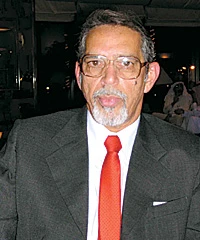
“I was a tenth grade student when I first came to know the details about the holy cities of Makkah and Madinah,” said Mahmood Sayed. “I decided at that time that Saudi Arabia was the place where I must go and live my life. My father had died when I was nine years old. My mother, a wonderful woman, was struggling to bring up eight children on her own. I wanted to leave school and go to work to help her. She insisted that I complete my education. So it wasn’t until I was in my early 20s that I was able to set off for the Kingdom.”
Arranging a visa to Saudi Arabia in the 1960s was somewhat complex, but eventually Ahmed Zainal Alireza agreed to sponsor a visit visa for Sayed.
“I landed in Dhahran off a TWA flight on the night of Oct. 23, 1965 and began the greatest adventure of my life,” Sayed said. “I had to reach my sister’s home. She was living in Rahimah and the only way to get there was by taxi down a single lane road lit by flares. It was a one and one-half hour journey and I was terrified the entire way!”
Not knowing exactly what to expect of life in the Kingdom, Sayed soon found out that most people focused on their work because there wasn’t much else to do. All the commercial activity in Alkhobar centered around the shops on King Khaled Street. If an item wasn’t to be found there, it probably wouldn’t found anywhere in the Kingdom.
“It took me a little while to pick up the rhythm of life in Saudi Arabia,” explained Sayed. “For example although I arrived just before Eid Al-Adha, I missed my first Eid prayers in the Kingdom because I didn’t realize how much coordination and planning was needed to get to the site of the Eid prayers. That day was a bit sad because I knew that the Eid back in India would be full of joy and celebration. In Rahimah it was very quiet at Eid time with most of the people either away for Haj or on holiday. I later discovered that Ramadan was very much the same. Many expatriates left the Kingdom during Ramadan. In those days there were no shopping centers or prize giveaways of course. Ramadan was about prayer and fasting, and nothing else intruded.”
Sayed had originally come into Saudi Arabia on a one-month visitor’s visa, which was extended again and again as he looked for work. Both his and his mother’s prayers were answered when he found a job in Dammam with M.M. Zahid & Bros. Sayed spent six years with the Zahid’s, during which time he was married. He next tried a few positions in the Saudi travel industry, before landing a challenging assignment in Dammam with the Suhaimi Family.
“In 1974, I took a job as sales manager and helped to start the Hempel Paints Factory,” said Sayed. “The factory was successful immediately. At the inauguration of the factory in 1975, 1,200 guests came, not only from the local community, but even from the UK and USA. Hempel was started with about SR3 million and the first order received by the factory was for SR7 million. There was so much construction going on in those days that demand for all building materials was very high. We couldn’t get enough raw materials sometimes to keep up with all the orders. In the mid-1970s waiting time at anchorage for ships coming to offload at Dammam port was 90 days. The only solution that we could find was to start bringing material in by road. It cost about twenty percent more but the time saved made it worthwhile.”
From his early years in Saudi Arabia, Sayed saw the importance to the national economy of creating factories to produce local goods. He personally introduced valve manufacturing to the Kingdom. However, even Sayed admits that it has been an uphill fight sometimes to sell those goods.
“There is an impression in Saudi Arabia that products manufactured abroad are better than those locally made,” commented Sayed. “Often, I had to push hard to convince Saudi companies to buy locally manufactured products. I would show local firms that the local goods I was offering met all international requirements, were supported with better service and were competitively priced, and still those gentlemen might choose to order from abroad. It is interesting but I have found that Saudi women tend to be stronger supporters of locally manufactured products than Saudi men are. Saudi women see a future for their children in all the locally produced goods.”
Sayed has also had to cope up over the years with negative attitudes from some Saudis in the workplace.
“Many young Saudis see that there is a ‘Hindi‚ making a good salary and they demand to have my job. Then the company manager has to tell them that if they would get serious and learn how to do my job he’d be pleased to let them have it,” said Sayed. “I tell you sometimes as a sales manager I have had to go to the homes of Saudi salesmen, get them out of bed and convince them to go take customer orders. It can be profoundly depressing. This is not a market where businessmen can fool around anymore and expect to make a profit. Young men who are intelligent, self-starters and willing to put in long hours are much in demand, but they are in short supply.”
Sayed arrived in the Kingdom with two pants, two shirts and a pair of shoes he bought at a flea market. Earlier this year the Interior Minister granted him permission to buy land and build a house. His home is now rising on the Aziziah corniche in Alkhobar. He plans to spend his retirement there.
“When I see all the negative stories about Saudi Arabia in the media it is painful,” Sayed said.
“I have met wonderful people during my career in the Kingdom. My daughter Rahat’s open heart surgery was paid for by King Khaled. His wife, the queen, gave my little girl personal attention during that difficult time. When my mother was ill, the entire community here surrounded her with care and goodwill. I am happy to say that Saudi Arabia is my dreamland and it is where I plan to live out my days.”