
"As far as I'm concerned, the Finger Lakes are so beautiful, one doesn't need to travel anywhere else." My uncle told me this as a young child. I never forgot his words.
Thirty-some years later, in celebration of our 10th wedding anniversary, my husband and I decided the time had come to discover the region. We didn't need the hokey of Niagara Falls - just some great scenery, good food and vineyards, a few museums, and lovely lakes. Sounded perfectly romantic. But then, that notion when out the window when we decided to bring along my 84-year-young Aunt Alice, who grew up in the region, and Carsten, a journalist-friend from Denmark.
According to Indian legion - a giant hand caressed and blessed the land, leaving the imprint of fingers, which formed the Finger Lakes in upstate New York.
Our little caravan started from Washington and took less than 7 hours to reach Syracuse. Women: plan to arrive in Syracuse early enough to shop at Carousal Center. Already huge in mall terms, it's slated to become Destiny USA, the largest Mall in the United States. The perfect place, in other words, to buy those few additional items you just realized you needed for your vacation.
Syracuse is worth a drive through town and offers several good restaurants; the local ethnic eateries are mainly Irish and located downtown on Armory Square and the Tipperary Hill area.
Here you'll find the Upside Down traffic light. The only traffic light in the country where the green light is on the top, and the orange is on the bottom. Next to it is Stone Throwers Park, which is a hint. First installed upside down by accident in the 1930s, the neighborhood took a shine to it because it highlighted their Irish pride. The story goes that when the city tried to reverse the light, putting the orange light back on top, the locals would stone it until they broke it. Tired of replacing it, the city elders finally gave up, and the traffic light remains upside down.
Next morning, we headed out to the magnificent area of Skaneateles. Take Route 20, which is slated to become a scenic byway. It's a bit longer, but you'll pass through the architectural and scenic beauty that abounds in Skaneateles, with the many big mansions in town belaying generations of graceful living. Hollywood has made movies here, some deceptively casting the area as a mountain town in the Alps.
It is easy to visualize Lac Leman, or Lake Geneva, from this vantage point. The town has a feel of northern Europe to it. A well-heeled community, Skaneateles has long been a place that tolerates, shall we say, tasteful tourism. No motels or hamburger joints here.
It's traditional to stop at the Sherwood Inn for a meal and an overnight stay, and to enjoy the magnificent view.
It was here Aunt Alice set the tone for our trip together. "Oh, how wonderful to be tourists!" we exclaimed.
"Yes, we may be tourists," said Aunt Alice. "But that does not mean we have to act like tourists." Carsten, the enfant terrible amongst us, made that his mantra for the rest of the trip.
Lake Skaneateles is one of the deepest lakes in the United States; the US Navy regularly test dives its submarines here in the sunken vastness of water. Look closely, as you can see maneuvers being held in the lake.
If you don't stop for lunch at Fox Run Winery, just beyond Skaneateles, you'll regret it. We spent several hours there and learned from the owner, Steve Osburn, that the region is famous for grapes because the lakes never freeze over.
If you're looking for a lovely hotel with a 'to-kill-for' view of the lake, which also offers a winery and fine dining, pull over at the Inn at Glenora. We almost lost Carsten here. The panoramic view from the rustic guestrooms-with-a-view, plus the king-sized beds, Jacuzzi whirlpool tubs and cozy fireplaces make it hard for anyone to leave. The elegant restaurant offers another spectacular panoramic view of Seneca Lake. No amount of pouting by Carsten, however, could excuse him from our travel plans.
We were tempted to linger, but had reservations to spend the night in Corning, a short drive down the road.
We recommend you stay at the Radisson Hotel in Corning for two reasons. First, it is conveniently located in the center of town, and within easy walking distance to all the great restaurants that line historic Market Street district. Secondly, the restaurant at the Radisson Hotel has gained wide acclaim for its innovative and delicious cuisine.
We dined in the center of town at "The Gaffer," the term, we learned, for a glass blower. We were, after all, in Corning - headquarters of Corning Glass.
The museums in Corning are another reason as to why you'll want to stay. Museums tend to be viewed by many tourists as boring, last-on-the-list places to visit when on vacation. Once again, Corning surprised us.
Visit the Rockwell Museum of Western Art, you'll be impressed by the collection of Western art in the galleries.
Another 'Must Do' Museum is the Corning Museum of Glass. The world's most comprehensive glass museum, Corning will educate and inform you about the difficulties involved in creating cut crystal and glass. There are informative, fun exhibits, interactive displays, glassblowing all day, and a workshop where you can make glass.
After touring the museum, and attending the glass-blowing class with demonstrations by gaffers, it is certain to reshape your perception of glassware.
The museum also has a wonderful downstairs café. We're not big on museum cafes, but yet again, Corning surprises - the food was fresh, delicious, and artfully presented.
Spend as much time as you can at the Corning Museum, there's so much to do. Take a class where a gaffer will help you learn how to blow glass and design a bead (more difficult than it sounds) or create your own free form flower. Just be careful when you leave, the exit runs through the Museum shop, making it strategically hard to resist items for sale - due to your newly acquired appreciation of glasswork.
Reluctantly, we left for the Genesee Country Village & Museum. It was on our tour program, and we couldn't skirt it. Admit it, Genesee Country Village & Museum sounds boring, like a wanna-be of Williamsburg. We speculated it would offer a few unoriginal houses minus Williamsburg's charm. We were tired, we wanted to drive by but - guess what - the place really is worth the drive.
Genesee Country Village & Museum, it turns out, is no wannabe. It's the real thing.
Located in Mumford, New York, it is home to one of the largest collections of furnished historic buildings in the US that date from 1797 to 1870. There are 57 restored and authentic buildings masterfully decorated with period furniture and pieces.
As in Williamsburg, the town is full of costumed interpreters that carry out typical 19th century tasks - Genesee offers a wagon maker, a blacksmith, a tinsmith, a boot and shoe man, a potter, a brewer, a hops grower, a cooper, a gunsmith, a dressmaker, a bookseller, printer and "the oldest insurance office in the United States."
The Genesee museum was conceived and founded by John Wehle, heir to the Genesee fortune, who thought that the work of regional carpenters, master builders, and house wrights was fast disappearing, and with it the vanishing culture of early American history.
We had great fun touring as many houses as we could, most of which were easily wheelchair accessible for Aunt Alice. Some of the homes still maintain the down-home feel of being occupied, and we felt like voyeurs in the past, which we all enjoyed. Of course, at Alice's age, and ours, we found items from our childhood - always a dreadful realization when touring a museum site!
Now enthusiastic, we wanted to see everything. In fact - I hate to admit it - they threw us out! Well, not literally, but we did stay past closing, which was gently brought to our attention. We left, vowing to return again.
After our tour around another of the Finger Lakes, we left for the Big City - Rochester.
Two separate surveys by American Demographics designated Rochester as the nation's friendliest city. It has also been named the leading city in altruism. Per capita, Rochesterians have donated more money to non-profit organizations than any other area of its size. To the visitor, this means that you can expect a beautifully maintained city.
Nearby is the Lake Ontario area, which offers a wide choice of restaurants, the beach and Abbott's ice cream cones. For those Canadians yearning for this famous ice cream, a ferry service will begin in May between Rochester and Toronto.
Rochester's first claim-to-fame was the Erie Canal, completed in 1825.
It's difficult to imagine life prior to the canal - when there was no simple way to transport people, raw materials or manufactured goods from the Atlantic Ocean to the Great Lakes, the country's internal thoroughfare.
The Erie Canal changed all that, cutting travel time in half, and reducing shipping costs by 94%. It made New York City the busiest port in the United States and turned Rochester into the country's first boomtown.
Don't miss breakfast at Jine's Restaurant on Park Avenue, a popular, local café for delicious fresh food. Peter Jines, the owner, is omnipresent and friendly, welcoming but not hovering. He also makes powerful cappuccinos, much needed as our mad dash touring was catching up with us.
Nearby, is the George Eastman House. Eastman Kodak is a universally recognized name, and the house gives a fascinating glimpse into the mastermind behind the Kodak camera. A guided tour is recommended, and there's a hidden elevator - which George had installed for his elderly mother, who lived with him - which brought Aunt Alice in her wheelchair up to the second floor to continue the tour with us.
The restored Colonial Revival-style mansion features Eastman's original furnishings, and includes four formal gardens and grounds.
Child Magazine has rated George Eastman House for its family friendly atmosphere when it named Rochester one of its top cities for families in 2001. It tied with Anaheim, California, - home to Disneyland - for 7th place.
Talking about children brings us to the Strong Museum. Ranked one of the Top Ten Children's Museums in the country by Child Magazine, the museum encourages interaction.
Children are able to run a grocery store at Super Kids Market, explore the world of communication as they pilot a giant helicopter, board a whaling ship, perform on stage, direct and be seen in a popular television show, and become a newscaster or a cameraman in the children's studio. Here kids rule.
Our next museum was to honor one of Rochester's most famous citizens - Susan B. Anthony, celebrated for her consuming fight for woman's rights. She is also related to this writer, as her middle initial "B" and mine are the same: Brownell. Reason enough for us to visit her house.
Her home, the area's second National Historic Landmark, is located on the edge of downtown Rochester. It has been preserved in its original condition, with authentic period furnishings. Many of Anthony's personal furniture is displayed there, including the desk where she helped write the words the monumental History of Woman Suffrage, which eventually helped women gain the right to vote.
In 1872, Susan B Anthony was arrested here for having illegally voted.
Susan B, we also learn, had an unusually strong constitution. One of the first in Rochester to have running water, she would take daily baths in ice cold water. This no doubt helped steel her nerves to in her fight for women's right to vote.
There is much more to be seen in Rochester, but we only earmarked one day. We opted to end our trip on a high note... back to the lakes.
From Rochester we traveled to nearby Canandaigua, as Carsten was begging for a night at the water's edge.
The Ontario Country courthouse is located here, where Susan B Anthony was tried and convicted of treason. Women were not yet allowed to vote, so it was deemed a crime against the government when she had voted. The all-male jury declared her guilty and gave her a $1 fine. Even back in the late 1800s, a dollar was considered a low fine. She never paid it, however, because she said paying the fine would admit she was guilty.
One can't help but be proud of such a feisty ancestor in the family.
After a few photographs of the courthouse, we drove on to our destination: The Canandaigua Inn, located at the foot of the lake. Book in advance, or you won't have much luck getting a room overlooking the lake. Need I mention that our Danish colleague was not pleased?
Fortunately, their restaurant offers a great view and good food, which raised Carsten's spirits. The Inn is also within walking the Kershaw Park, and an easy walk up to the main street.
Breakfast at Kellogg's Pan Tree Inn, walking distance to the Inn, famous for cinnamon sticky buns and offering another great view over the lake. Don't look for tourists here, as the townsfolk frequent this place, so it has to be good.
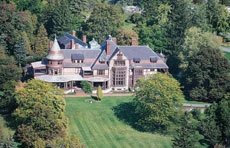
Finally, as you're leaving town, be sure to tour the Sonnenberg Gardens and Mansion.
The world-renowned 50-acre Victorian garden estate and mansion features nine themed gardens, sculptures, fountains, a turn-of-the-century conservatory and a 40-room mansion.
Driving home I remembered my uncle's decree about the area. He was right - this place is hard to match.
For more information:
- www.VisitFingerLakes.com
- Finger Lakes Tourism Alliance: www.fingerlakes.org
- Fox Run Vineyards: www.foxrunvineyards.com
- Genesee Country Village : www.geneseecountryvillage.org
- Corning Glass Museum: www.cmog.org
- Corning Chamber of Commerce: www.corningny.com
- Rockwell Museum of Western Art: www.rockwellmuseum.org
- The Inn at Glenora: www.glenora.com
- Greater Rochester Visitors Association: www.visitrochester.com
- George Eastman House: www.eastman.org
- Strong Child's Museum: www.strongmuseum.org
- Susan B. Anthony House: www.susanbanthonyhouse.org