
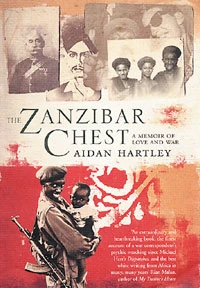
Aidan Hartley, the descendant through both his father and mother of a long line of British soldiers and colonial administrators, was born and brought up in East Africa, where his father had settled as a farmer after a career in the British colonial service in Africa and Yemen. Hartley was packed off to boarding school in the traditional manner, but returned to Africa in the 1980s to make a living as a journalist. After a false start as a stringer for the Financial Times in the sleepy backwater of Dar es Salaam in Tanzania, Hartley was given his break by the Reuters East Africa bureau chief in Nairobi.
"Africa!" the veteran Reuters man told Hartley, "It's wide open for a beach bum like you. You're young! You're hungry! Dream job, my lad. What you want to do is get out there... and bring us back some real stories."
And that's what Hartley spent the next few years doing, advancing with the Ethiopian rebels on Addis Ababa as the regime of Mengistu Haile Mariam collapsed, reporting from Somalia as it sank into total clan warfare, testifying to the horror of the genocide in Rwanda. These were not just "real stories". They were extraordinary stories, the under-reported flip side of the transformations that were taking place in geo-strategic politics after the end of the Cold War.
Hartley became one of a band of intrepid Nairobi-based European and American hacks, "danger junkies" as they were described by the expatriates in Nairobi, who reported the wars and famines of East Africa in the early 1990s. "You could take off at sunrise, commute to witness a battle or hear a starving man breathe his last and be back home by nightfall, in time to file the story... Or you were dropped off, watching the plane roar away in a cloud of red dust, and you were gone for weeks, out of contact and a thousand miles from help. And each time you returned from a trip like that for a few days you were as mad as Gulliver talking to his horses."
That kind of life inevitably took its toll. By the mid 1990s Hartley was burnt out. His father's death was a turning point. In his father's house in Kenya, in an old carved wooden chest from Zanzibar, Hartley finds the diaries of his father's old friend, Peter Davey, who had been killed in Yemen after the Second World War. Reading the crumbling pages of the diaries, Hartley begins to piece together the story of Davey's love for an Arab woman that eventually leads to Davey's violent death in a remote valley in Yemen.
The Zanzibar Chest weaves together Hartley's own experiences of love and war in East Africa in the 1990s with the story of Davey. The result is a lacerating, romantic, profound and compelling book. Don't look here if you want a dry and balanced explanation of what happened in Somalia or Rwanda in the 1990s, nor if you want policy prescriptions for how to put things right. But in his spare and often lyrical prose (which is reminiscent of another great book about Africa by a white man, Gerald Hanley's Warriors) Hartley serves up the sheer brutal awfulness of it all as well as some brilliant insights into the war reporter's trade and into the insensitive blunders of Western policy makers and humanitarians in Africa.
For my money the best passages of the book are when Hartley is writing from his own experiences in East Africa's war zones. "I had decided that what I was looking for was a war I could call my own, a story that was mine, a complete experience that would define me as the son of my fathers and involve me as an insider, from the outbreak of hostilities to the victory parades and humiliation of the vanquished." That war turned out to be Somalia, a war in which Hartley lost several of his friends.
The passages on Yemen, where Hartley travels in order to piece together the story of Peter Davey, are less gripping. Some mis-transliterations of Arabic suggest that Hartley is less sure of his material here. But Hartley's travels in Yemen and Davey's poignant story serve as a useful counterpoint to the traumatic account of his forays into the killing fields of Somalia, Rwanda and Eastern Zaire.
The search for Davey also provides the book with an important historical perspective. The colonial, racist attitude which drove Davey to his death in Yemen was similar to the attitude which led the London based Reuters managers to stint on their coverage of Rwanda and which led the UN to do nothing in the run up to the genocide.
"We should never have come," says Hartley's father shortly before his death. After a lifetime in Africa and Arabia, first as a colonial officer and later as a farmer and development consultant, Hartley's father believes that Africa's troubles can be traced back to the white man's drive to develop and modernize. In The Zanzibar Chest, Hartley himself traces the ruination he so eloquently describes to the same source.
— Arab News Review 13 November 2003