
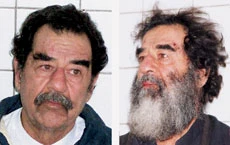
BAGHDAD, 15 December 2003 — Ending an eight-month manhunt, US forces have captured Saddam Hussein in northern Iraq, sparking jubilation all-around and giving the US-led coalition a major boost to its campaign to rebuild the country.
"Ladies and gentlemen, we got him," US civil administrator Paul Bremer said in Baghdad, announcing the operation late on Saturday near the town of Tikrit that yielded the most wanted fugitive from the former regime.
The ousted president, 66, was found hiding in a hole under an isolated farm, said US commander in Iraq, Lt. Gen. Ricardo Sanchez. He said Saddam was being held at an undisclosed location.
The arrest was greeted in Baghdad with the sound of gunfire as Iraqis who lived for nearly a quarter of a century in his iron grip fired automatic weapons in the air in celebration.
World leaders, including those who opposed the war to oust Saddam, hailed the arrest as an opportunity to bring peace and stability to Iraq, wracked by guerrilla violence since the fall of Saddam in early April.
President George W. Bush said yesterday that Saddam Hussein's capture marks the end of "a dark and painful era" in Iraq but cautioned that it does not mean the end of violence.
Bush said Saddam "will face the justice he denied to millions."
"It marks the end of the road for him and all who killed and bullied in his name," Bush said in a nationally broadcast address from the Cabinet Room. He was given confirmation early yesterday that Saddam had been captured without a shot being fired, and sees the detention as a major triumph, a senior aide said.
But the White House did not predict an end to deadly attacks on US troops in Iraq. "All I'm going to say is it's a great day for the Iraqi people," said the aide.
The arrest is a major coup for the US president, facing domestic criticism for the rising numbers of US casualties in the campaign with less than 12 months to go before the presidential election.
In video footage broadcast by jubilant US forces in Baghdad, a bearded and disheveled Saddam appeared like nothing more than a long-haired tramp, staring absently into the camera.
British Prime Minister Tony Blair, Bush's staunchest supporter in the war and its aftermath, said the arrest was "very good news for the people of Iraq.
"It removes the shadow that has been hanging over them for too long of the nightmare of a return to the Saddam regime."
"This is a great day in Iraq's history," added Bremer. "For decades hundreds of thousands of you suffered at the hand of this cruel man.
"Those days are over for ever."
Blair said that those still loyal to Saddam, blamed for months of attacks on US-led occupying forces, now knew they were backing a lost cause.
"The tiny minority of Iraqis who wanted Saddam back must now know their cause is a futile one," said Blair in a televised address.
"Saddam has gone from power. He won't be coming back — that the Iraqi people now know and it is they who will decide his fate," Blair added.
"It also gives an opportunity for Saddam to be tried in Iraqi courts for his crimes against the Iraqi people," he said in a separate statement. "And it gives us an opportunity to take a step forward in Iraq."
Even the states that opposed the war on Iraq, notably France and Germany, offered their congratulations to Bush and welcomed news of the arrest as likely to help restore stability and security there.
French President Jacques Chirac welcomed the arrest, his spokesman said, while German Chancellor Gerhard Schroeder sent a message of congratulations to Bush.
Iraqi Governing Council member Adnan Pachachi, one of three members taken to identify Saddam, said the former dictator was "unrepentant and defiant" and showed "no remorse" after his arrest.
Sanchez said the former Iraqi president appeared a "tired man and also I think a man resigned to his fate" when captured.
Bremer said the detention after one of the biggest manhunts ever staged should inspire reconciliation in the troubled country.
But the violence continued even as rumours of Saddam's capture spread: a suspected car bomb at a police station in the western Iraqi town of Ramadi killed 18 people, including a seven-year-old girl.
Sanchez said Saddam, who had a 25-million-dollar bounty on his head, was captured in Operation Red Dawn, at around 8:00 pm (1700 GMT) on Saturday.
"Saddam was captured without resistance," he said. The US commander would not say where Saddam was being held.
Sanchez said "there were no injuries, and in fact not a single shot was fired" during the operation.
"Saddam Hussein the captive is talkative and being cooperative," Sanchez said, adding that he was in possession of $750,000.
Although US forces had succeeded in capturing many of the most-wanted officials from Saddam's regime, and in killing his two sons, Saddam had remained at large with a $25 million bounty on his head.
On the streets of Baghdad and other cities men fired celebratory shots in the air and danced in the streets.
Russian Foreign Minister Igor Ivanov said he expected the arrest would help restore security in Iraq and enable a political resolution to the situation there "under the authority of the United Nations."
Saddam's fate "must be decided by the Iraqi people", he said.
That call was echoed by Arab League Secretary General Amr Moussa.
"It's the Iraqi people who must decide the fate of the old regime and its old leaders," he said in Cairo.
The head of Iraq's US-installed interim Governing Council, Abdul Aziz Al-Hakim, said that Saddam's arrest would boost attempts to restore democracy to Iraq.
"Without a doubt attacks will diminish. This is a big blow to terrorists in Iraq. It is a great day for humanity and the Iraqi people," said Hakim.
Iraq has been rocked by almost daily attacks against US forces and their allies blamed on militants loyal to Saddam -- the ace of spades on the US most wanted list.
Saddam Hussein, captured by US forces, is likely to be tried before a new Iraqi court set up only last week to prosecute crimes against humanity by his deposed regime.
After US civil administrator Paul Bremer's announcement "we got him" was greeted by cries of "Death to Saddam!" Yesterday, Iraqi Governing Council chairman Abdelaziz Al-Hakim said the ex-president would have a date with the new tribunal.
The captive dictator "will be taken before the judges and he will be judged according to the law in force before the tribunal that was set up in Iraq," Hakim said after learning the news while on a trip to Madrid.
Council member Ahmed Chalabi said that the 66-year-old Saddam would be tried in public.
"He was arrested without resistance and there was enough time for him before that to commit suicide if he wanted but he did not," Chalabi told Iraqi TV.
"The nightmare that was haunting the Iraqi people has been lifted. Saddam is under arrest and he will tried publicly and punished for his crimes," he said.
Blair called for the Sunni community in Iraq and former members of Saddam's Baath Party "to grasp the opportunity for reconciliation."
"We should try now to unite the whole of Iraq in rebuilding the country and offering it a new future," he said.
NATO chief George Robertson said Saddam's capture was "excellent news" and will help to stabilize Iraq.

