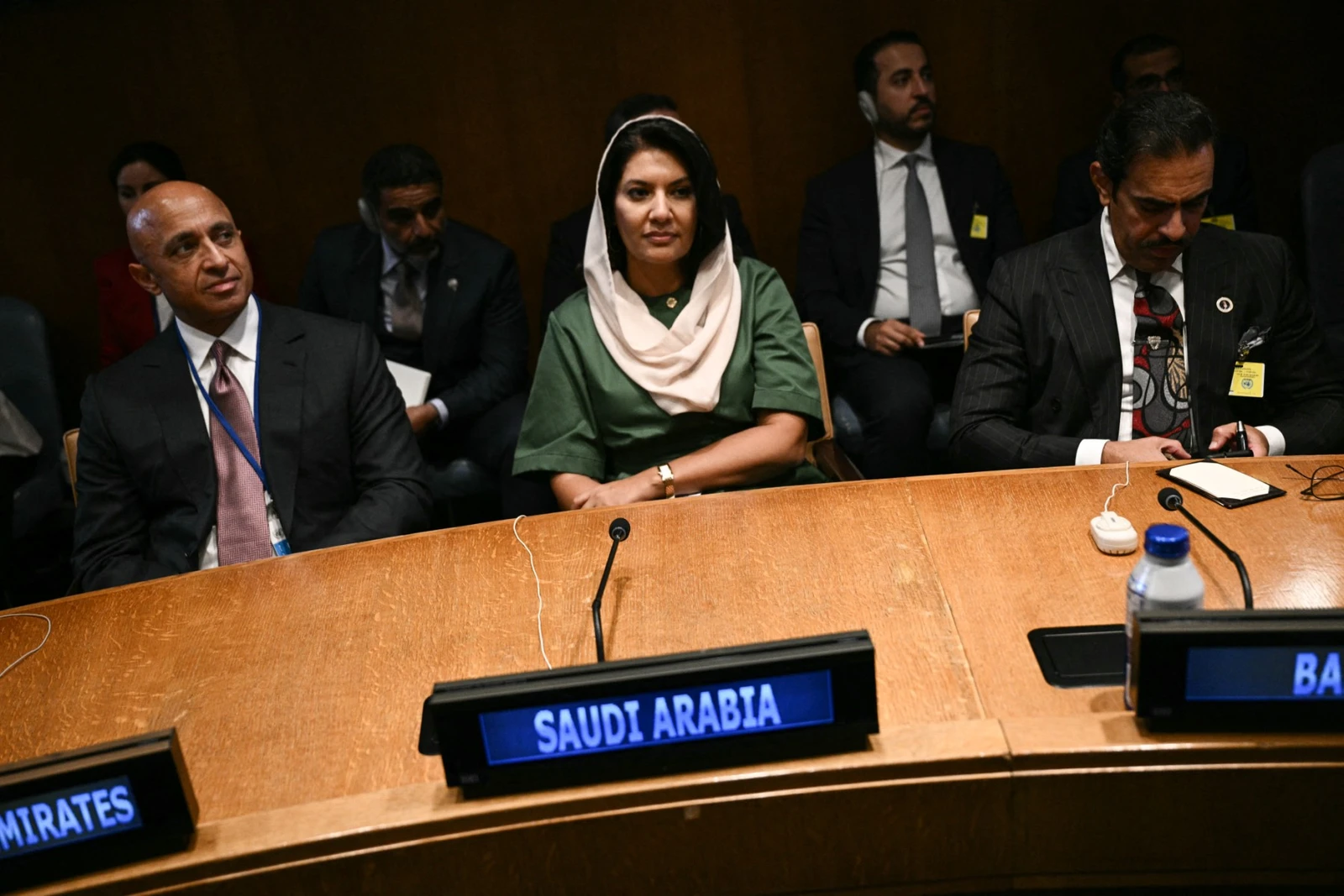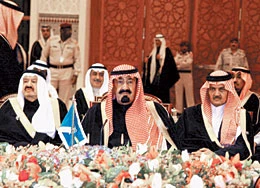
KUWAIT CITY, 22 December 2003 — GCC leaders opened their 24th annual summit here yesterday with a call by Kuwait’s Prime Minister Sheikh Sabah Al-Ahmad Al-Sabah to fight terror.
Sheikh Sabah, who opened the summit on behalf of Emir Sheikh Jaber, urged GCC states to confront and fight terror.
“Terrorism has spread to most parts of the world and to some of our states. This requires that we step up international efforts to confront and combat terror,” the premier said.
Crown Prince Abdullah, deputy premier and commander of the National Guard, who is leading the Kingdom’s delegation to the conference, set the tone last week with a ringing denunciation of terror.
“We must eradicate terrorism absolutely,” the crown prince told Arab and Saudi intellectuals in Riyadh two days before the Kuwait summit.
“When a part of the body is rotten it must be cut off,” he said and vowed to track down terrorists.
The GCC’s call to fight terrorism comes after two bomb attacks in Saudi Arabia, which killed more than 50 people and injured 200 others, and a series of shootings in Kuwait.
The leaders of the Gulf Cooperation Council, which groups Saudi Arabia, Bahrain, Kuwait, Oman, Qatar and the United Arab Emirates, are expected to approve a joint statement on combating terror.
The citizens of the GCC hope that the summit will usher in a new era of progress, prosperity and security and realize the aspirations of the people in the region.
Despite the chilly and blustery conditions on a day incidentally said to be the shortest of the year, the atmosphere inside the conference room was warm.
The Kuwaiti premier, who read out Sheikh Jaber’s inaugural address, welcomed the capture of former Iraqi President Saddam Hussein and expressed hope his capture and trial would help stabilize the region and make it more secure. “We have been following the developments in Iraq very closely, hoping it will be the prelude for...a new political era in which the Iraqi people rebuild their country,” the premier said.
Sheikh Sabah blasted Israel’s “oppressive measures” against the Palestinian people, saying they “constitute a threat to the security and stability of the whole region” and undermined efforts for a just peace.
The summit is being held amid heightened security with hundreds of tanks and armored vehicles and thousands of soldiers deployed to guard the conference venue of Bayan Palace, south of Kuwait City, and surrounding areas.
Former GCC Secretary-General Abdullah Bishara has urged the leaders to upgrade their internal security, cut dependence on the United States and establish normal ties with Iraq and Iran.
Two Kuwaiti Islamist groups, the Islamic Constitutional Movement and the Salafi Movement, in separate statements, called on the leaders to reject US military bases in the region and to embrace fundamental political reforms.
Kuwait’s Al-Taleea weekly, the mouthpiece of the liberal Kuwait Democratic Forum, said the GCC “must either live up to the peoples’ aspirations or sign its death certificate.”
A charter for educational reforms aimed at reformulating school curricula in member states and preventing the young from being influenced by extremist ideology will come up for approval.
Economic issues will be high on the agenda, with the leaders expected to review progress toward monetary union, a single currency and a common market amid wide criticism of the slow implementation of decisions already taken. They will also study a number of major projects like a railway and a power grid linking GCC states.
Informed sources told Arab News that Bahrain’s King Hamad is trying to patch up relations among some member countries on the sidelines of the summit.