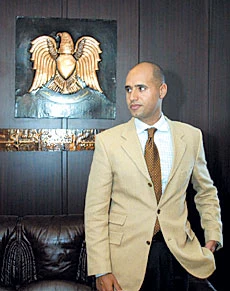
LONDON, 25 December 2003 — The son of Libyan leader Muammar Qaddafi has said the United States has committed itself to providing security for the country and that US officials will travel there soon to ascertain its needs.
Speaking to Asharq Al-Awsat, a sister publication of Arab News, Seif El-Islam also said British Prime Minister Tony Blair and US President George W. Bush would visit Libya in 2004.
El-Islam said Washington had “committed itself to protecting us from any sort of attack” and that there had been “consultations to conclude security and military accords that would lead to joint military maneuvers in the future.”
American military officials “will come to Libya soon to apprise themselves of its military protection requirements,” he added. Last Friday, Libya won applause from the international community, including longtime foes London and Washington, with a surprise announcement that it was renouncing efforts to develop weapons of mass destruction.
Blair described the announcement, which followed nine months of secret talks between Libya, Britain and the United States, as “courageous” and “historic.”
Bush said the move by Libya would help bolster security worldwide, adding that Libya had begun “the process of rejoining the community of nations.”
Referring to Tripoli’s decision, El-Islam said factories for the production of missiles, mostly Scud-Bs with a range of 300 km (185 miles) that had been built jointly with the former Soviet Union and North Korea “will not be dismantled or destroyed.”
However, he reaffirmed that “programs for the production of chemical, biological and nuclear arms would stop, “except those that are for defensive purposes and which will be submitted to international surveillance.”
Referring to the upcoming visits, El-Islam said “the British premier will visit Tripoli at the beginning of next year, followed by a visit by US President George Bush.
“I foresee (the Bush visit) happening after the lifting of US sanctions, which I believe should happen within three months at most,” he told the London-based Arabic newspaper by telephone from Tripoli.
In a separate interview published in another Al-Hayat daily, Libyan Prime Minister Shukri Ghanem said the weapons programs the country was now abandoning had been designed for defense, “given that countries in the Middle East such as Israel possess nuclear and mass destruction weapons.”
He expressed hope that the Libyan decision would inspire the international community to press Israel to abandon these arms, “which are an obstacle to a just and comprehensive peace in the region.”
He also denied speculation that Libya’s decision was based on “what happened in Iraq,” attacked by a US-led coalition in March over still unproven allegations that it possessed weapons of mass destruction.
Washington on Monday cautiously raised the prospect of lifting sanctions against Libya after Qaddafi’s decision. “As Libya’s policy changes, Libya’s behavior changes, Libya’s circumstances change, we’ll be willing to look at those things,” said State Department spokesman Richard Boucher.
“At some point, we may be in a position to make some changes,” Boucher said.
Washington and Tripoli have not had diplomatic relations since 1981.
The US government banned the import of Libyan crude oil in 1982 and in the following years imposed extra trade, export and investment bans.
Libya is also on a US blacklist as one of seven states accused of supporting terrorism.
As for Britain, diplomatic relations were severed in 1984 after a British policewoman was shot dead from inside the Libyan Embassy during an opposition demonstration in London. Relations were re-established in 1999.
The United Nations suspended sanctions against Tripoli in 1995, but did not fully lift them until September of this year when Libya admitted its role in bombing of a US airliner over Lockerbie, Scotland in December 1988, which killed 270 people, and began to pay compensation.