ISLAMABAD, 3 January 2003 — South Asian nations yesterday agreed on the broad framework of a free trade zone.
Indian Foreign Secretary Shahshank said the accord, which would start tearing down tariffs by Jan. 1, 2006, was agreed during talks between foreign ministers in Islamabad preparing for a leaders’ summit of the South Asian Association for Regional Cooperation, which begins tomorrow.
“Informal consultations among the foreign ministers has made it possible for the SAFTA agreement to go through,” said Shahshank. “This is a historic summit where many momentous decisions have been made.”
The South Asian Free Trade Area has been delayed repeatedly in recent years, both because of feuding between India and Pakistan and over concerns by smaller nations in the region that they will be overwhelmed by foreign investment.
Some of those fears were being allayed through a plan to phase in the tariff cuts over a period of years, though no details of the agreement have yet been announced.
The free trade zone would encompass India, Pakistan, Nepal, Sri Lanka, the Maldives, Bangladesh and Bhutan — the seven countries that make up SAARC.
A senior Pakistani official said the broad outlines are that the countries — which comprise one-fifth of the world’s population, including hundreds of millions of its poorest people — would have to reduce tariffs from 25-30 percent to 0-5 percent over five to 10 years.
Bangladesh and some of the smaller countries have sought concessions, fearing that lowering barriers too quickly would cause them to be flooded by cheaper goods from India.
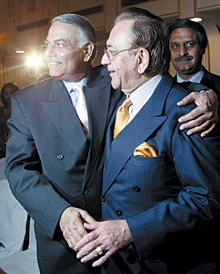
The accords were reached during meetings that began on a high note when Indian and Pakistani Foreign Ministers Yashwant Sinha and Khurshid Mahmud Kasuri publicly embraced, raising hopes for cordiality between the rival states’ leaders at their first encounter since near-war in 2002.
Agreements on free trade, terrorism and a social charter top the agenda of the 12th summit of the grouping. “Three documents have been agreed,” Shashank said.
They include an expanded regional terrorism agreement, the South Asia Free Trade Agreement and a social charter, he said.
“Contrary to the earlier feeling that there might be some delays, somehow considerable progress has been made during consultations of the Council of Ministers.”
Shashank said agreement was reached on an “additional protocol” to an existing anti-terrorism agreement, referring to an extra clause on choking terrorist funding.
“Differences had come because of its definition and scope and the debates in the UN, OIC and other forums. It was possible to bring the focus on the main issue.”
The SAFTA had also met problems in earlier negotiations, mainly over smaller countries’ anxieties that they would need extra concessions to create a level playing field with India and Pakistan.
“I have just come back from the meeting where there was a great degree of warmth and candor and friendship,” Kasuri said of the foreign ministers’ meeting.
“If we proceed in the same manner in the second session (Saturday) maybe our heads will be, or the summit will be, ready to sign the SAFTA agreement.”
A Pakistani official involved in the negotiations on the amended terrorism pact said it was directed at international terrorism, insisting it did not relate to the insurgency in disputed Kashmir, which Pakistan considers a struggle for self-determination and India considers terrorism.
A report on poverty alleviation was also approved, as was the establishment of a regional development bank, Shashank said.
— Additional input from agencies