
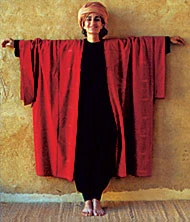
Nagada, the name of a traditional weavers village nestled on the left bank of the Nile between Qena and Luxor, is also a unique Fashion House founded in Cairo by Sylva Nasrallah, a Lebanese designer, and the Swiss Michel Pastore. At a time when a growing number of women are refusing the consumerist diktats of big-label fashion, Nagada aims to offer a timeless, informal style.
"We are not part of the fashion world. We do not follow fashion trends," Sylva says. Nagada is a fusion style. "Nowadays the so-called fusion trend is popular in food, interior design, music, art and clothes. We created a fusion style in clothes long before anyone else," she claims.
"We find ourselves outside the realm of today's fashion world. We work according to our instincts, our feelings, our senses. Our style is romantic, poetic," says Michel.
"We are special but definitely not folkloric. We like to create a timeless fashion clothes which will never be outdated," adds Sylva.
Michel and Sylva are both inspired by clothes from around the world like the "shapan" a traditional long shirt worn in Central Asia.
As Michel sews the latest Nagada prototype, he mentions that the couple have also been inspired by the Egyptian jalabeyah and the kaftan, usually worn underneath in rural areas.
In the beginning there wasn't a clear division of work, but Sylva speaks Arabic so she was better suited to dealing with the workshops. She is also responsible for the management and public relations, though both review all the prototypes together.
Some prototypes are set aside, sometimes for years, and later rediscovered.
Nagada is well known for its use of traditional fabrics. Most of them come from Egypt, like the cottons handwoven in Nagada, the Shahi manufactured in Mahalla in the Delta, the Melaya made in Domiat. But Nagada also work with Kurdish wool and Indian silks.
"All our textiles are linked to a tradition that we transcend. For example, I modified the traditional Nagada fabric. It was characterized by a complex motif which I transformed into a more graphic design. We also used the Milaya which is traditionally worn as a hijab in Upper Egypt for one of our dresses, and its been a huge success," says Michel.
Egyptians are particularly amazed by the way Nagada makes use of traditional fabrics like the "milaya". The handwoven textiles which have become Nagada's trademark are rarely made according to their specific requirements - the challenge, according to Michel, is to produce clothes from imperfect, handmade textiles.
"When we finally succeed, we say, 'if only this fabric could be manufactured with the same defect,'" he says.
Michel and Sylva pay great attention to the practical side of wearing clothes. "However creative we can be, 80 percent of the work goes into making these clothes practical - that is, easy to wash and easy to iron." Nagada is currently exporting to France, Italy, Switzerland and the Unites States. One of their bestsellers is the famous square jacket which happened to be their very first design. In the beginning it came in one size, but by popular demand it is now made in several sizes.
Nagada is known for its constant use of burgundy, no matter what the fashion dictates. Michel and Sylva admit that clients encouraged them to use bright colors. Michel is known to dislike green but he finally gave in when customers kept asking for green outfits. Although Nagada does not create a summer and winter collection, it does stage a yearly show in autumn which has become the highlight of the Cairene fashion scene.
"This show is an incentive. It encourages us to create new designs. It is a means to express ourselves. As well as being an advertising stunt, its also an event all our customers to look forward to. We feel we owe this fashion show to them. Its our way of thanking our customers for their support," says Sylva.