
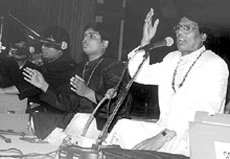
RIYADH, 9 April 2004 — Amid hectic electioneering in India and local Indian school politics again making headlines in the newspapers, respite for the Indian community came in the form of prominent Indian qawwal Ghulam Qadir Niyazi, who performed the Indian International School, Riyadh Wednesday.
Despite the drizzle outside, a large crowd had turned out, including various prominent members of the community and Indian Ambassador Kamaluddin Ahmed, who opened the event.
Ambassador Ahmed traced the genesis of qawwali in India, which was first conceptualized by famous poet and statesman Amir Khusro some 800 years ago. Qawwalis, at that time, were more like spiritual and devotional songs sung in the company of musical instruments.
The event was organized by the Indian Embassy in cooperation with the Indian Council for Cultural Relations, an autonomous organization of the Indian government. Established in 1950, the ICCR seeks to promote India’s cultural relations internationally. It was a pleasant surprise to hear qawwal Niyazi and his troupe singing Sufiyana Kalam, highly applauded lyrical ballads in the form of qawwali and many other songs rich in romantic overtones. The crowd in the school auditorium clapped and danced to the music of the famous “Dama Dam Mast Kalandar”, which was preceded by “Bhar Do Jholi Meri Ya Mohammed, Laut Key Main Na Jawoonga Khali”.
Niyazi, who has been performing for the last 30 years besides appearing on television, also sung popular numbers like “Tum To Thahre Pardesi Sath Kya Nibhaoge” and “Mohe Ayee Na Jag Se Laaj... Ki Ghoonghroo Toot Gaye”, which touched an instant chord among the audience, especially the young.
The Qawwali troupe even reproduced the sounds of the traditional “ghoonghroo” worn by dancing girls in India. Members of Niyazi’s party also gave brilliant performance on tabla and harmonium.