BAGHDAD, 15 April 2004 — Shiite cleric Moqtada Sadr offered the US unconditional talks to spare Najaf a bloodbath as coalition forces tightened their grip around one of Iraq’s holiest cities yesterday.
Sadr, whom the US have vowed to kill or capture, launched an anti-US uprising this month. He is now holed up in Najaf and had dropped previous conditions for talks with US authorities, his spokesman said.
US troops, embroiled in a two-front battle against Sadr’s militia and Sunni fighters that has pitched Iraq into its bloodiest period since Saddam Hussein’s fall a year ago, said they had not seen any sign of Sadr’s forces backing down. “The indication I’m getting is that they are not retreating,” said Col. Dana Pittard, commander of the 3rd Brigade Task Force poised outside Najaf. “They are reinforcing their positions inside the city.”
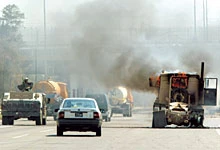
The US military announced eight more American soldiers had died in combat, bringing to 93 the number killed in action in April — four more than in the three-week war that toppled Saddam last year.
Russia offered to fly out more than 800 of its nationals and citizens of former Soviet states to escape the hostage-taking and violence sweeping Iraq.
Kidnappers freed a French journalist seized on Sunday, but more than a dozen foreigners remained captive. Japan’s Foreign Ministry said it was investigating reports two more Japanese had been taken hostage, in addition to three seized last week.
More clashes erupted between Sunni fighters and US Marines in Fallujah, west of Baghdad. Witnesses said a US airstrike hit the city’s Hay Al-Dubat area at dusk. They said four civilians and two fighters were killed in overnight fighting. In Baghdad, a rocket hit the 12th floor of the Sheraton Hotel, used by many foreign contractors and journalists. There were no casualties.
Sadr, branded an outlaw by US generals, had been staying near the Imam Ali Mosque, but an aide said he had since moved to his father’s house in eastern Najaf.
The 2,500-strong 3rd Brigade Task Force, along with Spanish and Polish troops, set up what officers called an exclusion zone around Najaf and sent out reconnaissance patrols from Forward Operating Base Duke, some 20 km (12 miles) west of the city.
The bloody chaos in Iraq has shown how hard Washington is finding the task of stabilizing the country it invaded to destroy Saddam’s still unfound weapons of mass destruction.