
Jubbah is one of the most curious places in the world, and to my mind one of the most beautiful,” wrote Lady Anne Blunt. The granddaughter of Lord Byron had arrived in January 1879 with her husband Wilfrid at the oasis more than two-thirds of the way across the Great Nafud Desert. En route to the city of Hail to see and perhaps buy some of the famous horses of Ibn Rashid, then ruler in Najd, the Blunts were among the first travelers from the West to reach Jubbah and Lady Anne the very first western woman to set foot in central Arabia. With their guides, horses and camels, the Blunts had taken more than a week to reach Jubbah from Al-Jouf. It took another three days of exhausting travel from Jubbah over yet more billowing red sand dunes before they reached Hail.
Today Jubbah is a small, quiet oasis town less than an hour by highway from Hail. Irrigated fields now cover much of the former lakebed and palm trees fringe the two-lane road that provides the final approach to the town. At the foot of the mountains that form a backdrop to the oasis, an array of rock art and inscriptions spanning millennia has been fenced off as an archaeological site by the Department of Antiquities.
A new highway is now being built north from Jubbah, crossing the Nafud and linking Hail with Al-Jouf.
Tucked away among the palm groves of Jubbah stands the museum (under a sign ‘The Monumentel (sic) Palace of Naif’), gardens and home of Naif Ateeq Al-Shammari.
Naif is the direct descendent of the young emir of Jubbah who extended the fabled desert hospitality to the Blunts on their visit. The smoke-blackened room where they sipped coffee is still there. On one of its adobe walls hang two framed and faded photographs of Lady Anne and two copies of her watercolors of the Nafud. Alongside are pictures of other notable visitors who have passed that way.
The Bedouin of the great northern desert still remember the name of Lady Anne and trot out stories of her exploits and desert travels. Curiously, no one seems to recall her impressive husband, Wilfrid. Back in the Blunt’s English homeland, the reverse is true. Sir Wilfrid Swawen Blunt has been the subject of three biographies and is remembered as an anti-colonial activist and poet as well as for his philandering and scandalous life. Before setting out on their crossing to Hail, the Blunts heard dreadful tales of the desert before them. In her diaries Lady Anne recalls some of these “blood and bones stories.” She writes of the 500 Turkish occupying soldiers of Ibrahim Pasha’s army, abandoned by their escorts to a ghastly fate as they set out to return to Damascus. She enjoys recording a more pleasant desert tale of two lovers who eloped from Al-Jouf and were pursued into the Nafud by their relations: “Suspecting that they would be tracked, and to avoid scandal, they had agreed that instead of walking together, they would keep parallel lines about a hundred yards apart and so set out on their journey, and when they came to a certain ‘fulj’ (depression between sand dunes) they were too tired and lay down to die each under his bush. Thus they were found and fortunately in time,” recalls Lady Anne, “and their discretion so pleased the relations on both sides, that consent was given to their marriage, and the nuptials celebrated with rejoicings.”
Discretion was something that Lady Anne’s husband lacked. He was invariably entangled in affairs, often with more than one woman at a time and invariably under the nose of the long-suffering, acquiescent and forgiving Lady Anne. The only time Wilfrid Blunt behaved was when he was traveling in Arabia.
Here their desert journeys provided the happiest times for Lady Anne and perhaps Wilfrid too. According to James Fleming, historical novelist and editor of Lady Anne’s letters and journals, Wilfrid Blunt was “a vain, caddish, indefatigable consumer of women. He went at it hammer and tongs. And what is striking is that the ladies he chased by no means sprinted shrieking to their husbands. By no means! They dillied, dallied, slowed to a walk, dropped their gloves — and pretty soon were where they wished to be.”
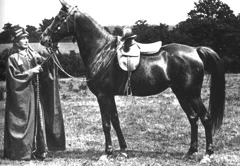
Now Lady Anne Blunt emerges from the shadow of Wilfrid. A biography by HVF Winstone lays out the story of her remarkable life of 80 years that ended in Cairo in 1917. The biography (‘Lady Anne Blunt’, Barzan Publishing, available in Saudi Arabia) took Winstone 15 years to research and write and includes reproductions of some of her watercolors of desert scenes. As well as her artistic skills, Lady Anne played the violin and was fluent in Arabic, translating Arabic epic poetry. She wrote two acclaimed travel books, ‘The Bedouin Tribes of the Euphrates’ and ‘A Pilgrimage to Nejd’. She was a dedicated and accomplished breeder of the purebred Arab horse and wrote passionately about the breed. The surviving bloodlines from her famed Crabbet Arabian stud thrive and are acknowledged throughout the world. Today most visitors to Jubbah call in at the folksy museum of Naif Al-Shammari. There, in the mud-walled parlor where the Blunts sat, guests receive the same enduring, traditional hearthside welcome.
“The style of entertainment at Naif’s house requires no special mention, as it differed in no respect from what we had already received elsewhere,” wrote Lady Anne in her diary entry of Jan. 20, 1879.
“There was a great deal of coffee drinking and a great deal of talk. Wherever one goes in Arabia only has to march into any house one pleases, and one is sure to be welcome. The ‘kahwah’ stands open all day long, and the arrival of a guest is the signal for these two forms of indulgence, coffee and conversation.”