
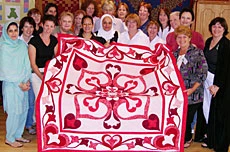
At a time when the world seems to be unraveling at its seams, the ladies of the Eastern Province Bedouin Piecemakers’ Quilt Club have their lives nicely stitched together. This group of women drawn from six continents meets monthly to share their craft, their experiences and their laughter. Led by coordinators Kelly Al-Nashmi and Patricia Smith, the Bedouin Piecemakers ([email protected]) have put out an invitation for families in the Eastern Province to come on Friday, May 7 to Al-Zamil Village from 10 a.m. to 2 p.m. to view their annual exhibit. Quilts in three categories will be on display at the show with the winners in each group chosen by the public. There will also be an “opportunity quilt” to be won by one lucky visitor to the exhibition, with proceeds earned by this quilt donated to charity.
“At this difficult time, when a sense of community and well-being is urgently needed, we are pleased to be creating a chance for families in Saudi Arabia to meet and view the outcome of the positive use of time and talents,” said Al-Nashmi. “As one of the categories will feature quilts done by artists under 18 years of age, we hope that teenagers will be encouraged to come and see how others in their age group are using their free time in a beautiful way.”
The Bedouin Piecemakers have been meeting monthly in the Eastern Province since June 1995. About 60 ladies come to the club’s monthly meetings where they have a chance to show off their stitchery, take classes to learn quilting techniques and work toward group and charity projects.
The craft of quilting has been experiencing something of a revival in the last decade. According to Smith, quilting is a very ancient art, which was practiced in Egypt, China and India. Quilting made its way to Europe when quilted clothing was worn under the armor and chain mail of soldiers returning home from the Middle East in the early 1200s.
North Country quilts from the northeast of England came to the fore after the Industrial Revolution in the early 1800s, although there are quilts in British museums that date back to the 1780s. In the US, the Pioneer women of the mid-1800s worked on quilts while traveling in covered wagons across North America. Quilts were used to keep warm before Pioneer homes were completed, to wrap and comfort the sick and injured, and sometimes they were even used as shrouds.
During the Civil War in the US, quilts were hung outside the homes of sympathizers to give a message to the slaves escaping from the south to the north on the “underground railroad.” Certain patterns gave a specific message and the quilts were changed to convey those signals. A good example of this is the Log Cabin quilt with its center square in a specific color. For instance, if the center square was black, it meant, “travel only at night with caution.”
“These days, quilts convey messages of love, beauty, serenity and pride in work well done,” said Smith. “I have lived in Saudi Arabia for 17 years and taught quilting here for more than a decade. The craft grows more popular every year. Quilting is also becoming extremely high-tech. Sewing machines used to piece the fabric, do applique and sew the quilt together can cost from $200 to $3,000, depending on the machine’s sophistication. But no machine can replace imagination. The very best quilts are made by individuals with the capacity to let their imagination bloom and grow.”
And some of the Kingdom’s quilters have become true stars. Last month, a quilt by Dhahran’s Philippa Naylor, a past coordinator of the Bedouin Piecemakers, won first prize in the Paducah, Kentucky, American Quilter’s Society 20th Anniversary Quilt Show and Contest in the category “Innovative Pieced, Professional or Amateur.” Her amazing work of art called, “Diamond Dust,” may be seen by clicking on the Internet to www.americanquilter.com.
Diamond Dust is an example of the new directions being taken in quilting. No longer are quilts simply blankets made of joined squares. Quilting now encompasses wall hangings, place mats, pillow covers and applique work of every sort. Many of the new art quilts even include fabric painting and embellishments such as buttons and beads. This doesn’t mean that traditional quilts are no longer popular though. In fact, heritage quilts made of 100 percent cotton material are hugely sought after and command excellent prices.
“But I don’t think that anybody goes into quilting for the money,” said Al-Nashmi. “One of the most common reasons that people take up quilting is that it is an excellent stress reliever. When I have had a difficult day at work, I come home and go to my quilting room. There I sit and sew or look through my quilting books to find a new project. It always makes me feel better.”
Smith agreed. “Quilting lets you forget where you are and how many problems you have. It allows you to create something beautiful for your friends and family. Quilting is a way that you can give the best part of yourself away. Quilts given as gifts are highly prized with many becoming heirlooms. It is a sharing craft and even men are now interested in taking up quilting.”
This year the Bedouin Piecemakers’ are emphasizing the sharing nature of their group through a project to benefit the children of Dammam’s Orphanage. By year’s end the club hopes to donate 30 baby quilts to the orphanage. The quilts will be given to individual children to keep. Sewn with love, the group hopes that these quilts will bring some comfort to children, who have no one to call their own.
“We would like to do even more charity work and with that in mind we are appealing to women in the community to come and join our group,” Al-Nashmi said. “Companies such as Al-Zamil Stores, Al-Mushari, Al-Zuhairen and Al-Saleh are supportive of our efforts, but we need hands to sew. Our club allows women of any nationality to learn new skills and make new friends. We really enjoy it when mothers and their teenage daughters come together. Quilting is a useful, creative skill that lasts a lifetime and improves with practice. Instead of sitting at home alone in front of the television, bring your hands and your heart to our monthly meetings. We’ll show you how wonderful it is to be a ‘piecemaker.’”