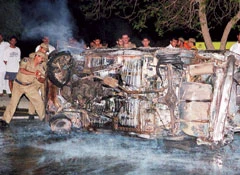
RIYADH, 9 May 2004 — Nearly 5,000 deaths occur due to road accidents in the Kingdom every year, and many of the victims are children. Absence of proper child safety procedures and neglect on the part of caregivers, law enforcement officials and drivers are some of the leading causes of traffic injury and death in the Kingdom.
Dr. Narges Daliri, an advocate for child safety and a consultant pediatric emergency physician at King Faisal Specialist Hospital and Research Center (KFSH), sees an urgent need for a national child safety campaign.
“One common misconception in this part of the world is that ‘it will not happen to me,’” Daliri told Arab News.
“When children are hurt in traffic accidents, their injuries are almost always serious; they may be thrown out of the car and may suffer disabling injuries, including injuries to the head, internal organs and the spinal cord.”
Studies show that correctly used seatbelts can prevent serious head injuries and reduce the risk of death in a crash by approximately 61 percent, whereas not using seatbelts and child restraints more than doubles the risk of serious and fatal injury. Regulations such as speed limits and the wearing of seatbelts usually go unheeded and child safety restraints are almost non-existent.
“Preventive measures are simply not there. People responsible for enforcing regulations are not enforcing them. I often see children standing in the front seats of cars or sitting on their mother’s laps,” she said.
Most modern cars have air bags in the front, and once they inflate, the force with which they hit the child’s face can have horrific consequences including decapitation or serious head injury.
There is no reason for not using child car seats in Saudi Arabia, she said. “If people can afford expensive cars, they can certainly afford a car seat for their child.”
According to experts, children under 12 should always be seated in the back seat and protected with age-appropriate child restraints. Child-seats reduce risk of death in infants by 71 percent and by over 50 percent in one- to seven-year olds.
High speeds are another major cause of road fatalities. According to Daliri, almost every accident in the Kingdom leads to fatalities, and speed is largely to blame.
“In Saudi Arabia, in particular, if the passengers are not restrained, the injuries are almost always fatal and the survival rate is very low,” said Dr. Daliri. At high speeds, an unrestrained child may be ejected from the car or thrown violently against the car’s interior.
Children are also more likely to be the victims in pedestrian accidents, which make up one third of all traffic related injuries and deaths worldwide. In Riyadh, children often play on the streets in residential neighborhoods.
Reflectors are unheard of and dark clothing coupled with dim street lights create a dangerous situation, especially for the young, who are often too small to be visible to the driver of an oncoming car. Pedestrians have a 90 percent chance of surviving car crashes at 30 km/h or below, but less than a 50 percent chance of surviving impacts at 45 km/h or above.
A similar situation prevails in the parking lots of many local supermarkets, where pedestrians, including families with several small children, and heavy traffic create a potential death trap for shoppers. Daliri urges parents to watch their children closely when they leave the car. Last year, a five-year-old girl was killed in Al-Oas shopping complex in Riyadh when she ran out in front of a car and sustained fatal head injuries. But several months later, Arab News found that nothing had changed; cars still sped through the narrow streets in the shopping complex, as pedestrians weaved their way through traffic and young children, some as young as two, stood unattended on the side of the road.
Daliri called for a national road safety strategy that people can follow. People need to see the reality of traffic accidents, she said.
That reality is what she tries to convey in the Pediatric Advanced Life Support course she teaches at KFSH.
“You would be surprised to learn that 95 percent of the health-care professional attending the course are not using proper road safety procedures for their children,” she said.
“I tell them, ‘you love your child, but you are using your child to protect yourself. You are killing your child by smashing her head against the dashboard’.”
Her straightforward approach serves as a wake-up call for her audiences.
“We need active high visibility law-enforcement and effective public education,” Daliri said. “I hope that more people will step forward and volunteer in a comprehensive campaign.”
She added that no one has ever conducted an in-depth study of traffic accidents in Saudi Arabia and “it is high time that someone does that.”